Before You Press Play
- Narrator: Casey Johnston reads her own account, which counts on a book about learning to occupy a body and say so out loud.
- Subjects: Weightlifting against diet culture, restriction and recovery, strength as self-regard rather than punishment
- Tone: Warm, argumentative, and sharp about the doctrine it is dismantling
- Bottom line: A memoir that earns its manifesto, so long as you are not shopping for a program to follow.
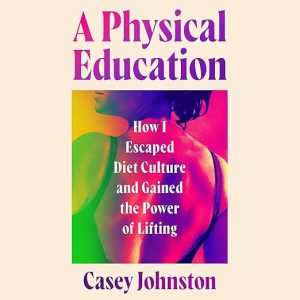
Grand Central sells this audiobook as two books at once, a memoir and a manifesto, and the copy makes no attempt to hide the seam. On one side, Casey Johnston recounting her own years of restrictive eating and endless cardio and what changed when she picked up a barbell. On the other, what the publisher bills as a staggering exposure of the damaging doctrine spread by diet and fitness culture. Just over seven hours has to hold both of those. Which one you actually get, hour by hour, is the thing the description will not tell you.
A Closer Look at A Physical Education
Diet culture is the antagonist here, and Johnston builds the case from inside it rather than from a podium. The trajectory the copy describes is specific: years of calorie restriction and endless cardio, a move into weightlifting, and then the detail that turns the whole book, which is that once she began eating to fuel the strength she was building, the food cravings vanished. That single reversal carries the argument. She had been taught that physical improvement was a matter of suffering. What she found was that it required self-regard and patience instead, and the book keeps circling back to the distance between those two theories of a body.
The reception numbers on this listing are, unusually, worth reading closely. One hundred eighty-eight people have rated it and the badge sits at 4.4, while the five written responses run five, five, four, three and five, which averages to exactly 4.4. The readable sample and the silent majority agree to the decimal. That almost never happens on a page like this, and it means the handful of responses a shopper can read is a fair picture of the whole rather than a self-selected pocket of enthusiasm. On a book this personal, that is more useful information than the badge itself.
What Makes A Physical Education Worth Hearing
Johnston's register is the reason the thing works. A five-star response calls the experience talking to a friend who really, honestly gets it, then immediately names where they part ways, a love of running among them, on a book that is busy leaving cardio behind. Recognition plus argument, in the same paragraph, is what a memoir with a thesis is supposed to produce. You are not being lectured at. You are being handed somebody's actual history with food, exercise and codependency, laid out in enough detail that you can hold your own history up against it and see where the shapes match.
Author-read memoirs run from indispensable to merely economical, and this one sits near the first end for a structural reason: the book argues about being at home in a body, in a voice that had to learn how. Casey Johnston reads it herself across seven hours and twenty-two minutes. Sample the opening if delivery matters to you, because a memoirist speaking her own restriction years aloud is a different proposition from a hired reader performing them, and the difference cuts in both directions depending on what you want from the hours.
Things to Know Before Starting A Physical Education
Three stars, and the objection deserves to be heard in full. A response from somebody describing himself as a senior male reader says the author seems more preoccupied with being a girl in a man's universe, allows that it contains good pointers, and concludes the book is directed mostly at a woman's experience in a mostly men's gym. He is right about the framing, and the book never claimed anything else: the copy is explicit that the target is mainstream messaging about women's bodies and the status quo it was built to preserve. That response documents the edge of the audience rather than a flaw in the writing. Arrive wanting a general strength primer and the fit will be poor.
Another thing to price in is what the file does not carry. Another five-star response points out that the material here is drawn from years of the author's articles on strength training, and recommends reading the book and the articles together. That advice is free on a web page and impossible inside a download. The book gathers the thinking; whatever else lives in that archive stays outside this recording, and nothing in the audio edition points a listener toward it. Arrive wanting sets, reps and a plan for your first eight weeks and you will finish with a philosophy and no spreadsheet.
Who Casey Johnston Is Writing For
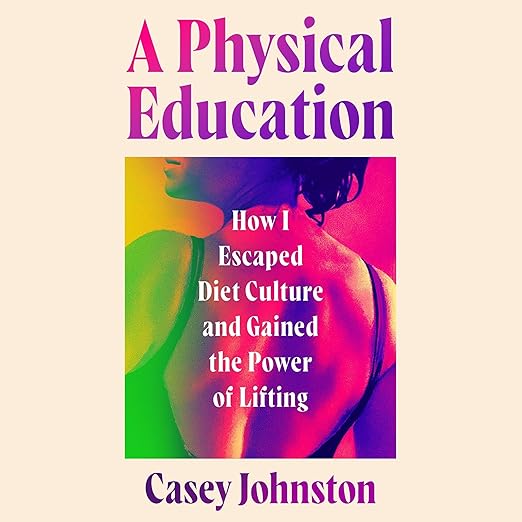
It belongs with anyone who has spent years making a body weaker in the name of getting healthy, which is the question printed on the book's own cover. Women who have cycled through restriction and cardio will find their own history described with uncomfortable precision. So will anybody who has stood at the door of a weight room and decided not to walk in. Readers of the memoir-with-a-thesis form, the kind that argues from one life outward toward everybody else's, will recognize the shape immediately and find this a strong example of it, light on its feet where it can afford to be and unsentimental where it cannot.
Pass on it if you want a training program, because this is not one and never claims to be. Redirect anyone who considers the diet-culture argument settled and wants technique alone, since the cultural critique is not a frame around the lifting, it is most of the book by volume. What remains is a clean proposition: a shade over seven hours, read by the person it happened to, arguing that strength is something you build rather than something you earn by suffering for it. That last idea is worth the purchase on its own.
Questions Listeners Ask
Does this audiobook work as a strength-training program?
No, and it never offers itself as one. The running time goes to how a shift from restriction and cardio into lifting changed one person's relationship with food and with her own body. Sets, reps and progression schemes are not the content. Pair it with a written program if you need the numbers.
Is the audiobook read by Casey Johnston?
Yes. The author field and the narrator field carry the same name, so the writer delivers her own account of restriction, recovery and the weight room. On a memoir assembled from private history, that changes the texture of the hours, and it is the strongest single reason to choose audio over print here.
How direct is the book about disordered eating?
Direct. The description names years of calorie restriction, endless cardio, and a relationship with food that only settled once she started eating to support the lifting. Nothing on the page flags any of it in advance, so anyone for whom restriction detail is a live risk should treat that silence as the warning.
Where does the profoundly engrossing quote on the cover come from?
The copy attributes it to Elizabeth Greenwood, whose endorsement runs across the top of the description. Blurbs of that kind are written for the printed edition and then travel to every format afterwards, so read it as the publisher's framing rather than as any judgment on the recording you would be downloading.