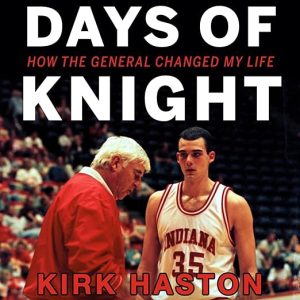
Lobelville, Tennessee is not the kind of town that produces Big Ten basketball legends. Population under 1,000, perched in the hills of western Tennessee, it is exactly the sort of place people tend to leave. Kirk Haston grew up there, shot up to six-foot-nine, and got a phone call that rerouted his entire life. This audiobook opens with that call, a two-minute conversation with Bob Knight, and from that moment the book's engine is running. I settled into Days of Knight: How the General Changed My Life on a long drive home from visiting family, and it felt like exactly the right company for a road stretching through flatland, plainspoken, funny in the right places, and full of the kind of specific detail you only get from someone who actually lived it.
Haston is not a professional writer, and that is precisely what makes the book work. He writes the way a thoughtful former athlete might tell you a story over dinner: no flourishes, no attempts to dramatize what is already dramatic. The audiobook format suits his register well, and narrator Chaz Allen matches that energy throughout, steady, warm, and never condescending toward the material.
What separates this memoir from the shelf of coach tributes is the honesty about what it actually felt like to play for Bob Knight. Haston does not shy away from the coach's volatility or the pressure cooker of Indiana Hoosier basketball at its most intense. But he also refuses to flatten Knight into a caricature, either the cartoon tyrant that tabloid coverage preferred or the sentimental legend that retrospectives tend to construct. What comes through instead is a portrait of a man who demanded more from his players than any reasonable human being should be allowed to demand, and who occasionally, unexpectedly, revealed genuine care.
The stories Haston shares are specific and previously unknown outside the program: how Knight challenged players mentally in practice, which past Hoosier greats came back to work with the current team, and how the players processed the coach's firing. That last section carries real weight. Haston writes about the termination with the complexity it deserves, relief mixed with grief, institutional loyalty tangled up with personal feeling. It would have been easy to take a cleaner line. He does not.
Why Days of Knight: How the General Changed My Life Works as an Audiobook
The obvious draw is the access. Haston played for one of the most discussed, analyzed, and debated coaches in college sports history, and he was there for the final chapter at Indiana. The quotes and anecdotes he provides are the kind that do not appear in newspaper profiles or ESPN retrospectives. If you have ever wondered what Knight's practices actually felt like from the inside, this is where you find out.
But the book earns a wider audience than Hoosier faithful. Haston's personal arc runs parallel to his basketball story, and the sections dealing with family carry the memoir's deepest emotional current. His account of losing his mother in a tornado accident is devastating and handled with extraordinary restraint. He does not use it for cheap pathos. It simply lands, the way real loss does, amid an otherwise forward-moving life. The famous three-point shot against top-ranked Michigan State is here too, and Haston renders it with the clarity of a memory that will never fade, not triumphant, but precise.
Chaz Allen's narration keeps the pacing honest. He does not push the tender moments toward sentimentality or punch up the humor beyond what the writing earns. The result is a listening experience that feels like an honest conversation rather than a performance, which is exactly what a memoir like this requires.
Weak Spots in Days of Knight: How the General Changed My Life
The book's structure is loose rather than chronological, which serves some sections better than others. Readers looking for a sustained narrative through-line may feel the chapter-to-chapter connective tissue occasionally goes slack. Haston writes more comfortably in specific scenes and anecdotes than in transitional summary, so the book is best experienced as a series of vivid episodes rather than a unified arc.
The Knight material, while revealing, is also weighted toward admiration. Haston is honest about the coach's excesses, but this is not a critical biography. Those wanting a fuller reckoning with Knight's behavior and its institutional context will need to look elsewhere. What this book offers is perspective from inside the relationship, which is both its limitation and its value.
Listeners unfamiliar with IU basketball history may find some of the references require extra context. Haston assumes a certain level of familiarity with the program's culture and key figures. The book rewards those who bring some background knowledge, though the personal dimensions of the story are accessible to anyone who has ever been shaped by a demanding mentor in any arena.
The Right Listener for Days of Knight: How the General Changed My Life
Indiana basketball fans will get the most out of this audiobook, particularly anyone who followed the Hoosiers during the Knight era and wondered what the view looked like from the locker room. Sports memoir readers who appreciate specific, unembellished storytelling over glossy celebration will find plenty to appreciate here. The book also resonates with listeners drawn to mentor-student relationships and the complicated inheritance that comes from being formed by an extraordinary and difficult person.
Skip it if you want a comprehensive, critical account of Bob Knight's career, that is not what this is. And if you need tight narrative architecture to stay engaged, the book's episodic structure may test your patience. But if you want to sit with someone who was actually there, who remembers the details, and who has figured out how to tell the story with both humor and honesty, this audiobook delivers exactly that.
Does the audiobook cover Bob Knight's firing from Indiana?
Yes. Haston devotes meaningful space to Knight's termination and shares how the players experienced and processed that moment, which is one of the more candid sections of the audiobook.
How long is the Days of Knight audiobook?
The audiobook runs 5 hours and 20 minutes, making it an easy one-session listen for most commuters or road trip companions.
Is this audiobook suitable for listeners who are not sports fans?
Listeners primarily drawn to memoir and personal history will find the family material and the mentor dynamic compelling enough to sustain interest even without a background in college basketball.