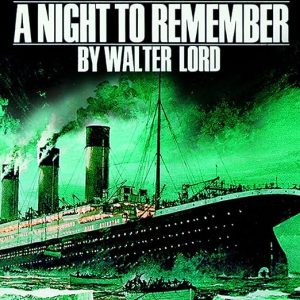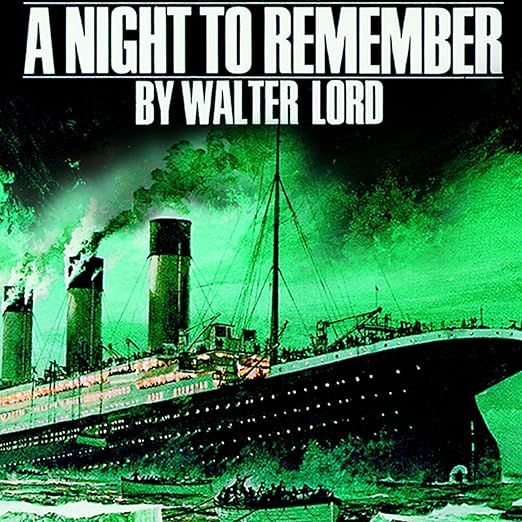
The Titanic was four city blocks long, marketed as unsinkable, yet carried lifeboat space for fewer than half the people aboard: how does that happen? Walter Lord spends this audiobook answering that question through a minute-by-minute reconstruction of the ship's final two hours and forty minutes, built from firsthand interviews with actual survivors rather than secondhand retelling. First published more than sixty years ago, A Night to Remember helped establish the entire genre of narrative disaster history, and narrator Fred Williams reads Lord's original text for a new generation of listeners rather than any updated or abridged version.
What We Made of It
Reviewer Liz highlights exactly what makes Lord's approach still feel fresh: the narrative 'skips around from first class passengers to the captain to people on other ships,' weaving together dozens of individual vantage points into one continuous timeline rather than picking a single hero to follow. That structural choice, built from Lord's own interviews with survivors conducted decades after the sinking, gives the book a documentary quality that later dramatized Titanic accounts borrowed from directly.
Reviewer MagnoliaSouth's comparison to other Titanic books is useful context for what this one specifically avoids: many books on the subject open with long, drawn-out details about shipping history before ever reaching the disaster itself, and Lord's book gets to the ship and the night in question far more directly. At five hours and nineteen minutes, this is a notably lean treatment of one of the twentieth century's most exhaustively documented disasters, prioritizing the human timeline over exhaustive technical or corporate backstory.
Lord's own research method was itself groundbreaking for its time: he tracked down and interviewed dozens of actual Titanic survivors during the 1950s, decades before oral history became a standard tool of narrative nonfiction, capturing testimony that would otherwise have been lost entirely once that generation passed. That research effort is part of why the book still holds up as a primary source in its own right rather than just a well-written secondary account, and it's part of what later inspired a well-known film adaptation that helped cement the Titanic's place in popular memory for the following decades.
Why A Night to Remember Works as an Audiobook
Narrator Fred Williams brings a measured, ceremonial delivery well suited to formal mid-century narrative prose, a register he's demonstrated before on early-twentieth-century material with large ensemble casts, treating dozens of named passengers and crew with consistent gravity rather than reaching for artificial character voices. That steadiness matters enormously for a book moving constantly between vantage points, since a narrator who tried to differentiate every named passenger vocally would fight against Lord's own documentary, historian's-eye style rather than serve it.
Reviewer Carl E. Ahlm's review lingers on the specific names still recognizable a century later, Guggenheim, Astor, Straus, Molly Brown, and that specificity is exactly what oral history-style narration delivers better than a page of names skimmed silently. Hearing those names spoken aloud, attached to specific moments in Lord's minute-by-minute reconstruction, does more to convey the scale of who was actually aboard that night than a printed passenger list would on its own.
The book's famous restraint, Lord avoids editorializing about blame or negligence, letting the sequence of decisions and mistakes speak for itself, asks a narrator to resist the temptation to add dramatic weight through vocal emphasis where the prose itself is deliberately understated. Williams' ceremonial evenness serves that restraint well; a more theatrical reading would work against Lord's own stated approach of presenting the events and letting listeners draw their own conclusions about what went wrong and why.
What Might Not Land
The genre tag attached to this listing, science and engineering, undersells what the book actually is: while the synopsis nods to the Titanic's ingenious safety devices, this is fundamentally narrative history and disaster reportage, not a technical account of shipbuilding or naval engineering. Listeners specifically hoping for deep engineering analysis of what went wrong structurally should look for a more technically focused Titanic title instead.
The five-rating count behind this audiobook's 4.4 average is worth noting honestly; this is a much thinner review base than a book this well-established in the disaster-history canon would typically carry, likely a function of this specific audio edition rather than the book's overall reputation, since A Night to Remember has been continuously in print and adapted for decades. The Titanic Chronicles series label attached here also appears to be a packaging convention grouping Lord's Titanic-related titles together rather than a true sequential fiction series, worth knowing before expecting book two to continue a single ongoing story.
Worth knowing going in: this account predates the 1985 discovery of the wreck by three decades, so certain physical details about exactly how the ship broke apart and sank, later confirmed or revised once the wreck itself was found, reflect the best understanding available in the 1950s rather than current forensic knowledge. This doesn't undermine the human account at the book's center, but listeners interested in the precise physical mechanics of the sinking may want to supplement with more recent research.
Should You Listen to A Night to Remember?
This suits history listeners who want the foundational text in Titanic disaster literature, the book against which nearly every subsequent account gets measured, read in a format that suits its interview-driven, multi-perspective structure well. Anyone who has only encountered the Titanic through film adaptations will find the original survivor testimony underlying this account adds real depth beyond the familiar cinematic beats. Listeners with a broader interest in early-to-mid-twentieth-century maritime history, or in the specific genre of minute-by-minute disaster reconstruction Lord helped pioneer, will find this a foundational text worth returning to more than once.
Listeners who enjoy primary-source-adjacent history generally, accounts built from direct testimony rather than a historian's later synthesis, will recognize this as an early, influential example of a form that's since become common in popular history and long-form journalism alike. Lord essentially pioneered a documentary approach decades before it became a standard toolkit for narrative nonfiction writers, and hearing that approach in its original form gives useful context for understanding where a whole later genre of survivor-testimony history writing actually came from. Anyone who has watched a Titanic film adaptation and wondered how much was invented for drama will find this a useful corrective, since so many now-familiar scenes and details trace directly back to specific testimony Lord gathered and preserved here first.
Those wanting rigorous engineering or shipbuilding analysis should look elsewhere despite how this specific edition happens to be filed, and listeners who prefer a single central character to follow through a disaster narrative, rather than dozens of interwoven vantage points, may find Lord's documentary approach less immediately dramatic than a more novelistic disaster account would be.
Common Questions
Is the A Night to Remember audiobook a technical account of the Titanic's engineering?
No, despite the science and engineering genre tag attached to this listing. It's narrative history built from survivor interviews, not a technical analysis of the ship's construction.
How long is the A Night to Remember audiobook?
It runs 5 hours and 19 minutes, a notably lean treatment compared to many other Titanic histories.
Is A Night to Remember based on real survivor accounts?
Yes. Walter Lord built his minute-by-minute reconstruction from firsthand interviews with actual Titanic survivors.
Does the Titanic Chronicles label mean this audiobook is part of an ongoing story?
Not exactly. It appears to group Walter Lord's related Titanic titles together for packaging purposes rather than continuing a single sequential narrative.