Before You Press Play
- Performance: Grover Gardner brings the measured precision that dense nonfiction requires, his pacing leaves enough space for Oakley's conceptual frameworks to settle before moving on.
- What it covers: Focused vs. diffuse thinking modes, procrastination and the learning brain, retraining mathematical ability
- Feel: Bracing and practical, with an undercurrent of personal discovery
- Our call: The audiobook companion to the world's most-enrolled online course delivers on its promise, a neuroscience-grounded guide to learning that applies far beyond math and science, narrated by one of nonfiction audio's most reliable voices.
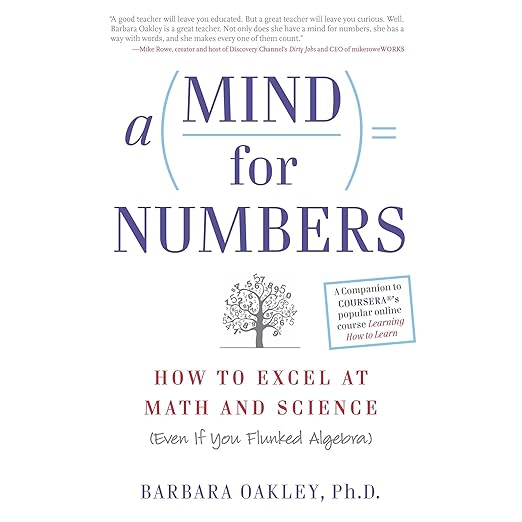
Barbara Oakley's audiobook A Mind for Numbers opens with a kind of intellectual dare: a professor of engineering who once failed her way through every math and science course she attempted is now teaching you how to learn. The dare lands because Oakley is not posing as someone who always found this easy. She enlisted in the army straight out of high school, returned to school years later with genuine determination to rewire her own brain, and built a second career out of understanding the mechanisms behind that transformation. Grover Gardner narrates, bringing the same unhurried authority he has brought to dozens of nonfiction audiobooks, and at seven hours and four minutes, the listening experience is dense but consistently rewarding for anyone willing to engage with it actively.
How A Mind for Numbers Holds Up
The book is widely known as the companion volume to Coursera's "Learning How to Learn" course, one of the most enrolled online courses in history. That association sets certain expectations: structured, research-grounded, practically oriented. Oakley meets all three. The central insight she builds around is the distinction between focused and diffuse modes of thinking. Focused mode is the concentrated, laser-directed attention most students assume is the only legitimate form of study. Diffuse mode is the relaxed, associative mental state that activates when you step away from a problem. Oakley's argument, grounded in neuroscience and cognitive psychology, is that effective learning requires both, and that our cultural bias toward focused effort is actually working against deep comprehension and long-term retention.
This has direct implications for how to study math and science specifically. Contrary to what students are usually taught, re-reading textbooks and solving the same problem type repeatedly are among the least effective study strategies available. Spacing practice out, interleaving different problem types, and deliberately stepping away when stuck are all more effective approaches. Oakley explains why each of these works at the neurological level, not just asserting that they do. That grounding in mechanism is what separates this from motivational study advice. You understand not just what to do differently but why your brain responds the way it does to different kinds of practice, and that understanding changes your relationship to confusion and difficulty in ways that generic encouragement cannot.
Grover Gardner is one of the most experienced narrators in nonfiction audiobooks, and his work here is characteristic: precise, clear, and calibrated to the register of intelligent popular science writing. He does not over-explain and he does not rush. For a book that requires the listener to hold several conceptual frameworks simultaneously, focused vs. diffuse modes, chunking, interleaving, procrastination mechanisms, Gardner's pacing is genuinely helpful. He leaves enough space for the ideas to settle before moving on. One reviewer specifically noted that the book is "very useful for everybody who wants to be a SMART 21st Century lifelong learner," and the audiobook format actually extends that reach: people who would not sit down with a print copy of a study-skills book often find audio more accessible for this kind of material.
The book also ranges well beyond its stated subject. While the framing is math and science, the learning mechanisms Oakley discusses apply to any domain where people struggle with material that does not come naturally. Language learning, music, programming, writing, the principles transfer cleanly and without distortion. That breadth makes this a more durable audiobook than its somewhat academic-sounding title might suggest on first encounter.
Weak Spots in A Mind for Numbers
The overlap with the Coursera course is substantial. Listeners who have already completed "Learning How to Learn" will find the audiobook covers much of the same ground, though Oakley has noted the book provides additional depth and supplementary content not in the course. Whether that addition is worth the full runtime depends on how thoroughly you engaged with the course material and how much you want the extended first-person narrative. Listeners coming to Oakley's framework fresh will find the audiobook the more immersive experience: the arc of her own failure and recovery adds emotional texture that a structured online course format does not easily accommodate.
Some sections, particularly those involving visual aids, diagrams, and the reading tests mentioned in the book's description, lose something in the audio format. The print version includes graphical elements that are described but not fully replicated in audio. For a book about how the brain processes information, the absence of those visual tools is a minor but real limitation. Listeners who want the full apparatus of Oakley's learning framework may want to have the print version alongside the audiobook, at least for the sections that lean most heavily on visual demonstration.
The Right Listener for A Mind for Numbers
Students currently struggling with math, science, or any technically demanding subject will find this audiobook immediately applicable. Career changers picking up new technical skills and adults returning to education after a long break will find Oakley's first-person experience of exactly that process directly relevant. The audiobook also works well for educators and parents trying to understand why conventional study advice, more time on task, more re-reading, more drilling, often fails students who are genuinely working hard. Anyone who has written themselves off as "not a math person" and is open to the possibility that they were never taught how to learn rather than lacking inherent ability will get the most from this audiobook.
A Few Questions About A Mind for Numbers
Is this audiobook essentially the same content as the Coursera "Learning How to Learn" course?
There is substantial overlap, the book was explicitly designed as a companion to the course. Listeners who have completed "Learning How to Learn" will find much familiar territory. Oakley has noted the book provides additional depth and supplementary content the course does not cover, and the narrative arc of her own learning story adds emotional texture that a structured course format cannot replicate.
Does the audiobook version of A Mind for Numbers work well, or is the print version better?
The audiobook works well for absorbing the conceptual framework, and Grover Gardner's narration handles the material effectively. However, some sections reference diagrams and visual aids that do not translate fully to audio. If the visual learning tools are important to you, having the print version alongside the audiobook, or at least for specific sections, will give you the complete experience Oakley designed.
How long is this audiobook and is it worth the full runtime?
The audiobook runs seven hours and four minutes. It is dense throughout, Oakley does not pad, so listeners who engage actively will find the full runtime justified. Those who want only the core framework can extract the essential focused/diffuse thinking model and study strategy chapters, but the personal narrative and neurological explanations that support the techniques are what distinguish this from a shorter summary.