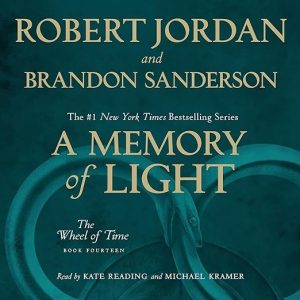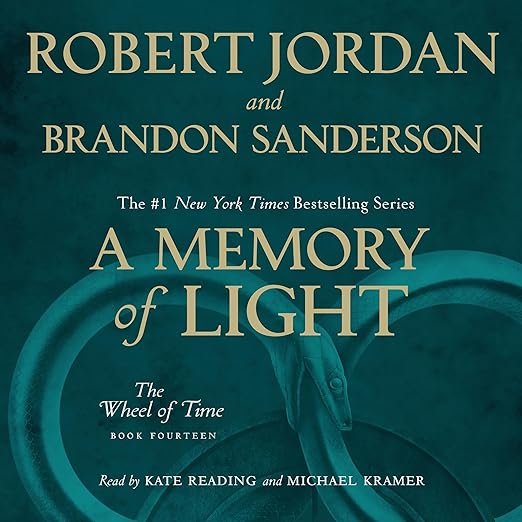
Robert Jordan began The Wheel of Time in 1990 with The Eye of the World. He died in 2007, leaving the final volume unfinished. Brandon Sanderson completed the series across three books, with A Memory of Light serving as the true and definitive conclusion to a story that had been building across thirty-three years of publication. This audiobook is the final chapter of that project: 41 hours and 47 minutes in which every thread started across thirteen preceding volumes must be resolved, honored, or deliberately left open in ways that feel earned. Michael Kramer narrates the male POV chapters as he has throughout the series, and his presence here is itself a form of narrative continuity that the story's own themes of memory, cycle, and return make feel structurally appropriate.
Where This One Lands
What Sanderson accomplishes in this final volume is something that deserved to fail on paper: closing a series with hundreds of named characters, dozens of interlocking storylines crossing multiple continents and cultures, and a readership that had been waiting in some cases for two decades for answers they had been promised since the earliest books. That it does not collapse under that weight is the real achievement. The Last Battle sequence, which spans a significant portion of the runtime and intercuts between multiple theaters of conflict simultaneously, is the most structurally ambitious set piece in epic fantasy audio, and Kramer handles it with the controlled energy it demands. Characters who have spent multiple volumes developing toward their narrative conclusions arrive at those moments with weight proportionate to the time invested. Some threads close more cleanly than others; some readers will feel that certain arcs were compressed or deprioritized in service of the larger spectacle. These are real criticisms and fair ones. But reviewers who have come the full distance consistently describe the ending as satisfying, and that satisfaction is the relevant measure for book fourteen of a fourteen-book series. The conclusion is not perfect because the series is not perfect. It is the right ending for what this story is.
What Makes A Memory of Light Worth Hearing
For listeners who have been with Michael Kramer throughout the entire series, there is no meaningful question about whether to listen to this volume. The sheer scale of what this audiobook accomplishes as a listening experience is worth appreciating separately from its literary achievement. Kramer has been recording these books across a span that mirrors the publication history itself, and his command of the vast character roster is complete and settled in a way that only sustained engagement over time can produce. He has narrated every male POV chapter across the complete run, and his performance here is the capstone of a body of work that spans decades of recorded audio. The voices he gives Rand al'Thor, Perrin Aybara, and Mat Cauthon are not just characterizations at this point - they are the voices those characters have had for hundreds of hours of accumulated listening, and hearing them arrive at their endings carries an emotional resonance that does not fully translate to reading the same words on a page. One reviewer describes it as a satisfying and fun conclusion to a wonderful series; another as an amazing ending to a truly astonishing epic. Both responses reflect the specific relief and grief of a long-haul reader who finally reached the destination that was promised across so many years of story. At 41 hours and 47 minutes, this is not a casual listen, but it is the appropriate length for a conclusion at this scale. The audiobook rewards the investment fully.
What Gives Us Pause
The scope of the final volume creates an inescapable arithmetic problem. With so many characters requiring resolution and a single narrative climax serving as the structural anchor, some storylines receive less space than readers invested in them might have hoped for. Characters who have been centrally important in earlier volumes may appear in this one as supporting presences rather than active protagonists, and that redistribution of focus will satisfy some readers while frustrating others. This is not a failure of execution so much as the unavoidable consequence of ending a fourteen-book epic with structural integrity intact. The Sanderson-era Wheel of Time books are also paced and written with a different sensibility than Jordan's original volumes - the prose style, the approach to action sequences, the texture of interiority all reflect Sanderson's distinct voice rather than Jordan's. Listeners who noticed that shift through books twelve and thirteen will feel it again here. It is not disqualifying, and reviewers consistently describe the emotional conclusion as fully realized, but it is a real seam in the larger fabric of the series. For most who have come this far, the destination matters more than the seam.
Who Should Pick Up A Memory of Light
This audiobook exists only for listeners who have read or listened to the preceding thirteen Wheel of Time volumes. It is the final chapter of a very long and very specific story, and there is no version of it that functions as a standalone entry point into the series or into epic fantasy more broadly. If you are somewhere in the middle of the sequence and wondering whether the ending justifies the investment, the answer from reviewers who have made the full commitment is consistently yes - but the question answers itself more convincingly by simply arriving here through the proper sequence. For those who have already come the full distance, there is nothing more to weigh. This is the conclusion. In Michael Kramer's narration, in the Last Battle and what follows it, it sounds the way the end of something irreplaceable should sound.
Is this audiobook accessible to listeners who have not read the previous Wheel of Time books?
No. A Memory of Light is the fourteenth and final volume of a series with an enormous cast, a decades-long internal timeline, and dozens of interlocking storylines that all converge here. It requires all thirteen preceding volumes as foundation and is not designed to function as a standalone listen in any meaningful sense.
Does Michael Kramer narrate the entire audiobook, or is the narration divided with another performer?
The Wheel of Time audiobooks traditionally divide narration between Michael Kramer for male POV chapters and Kate Reading for female POV chapters. Both narrators appear throughout the series including this final volume, maintaining the format that has been consistent across the entire fourteen-book run.