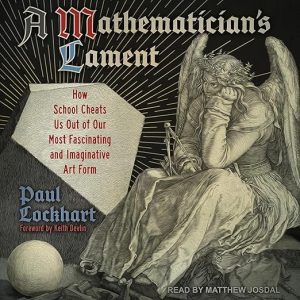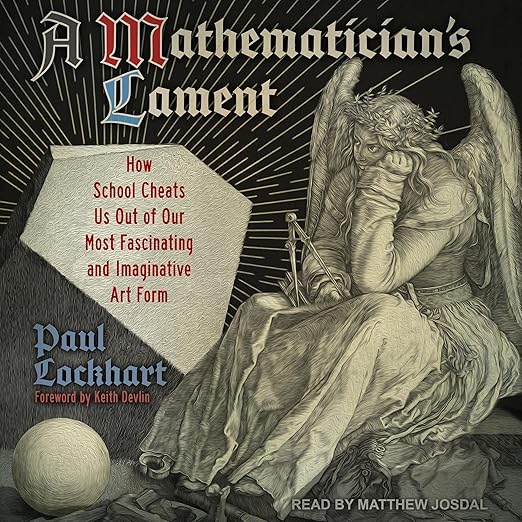
I was an English Literature student who avoided mathematics beyond the minimum required, and I came to A Mathematician's Lament as someone who had genuinely believed, for most of my adult life, that my discomfort with math reflected an aptitude gap rather than a pedagogical one. Under three hours of Paul Lockhart is enough to dislodge that belief entirely. I finished the audiobook on a weekday evening feeling mildly outraged on behalf of every student who got the version of math that Lockhart is describing, which is to say almost every student who has ever been through a standard school system.
The book began as a twenty-five-page essay that Lockhart circulated among mathematics educators and which spread widely before being expanded into this short book. The central argument is direct: mathematics, as actually practiced by mathematicians, is a creative discipline closer to painting or poetry than to the algorithm-execution that school mathematics requires of students. The complaint is not that schools are teaching math wrong in some technical sense. It's that schools have replaced the subject entirely with a pale administrative substitute that shares math's notation while having nothing to do with mathematical thought.
Lockhart's most effective rhetorical device is an extended analogy asking the reader to imagine if music education worked the way math education does. Students would learn to read sheet music notation and execute written exercises without ever being allowed to listen to or play actual music until advanced study. They would learn to identify note names, transcribe rhythms, and produce technically correct notation exercises, and they would overwhelmingly find this boring and feel no connection to music as something human beings actually do. Most would conclude they are not music people.
This is precisely what standard math education does, Lockhart argues, and the analogy makes the mechanism visible in a way that abstract critique cannot. We recognize immediately that music notation is not music. The argument that mathematical algorithms are not mathematics is the same argument in a different domain, and Lockhart makes it with the patience and precision of someone who has spent his career watching students be failed by the substitution. Matthew Josdal's delivery paces the analogy well, giving each stage of the comparison enough space to register before moving on.
What Works
One of the things Lockhart does that distinguishes this from pure polemic is that he actually shows you what mathematical thinking looks like. He walks through elementary mathematical problems in the way a mathematician would approach them, with curiosity and aesthetic response and the willingness to not know where you're going, rather than the way a student executes an algorithm. The difference between these two modes of engagement is the difference between experiencing mathematics as creative and experiencing it as clerical.
A reviewer who had been in a math education program and was losing enthusiasm for teaching found that Lockhart's book reminded them why they'd wanted to teach math in the first place. Another noted that it made them feel like they were actively doing math rather than just reading about it. This is the accomplishment that Lockhart is actually attempting. A book about mathematical creativity that doesn't create mathematical experience in the reader is just advocating for something it can't deliver. This one largely delivers it, even at under three hours.
What to Watch For in A Mathematician's Lament
Lockhart is more precise in his diagnosis than in his prescription, and honest reviewing requires noting this. The book is a sustained and convincing argument that something has gone wrong in how mathematics is taught. It is less developed on what should replace the current system at scale, which is the harder and more politically constrained problem. Reforming music education to include actual music is logistically simple. Reforming mathematics education to include actual mathematical exploration requires teacher training infrastructure, curriculum development, and standardized assessment redesign that Lockhart largely sets aside.
One reviewer noted this thoughtfully: any criticism of modern education will need to be much larger and more expansive than this. That's fair. What Lockhart's book provides is a basic narrative context of mathematical thought that allows you to ask further questions, which is a less complete thing than a policy framework but a more generative one than a policy framework that doesn't first change how you see the problem. The book earns its influence precisely because it doesn't overreach into territory where it would be weaker.
Who It's For
People who found school mathematics deadening and concluded they weren't math people will find this book retroactively explanatory in ways that may be both liberating and frustrating. Mathematics educators who've felt uncomfortable with their own curriculum but couldn't articulate why will find Lockhart's argument a useful tool for clarifying that discomfort to themselves and others.
At under three hours, this is a low-commitment listen and the argument is dense enough that most of that time is well-used. People looking for a how-to guide on mathematical pedagogy, a practical classroom curriculum or an actionable reform proposal, will need to look elsewhere. This is a critique and a call to imagination, not a manual. Within those limits, it's one of the more genuinely clarifying things you can listen to about what education is actually for.
One reviewer who described having loved mathematics and hated art their whole life finished the book realizing they'd never thought about them as being one and the same. That reconceptualization, arriving in under three hours, is Lockhart's actual achievement. It doesn't require you to do mathematics. It requires you to understand what mathematics actually is, which turns out to be something almost no one was taught.
Do you need a mathematical background to understand A Mathematician's Lament?
No. The book is explicitly written for a general audience and the mathematical examples Lockhart uses are accessible to anyone with basic arithmetic. The argument is philosophical and educational rather than technical, and Lockhart's point is precisely that the beauty of mathematical thought doesn't require advanced training to access.
Is the book primarily for educators or for general readers?
Both. Educators will find it useful as a tool for articulating why standard curriculum often fails students. General readers who had bad experiences with school mathematics will find it explanatory about why that happened. One of the more interesting reviews came from an adult student preparing to become a math teacher who found the book restored their enthusiasm for the subject.
Does Matthew Josdal's narration add anything to Lockhart's argument or is it a neutral delivery?
Josdal's delivery is appropriately measured, keeping the intellectual tone of the argument without adding a performance layer that would distract from the content. For a book this ideas-forward, the best narration is usually the most transparent, where the argument is allowed to carry the listener rather than the narrator carrying the argument. Josdal achieves this.