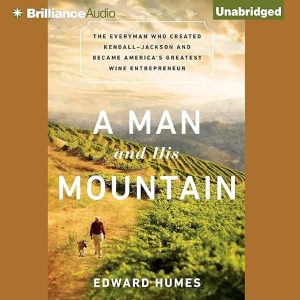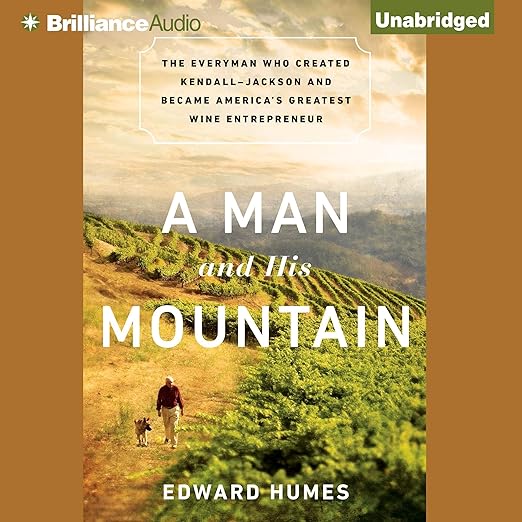
I grew up knowing Kendall-Jackson Chardonnay as the bottle that appeared at virtually every party my parents threw in the 1990s. It was ubiquitous to the point of invisibility, the default premium wine, the background hum of a certain kind of California optimism. I never thought much about where it came from or who built it. A Man and His Mountain by Edward Humes is the book that finally gave that bottle a story, and it is a far more interesting story than the label ever suggested.
Humes brings significant credentials to this project. A Pulitzer Prize-winning journalist, he approaches Jess Stonestreet Jackson's life with the rigor and structural clarity you would expect from a reporter used to working at full length on complex subjects. At 12 hours and 30 minutes, narrated by Mel Foster for Brilliance Audio, the book has room to do justice to both the wine empire and the man who built it, and Humes uses that space well.
Saving the Crop With a Midnight Scuba Dive
The central story is genuinely improbable. Jackson was a lawyer approaching the twilight of his career when he purchased a small pear and walnut orchard adjacent to California's wine country as a potential retirement venture. The cold-night incident that one reviewer describes, a broken watering system, a scuba dive to unclog a filter and save the crop, becomes in Humes's telling the kind of defining moment that biography depends on: a man at his limits, examining why something is harder for him than it should be, and arriving at the question that changes everything. Why were the other wineries struggling while his operation was not? That question, followed relentlessly, produces Kendall-Jackson.
What separates this from the usual business hagiography is Humes's willingness to hold the complexity. One reviewer in the wine industry specifically praised the book for not descending into "worshipful whitewash", a real risk given that the family cooperated with the biography and that Jackson died in 2011, relatively recently when the book was published in 2013. Humes captures the feuds and the contrarianism alongside the brilliance. Jackson was, by most accounts, difficult: a man whose decisions were repeatedly ignored, then derided, then envied as competitors scrambled to catch up. The portrait of that arc, visionary dismissed, then vindicated, then imitated, is the book's strongest thread.
Foster's Respectful, Unreverential Take on Jackson
Mel Foster's narration deserves credit for handling a subject who is, by the book's own account, not always likable. Foster finds a register that is respectful without being reverential, he reads Jackson's story as biography rather than eulogy, which is exactly the right call. The pacing is steady throughout, and at 12-plus hours Foster maintains enough variation in delivery to keep the business detail from becoming monotonous. For a book that must cover wine regulations, horseracing bloodlines, real estate disputes, and multi-decade industry dynamics, that sustained clarity is genuinely valuable.
The book's dual focus, wine and horseracing, Jackson's two consuming passions, might seem like a structural indulgence, but Humes makes the case that both reveal the same man. Jackson approached both with the same contrarian instinct: find what the establishment is ignoring, pursue it with absolute conviction, absorb the mockery, wait for the market to come around. One reviewer called this "an inspiring read of a complicated and hard driving man", and that is the tone Humes achieves.
Sweet Chardonnay Innovation Triggers a Partner Lawsuit
The sections covering the late-residual-sugar innovation that defined Kendall-Jackson's signature Chardonnay are particularly interesting. Jackson essentially created a new category of American premium wine, not sweet, not dry, but something in between that the market turned out to want enormously, despite the derision of wine critics who preferred drier European-style profiles. The story of that innovation and the lawsuit it triggered with his former partners is the book's most dramatic sequence and one of the more compelling accounts of taste-making in American food culture that I have encountered in audio form.
Watch also for the horseracing material, which some listeners may expect to feel like a detour but which Humes integrates as a genuine parallel narrative. Jackson's approach to breeding and owning thoroughbreds was as contrarian and as ultimately successful as his approach to wine, and the two stories illuminate each other.
Strong for Biography, Less So for Winemaking
Strong recommendation for fans of American business biography, California history, and food and wine culture. The book rewards listeners who appreciate long-form journalism applied to entrepreneurial narrative, it is not a management manual or an inspirational self-help text but a serious, reported account of how one man built something remarkable.
Less essential for listeners who want an insider's technical account of winemaking or viticulture; Humes is a journalist, not an oenophile, and the book stays at the level of industry dynamics rather than winemaking craft. Also, listeners expecting a balanced dual biography of the Kendall-Jackson wine region rather than a focused portrait of Jackson specifically may want to supplement with other sources.
The Short Version
- Performance: Mel Foster delivers a steady, confident performance that matches the book's no-nonsense biographical tone
- What it covers: American entrepreneurial drive, the reinvention of California wine culture, legacy and rivalry
- Feel: Richly reported and compelling, with the texture of good long-form journalism
- Our call: A sharp, honest portrait of Jess Jackson and the making of Kendall-Jackson that avoids hagiography and earns its place in American business biography.