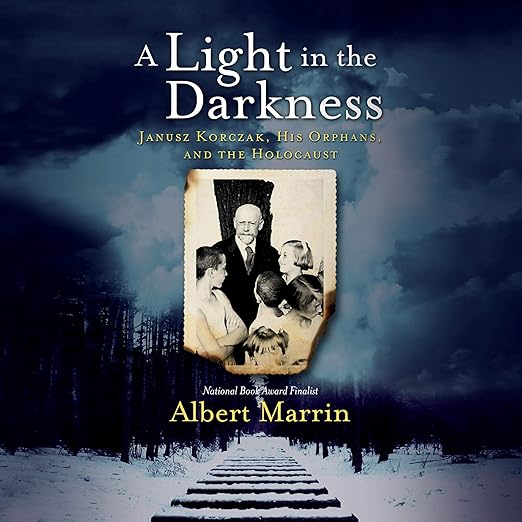
Nine hours with Janusz Korczak is not a comfortable listen, and Albert Marrin makes no attempt to soften it. This audiobook, read by Stefan Rudnicki for Listening Library, is filed under teen and young adult, which is accurate about the intended reader and misleading about the difficulty. Marrin builds a double portrait: the Polish Jewish doctor who ran an orphanage on the principle that children are people today rather than the people of tomorrow, and Adolf Hitler, whose ideology treated children as instruments of the state. Setting those two lives against each other is not a framing device. It is the argument.
Our Take on A Light in the Darkness
Korczak was, in the description's phrase, the Dr. Spock of his day, a physician who broadcast on the radio, published books for a wide public, and built institutions around a conviction that children deserve to be honored as individuals rather than managed as future adults. That conviction eventually fed into the U.N. Declaration of the Rights of the Child, which is a remarkable afterlife for a man whose own life ended in Treblinka. Marrin refuses to let the ending swallow the career, and the book is better for it. You get the pediatrician and the pedagogue before you get the martyr.
The refusals are what stay with you. Korczak turned down more than one chance to get out, remained with his orphanage as it was confined to the Warsaw Ghetto, dressed the children in their Sabbath finest, and walked with them to the trains. A four-star response from July 2024 caught the register precisely, describing a director who demonstrates calmness, faith and hope so the children will not panic while staring death in the face, and noting that each time an escape was offered he refused it. The book does not stage that as heroism. It presents it as consistency, and the detail I have not been able to shake since is the decision to dress the children properly first.
Why Listen to A Light in the Darkness
Marrin is not only writing a life. Substantial stretches reconstruct the Warsaw Ghetto itself: what it looked like, how it was administered, how Jews inside and Poles outside responded, who worked to save lives and who found ways to profit from the suffering around them. For a listener whose Holocaust reading has been built on camps and liberation, the ghetto as a functioning, corrupt, improvised system is the part that reorganizes your understanding. Nine hours is enough room to do that without turning the book into a survey, and Marrin keeps returning to Korczak so the scale never goes abstract. The description introduces Marrin as a National Book Award finalist, and the discipline shows in how rarely the book reaches for an easy emotional beat when a documented one is available.
A five-star from December 2020 makes the practical case better than a critic can. That response came from a mostly-fiction reader and a college student who used the book for a class unit plan, and reported learning a great deal about an event already thought to be familiar, with the assignment made easier because the writing held attention. That is a specific claim about usability, and it lines up with what the text is doing. Marrin has spent a career writing nonfiction for young readers, and the sentence-level clarity here is built for someone taking notes.
What to Watch For in A Light in the Darkness
The print edition carries photographs, and the audio cannot. A November 2023 five-star singled out the illustrations, describing a book illustrated with many photographs and calling it a page-turner suitable for adults as well as older teenagers. Photographs do specific work in a book like this: they prove that Korczak and the children in his care were particular people with faces, not a category. Losing them costs the audio something real, and nothing on this record mentions a supplementary download to replace them.
The apparatus is the other casualty. One five-star response praised the research and counted hundreds of footnotes, treating them as the reason to trust the book on Hitler's racial ideology and its aftermath. Footnotes are unreachable by ear. You cannot glance down, check a source, or follow a citation into another book, so the audio asks for a level of trust the print edition earns visibly. Worth flagging too: not a single response on this page says anything about the reading itself, so the performance is a question you will answer only by listening.
Who Should Listen to A Light in the Darkness
Teachers, parents and older teenagers are the core audience, and the record supports that. Another five-star amounts to two sentences of thanks and an instruction to everyone to read the book, which is the response a moral biography wants. If you are building a unit on the Holocaust for students who already know the standard survivor narratives, this supplies a different angle: an adult who chose the children over his own survival, and a historian willing to explain the ideology on the other side rather than simply condemning it.
Adults reading widely on the period will find it accessible rather than thin, though specialists will want the footnotes they cannot hear. Anyone looking for a gentle introduction to the subject should know what the last hour contains. And if you want the photographs, buy the print edition alongside the recording, because the audio gives you Marrin's argument in full and the evidence only in summary. What the recording keeps intact is the claim the description ends on, that one man came to stand for the conscience of a period that had very little of it left, and nine hours is exactly long enough to make that claim land as a conclusion rather than a slogan.
Key Details
- Read by: Stefan Rudnicki is handed a text built from documents and testimony, and not one response on the page assesses how the reading turns out.
- At its heart: the rights of the child, the Warsaw Ghetto, two opposed ideas of what a child is for
- Vibe: Sober, documentary, quietly devastating
- Short version: A rigorous young adult biography that leaves its strongest evidence, photographs and footnotes, behind in print.
Common Questions
Is this audiobook suitable for younger teenagers, or only older ones?
It is filed as teen and young adult and the prose is pitched there, but the content covers the Warsaw Ghetto, deportation and Treblinka without softening. Nothing is sensationalized. Younger listeners will do better with an adult available to talk afterward, and the nine-hour runtime breaks into manageable sittings more easily than a print sitting does.
Does the audiobook work as a standalone if I have never read about Janusz Korczak?
Yes. The book assumes no prior knowledge of Korczak, his orphanage or his writing, and introduces the Polish and Jewish context from the ground up. If you know the Holocaust only through camp narratives, the ghetto material will be new, and the biography carries the history rather than the reverse.