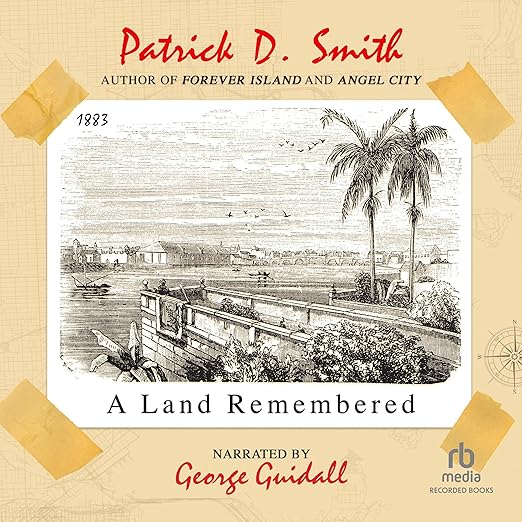
I came across A Land Remembered through an offhand recommendation from a Florida-based colleague who mentioned it the way people mention books they assume everyone has already read. I had not read it. I started the audiobook on a Sunday morning and was still listening that evening, which is unusual for me with historical fiction that predates my own interests. Patrick D. Smith published this novel in 1984, and it has persisted in Florida's cultural consciousness with an intensity that few regional novels sustain. Understanding why requires only that you listen to the first two chapters.
The novel opens in 1858, when Tobias MacIvey arrives in the Florida wilderness with little more than determination and a willingness to endure. What Smith builds from that opening is a three-generational saga that traces the MacIvey family from cattle-driving poverty to real estate wealth, and then asks, through Solomon MacIvey in 1968, whether any of it was worth what the land cost. The structure is elegant in its simplicity and devastating in its implications. George Guidall's narration understands this: he reads the early Tobias sections with a physical directness that evokes the hardship without sentimentalizing it, and his pacing slows and deepens as Solomon's environmental reckoning approaches.
Tobias and Zech's Cattle Drives Feel Documentary
This is a Pulitzer-nominated novel that received Florida's highest literary honor from the Florida Historical Society in 1986, and those credentials are not marketing ornament. Smith's achievement is that he makes you care about the MacIveys as a family before he asks you to reckon with what their success required of the land itself. The cattle-driving sequences involving Tobias and then his son Zech are genuinely thrilling: the imagery of wild yellow-hammer cattle being driven through deep Florida wilderness toward the coast is unlike anything in American fiction I can easily compare it to. Smith clearly knew this landscape intimately, and that knowledge produces prose that is specific to the point of being almost documentary.
Guidall's Rough-Hewn Elegance Spans Fifteen Hours
Guidall is one of the few narrators who can sustain genuine authority across fifteen hours without the voice losing its texture. His work here is among his best. The dialogue in Smith's novel spans three distinct historical periods and several social registers, from frontier vernacular to the clipped speech of twentieth-century real estate developers, and Guidall modulates across these without calling attention to the modulation. Listeners who discovered Guidall through his narration of other American historical novels will find him at home here in a way that enhances the listening considerably. One reviewer described the novel's language as written in rough-hewn elegance, and that phrase could describe Guidall's approach to the material as well.
Solomon Watches Wilderness Turn Into Subdivisions
The novel's emotional and thematic weight accumulates over time rather than arriving in discrete revelations. Listeners expecting plot-driven tension will need to recalibrate their expectations: this is a novel about time and land, and its most powerful moments are often the quietest ones. Solomon's final section, set in 1968, carries a weight that is only fully accessible after you have spent hours with Tobias and Zech. Smith does not cut corners on that accumulation, and neither does Guidall. The environmental argument the novel makes is not heavy-handed or didactic: it emerges from the story itself, from the transformation of wilderness into subdivisions that Solomon witnesses in his lifetime, and from the cattle land his grandfather bled for turned into golf courses and condominiums.
Lonesome Dove Fans Will Recognize a Kindred Seriousness
This audiobook is essential for anyone with a serious interest in American regional literature, Florida history, or the literature of land and environmental conscience. Readers drawn to works like Lonesome Dove or Wallace Stegner's Crossing to Safety will recognize a kindred seriousness of purpose and similar pleasures in sustained historical immersion. Casual listeners looking for plot momentum should approach with patience: the novel rewards slow listening more than it rewards speed. Those with personal or familial connections to Florida will find the specificity of Smith's landscape descriptions particularly striking. The novel is also genuinely funny in places, especially in Zech's chapters, and Guidall handles that humor with a light touch that does not undercut the surrounding gravity.
In Brief
- Performance: George Guidall is an ideal match for Patrick D. Smith's sweeping Florida saga, bringing an unhurried authority to three generations of MacIveys that honors the novel's relationship with land and time.
- What it covers: the cost of progress and prosperity, generational inheritance of both wealth and guilt, Florida's ecological transformation
- Feel: Expansive and elegiac, with a distinctly American melancholy running beneath the frontier adventure
- Our call: One of the genuine undersung classics of American regional fiction, and Guidall's narration makes the full fifteen hours feel earned rather than indulgent.