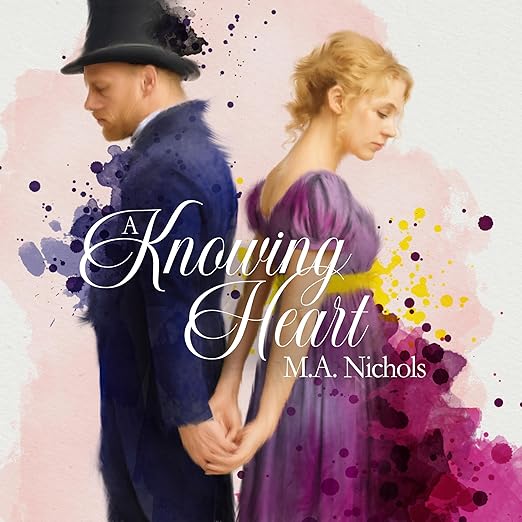
I picked up A Knowing Heart on a Saturday morning with a cup of coffee and the loose intention of listening for an hour or so. Four hours later I realized I had not moved. M.A. Nichols has a devoted following in the clean Regency romance space, and this opening installment of The Vosses series earns that loyalty with a premise that immediately complicates the simple happiness its characters believe they have secured.
Thea Keats and Frederick Voss are already engaged when the story begins. The narrative does not open with will-they-won't-they uncertainty but with the sudden destruction of everything they thought was settled. Frederick's father dies and leaves behind not an estate but a crater of lies and debts. Frederick, believing he cannot drag Thea into poverty and ruin, begins to push her away. And Thea, surrounded by family and friends urging her to cut her losses, has to decide how much she actually believes in this man and what loyalty costs when it stops being romantic and starts being genuinely difficult.
A Closer Look at A Knowing Heart
What elevates this above the standard Regency template is that the obstacle is not a misunderstanding or a prideful hero refusing to communicate. It is a structural crisis. Frederick is not wrong that his situation is dire, the estate genuinely is bankrupt, the disgrace genuinely is real, and the social consequences for Thea genuinely would be significant if she chose to stand by him. Nichols does not soften those stakes to make the romance easier. She makes both characters work hard for their eventual reunion, and the emotional payoff lands because it was earned rather than bestowed by a convenient plot resolution.
Readers who encountered Thea and Frederick first in Flame and Ember, a previous Nichols novel set in the same world, will arrive with existing attachment to these characters, which the reviews suggest amplifies the emotional experience considerably. But the story functions fully on its own terms. The historical texture is rendered with care, one reviewer specifically praised the portrayal of nineteenth-century class anxiety and the way social structures trap characters who might otherwise behave generously. Another noted real and raw emotional pain alongside genuine awe at the strength the characters discover. That combination is harder to write than it sounds, because sentimentality is always the easier path.
What Makes A Knowing Heart Worth Hearing
Madeleine Brolly is a good match for this material. Her narration is warm without being cloying, and she handles the restraint that the era and the clean-wholesome tag demand without making the characters feel emotionally flat. Regency romance narration faces a particular challenge: the conventions of the period require a certain formality of address and behavior that can read as stiffness in the wrong hands. Brolly navigates that by finding the emotion beneath the propriety rather than performing the propriety at the expense of the emotion. The 9 hour and 43 minute runtime gives the story room to breathe, which is necessary because the emotional arc here is not just romance, it is the slow process of two people learning what they are willing to sacrifice. Brolly tracks that progression with patience and conviction.
Things to Know Before Starting A Knowing Heart
Listeners should know that the secret at the center of the plot, what Frederick's father actually lied about, deepens significantly in the final third. The summary hints at it, but the full implications arrive late and affect more than just the two central characters. The revelation reframes events the reader thought they understood, which is a satisfying structural payoff but one that requires attention to the details seeded earlier. Also: this is book one of The Vosses series, and while it concludes satisfyingly, some secondary characters are clearly being positioned for future installments. That is not a complaint, just context for managing expectations before you reach the ending.
Who M.A. Nichols Is Writing For
Anyone who reads clean Regency romance and wants a plot with genuine structural conflict rather than manufactured miscommunication will find this rewarding. Fans of authors like Julianne Donaldson or Sarah Eden will recognize the emotional register and the tonal commitment to character over plot mechanics. Listeners who need explicit content will need to look elsewhere, this is firmly in the inspirational-adjacent space without being overtly religious, which gives it broader appeal within the clean romance audience than some comparable titles. If you are new to M.A. Nichols, this is a strong entry point.
Before You Listen
Do I need to read Flame and Ember before A Knowing Heart?
No. A Knowing Heart is book one of The Vosses series and functions as a standalone introduction to these characters. That said, readers who have encountered Thea and Frederick in Nichols's connected books report that prior familiarity deepens the emotional experience considerably.
How explicit is the romance content in A Knowing Heart?
The book is firmly in the clean and wholesome category, there is no explicit sexual content. The romantic tension is emotional rather than physical, and the relationship develops within the social norms of the nineteenth-century setting.
Is the financial ruin storyline historically accurate, or is it a plot convenience?
Nichols grounds the crisis in the real mechanics of nineteenth-century inheritance law and estate management. The bankruptcy and disgrace are treated as structural problems with genuine social consequences, not just temporary obstacles to be waved away by the plot.
Does A Knowing Heart end on a cliffhanger or with a complete resolution?
The central romance between Thea and Frederick reaches a satisfying resolution within this book. Some secondary storylines are left open for future installments in The Vosses series, but listeners will not finish the audiobook feeling stranded.