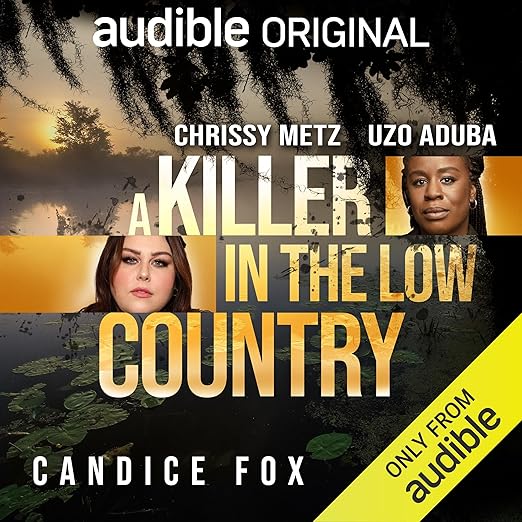
Thirty-one performer names sit in the copy of this audiobook, and exactly one of them made it into the narrator field. That gap is the first thing to understand about A Killer in the Low Country, because it changes what you think you are buying. This is not a five-hour solo reading of a Candice Fox crime novel. It is a full-cast production, offered in Dolby Atmos, about two women who fall down a true-crime rabbit hole and climb out the wrong side of it.
A Podcast Habit Becomes a Prison Correspondence
Amber Dorris and Leticia Laye teach at the same high school and share a podcast habit, which is how ordinary this starts. The show they follow covers the 1999 murder of twelve-year-old Sarah Gerlach and the conviction of Blake Wernerhet, a local man who had been friends with Sarah's older sibling and who has never stopped insisting he did not do it. Everything visible points at him. Amber's own marriage is coming apart at the same time, and the case becomes the thing she pays attention to instead.
What Candice Fox does with that setup is refuse to let the reader stand outside it. Amber starts writing to Blake in prison and finds a connection she cannot account for, and by the time she and Leticia are planning to get him out during his final appeal hearing, the book has quietly relocated the suspense. The question is no longer whether Blake is guilty. It is whether Amber can tell the difference between a wrongly convicted man and a charismatic one, and the honest answer, for most of the running time, is that neither she nor you can. That is a far more uncomfortable engine than a whodunit, and it is why the true-crime framing earns its place rather than decorating the plot. I spent the day after finishing it arguing with myself about whether I had been played, which is precisely the reaction the book is engineered to produce.
Aduba Leads Thirty-One Voices in Five Hours
A story about a podcast is close to the ideal shape for multi-voice audio, because a podcast is already a performance of voices, and the format lets the production do structurally what a print novel has to describe. Uzo Aduba heads a cast of thirty-one, and the assignment is genuinely complicated: a documentary register for the show-within-the-book, a domestic register for a marriage falling apart, and the prison correspondence sitting between them, where a listener has to weigh a voice without seeing a face. That last problem is the book's whole argument rendered as a production choice.
Five hours is also exactly right for this. Long enough to make Amber's slide credible, short enough that the tension never slackens into procedure, and short enough to finish in one evening, which is how a story built on obsession wants to be taken. Sample a passage of the prison correspondence rather than an early scene, since the opening establishes the case and the middle is where the production has to carry the ambiguity.
Credits That Don't Add Up, Spelling That Slips
The credit line is not describing the product. Thirty-one names are listed in the copy as the complete cast, and the narrator field carries one of them. Look closely at that list and it has its own problem: one name appears twice, once in the middle of the sequence and again at the end, so the roster does not even agree with itself about how many performers are involved. Anyone shopping by narrator, which a great many listeners do, is being given a fraction of the information.
Nor is the description really a description. After the plot summary it turns into an author biography, running through Ned Kelly Awards, a screen adaptation, cowritten bestsellers and an anecdote about visiting prisons for research, then closes with a note about the audio format. Useful material, all of it, but a buyer looking for the story has to wade through a publicity packet to find it. And the copy cannot hold a spelling steady: the same character is Leticia in one sentence and Letitia in the next, which is a small thing that suggests nobody read the page after assembling it.
One Review, One Rating, No Real Signal
Reception is close to nonexistent. A single written response calls it a great listen, praises the characters and reports being kept interested, which is warm and entirely unhelpful for anyone weighing a purchase. One rating stands behind the perfect average, and a lone five-star vote is arithmetically fine and evidentially worthless: nothing about a sample of one tells you how a book performs. On a recent release this is normal rather than sinister, but it does mean the page cannot help you and the sample has to.
True Crime Obsessives, Not Procedural Purists
Take it if you are the sort of listener who finishes a true-crime series and immediately reads the case file. Fans of Candice Fox already know the register, and the moral trap at the center will land hardest on anyone who has ever found themselves convinced of a stranger's innocence from the comfort of a podcast feed. Full-cast audio enthusiasts should treat this as a priority, since a thirty-one-voice production at this length is not a common object.
Procedural fans who want forensics, courtroom mechanics and investigative method should adjust expectations, because the machinery of the case matters far less here than the psychology of believing in it. The same caution applies to listeners who need a clean resolution, given that the book's central question is designed to stay uncomfortable. Anyone sensitive to material involving the murder of a child should also know the crime at the heart of this involves a twelve-year-old, handled without gratuitous detail but never far from the surface. Five hours is the length of one evening, and this is a story built to be taken in exactly that way.
Is this audiobook a solo reading or a full-cast production?
Full cast, and by a wide margin. The copy lists thirty-one performers and notes a Dolby Atmos option, even though the credit line displays only the lead. For a story built around a true-crime podcast, that structure is doing narrative work rather than adding polish, since the show inside the book needs to sound like a show.
Does the audiobook resolve whether Blake actually committed the murder?
The question the book poses is deliberately unstable, and saying more would ruin it. What can be said is that the description frames the ending as a choice between a good man wrongly accused and a charismatic monster, and that the whole experience depends on genuinely not knowing which, almost to the end.
Do I need to have read Candice Fox before starting this?
Not at all. This is a standalone with no series ties, and nothing in the setup assumes familiarity with her previous crime novels or the cowritten thrillers listed in the description. It also runs considerably shorter than her novels, which makes it a reasonable entry point rather than a reward for existing readers.
How intense is the content given the crime involved?
The murder of a twelve-year-old girl in 1999 is the case at the center, and the record carries no formal content advisory. The violence is historical rather than depicted in the present action, but the subject stays constantly in view, and listeners sensitive to crimes against children should weigh that before starting.