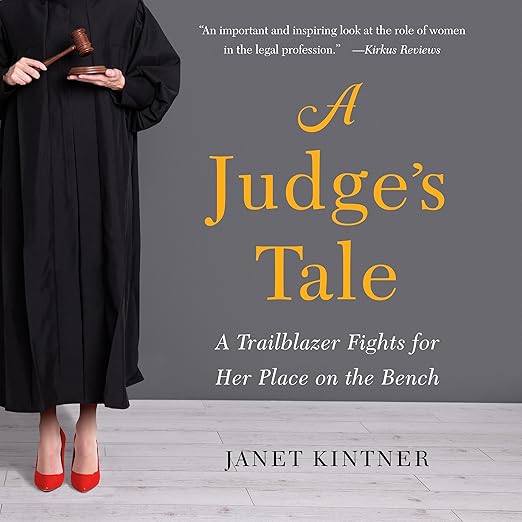
The craft of A Judge's Tale is in what it refuses to do. Janet Kintner, narrating her own audiobook memoir, does not write herself as a hero in the conventional sense - she writes herself as a lawyer, which is more interesting. Her prose has the same qualities as the legal work she describes: precise, organized, concerned with evidence and consequence rather than sensation. The result is a memoir that trusts its material rather than dressing it up, and the material is substantial. In ten hours, Kintner covers nearly a full career's worth of institutional resistance, from the District Attorney's office that told her in 1968 they would not hire a woman lawyer, through her appointment as the third female judge in San Diego history in 1976, to the judicial election that followed two years later - when she was pregnant with her second child and facing two male challengers in what reviewers described as the nastiest judicial election of the year.
The chronological structure serves the memoir well. Kintner begins with the personal history that shaped her pursuit of law - a traumatic childhood, a sexual assault in young adulthood - and traces the path from that beginning to a twenty-four-year-old newly licensed lawyer determined to secure justice regardless of gender, race, religion, or income. The arc is not a rags-to-robes narrative, exactly. It is something more specific and more useful: a detailed account of how one woman operated within and against a system that was not designed to accommodate her at any point along the way.
One reviewer cited the fascinating vignettes about her cases and the personal and professional challenges she faced as she transitioned from a newly inspired law student to a Municipal Court judge. Another described the book as taking the listener into the workings of the judicial appointment process as well as the court itself. Both observations point to the same strength: this is a memoir with substance. Kintner does not generalize her experience into a universal narrative. She gives you the specifics - the case types, the names, the procedural realities - and lets the specifics carry the argument.
The 1978 judicial election is the climactic set piece, and it earns that position. Running as a pregnant incumbent judge against two male challengers, managing a full caseload while campaigning, aware that her outcome would affect other women in and out of the judiciary - Kintner renders this period with the kind of granular detail that makes the listener understand what was actually at stake, not just symbolically but practically and personally.
Kintner's Own Voice Makes the Fire-Escape Detail Land
The self-narration by Kintner is, genuinely, one of the primary reasons to choose the audiobook. A legal memoir narrated in a lawyer's voice has a particular quality of reliability - you believe that what you are hearing is what happened, reported by someone who knows the difference between assertion and fact. Kintner's cadence is measured, occasionally dry, and occasionally allows something sharper to surface when the subject demands it. Listening to her describe the fire-escape entrance that female lawyers were required to use because they were not permitted to use the front door of certain buildings gives that detail a different weight than reading it would.
At ten hours, this is a listening commitment suited to serious engagement rather than background play. The material rewards attention - there are procedural details, case summaries, and political context that build on each other. Reviewers who have come to the audiobook with interest in legal history, women's professional history, or California judicial history have found it well-organized and well-written, which in the audio context translates to a narration that never feels rushed or overly compressed.
Fifteen Strong Reviews From a Narrow San Diego Lens
The audiobook's reach is somewhat specific: San Diego in the 1960s and 1970s, the California court system, the consumer fraud cases Kintner specialized in. For listeners whose interest is in legal history broadly, or in women's professional history as a category, these specifics enrich rather than narrow. For listeners looking for a memoir with the sweep of a national narrative or the reflective distance of a late-career retrospective that touches on major public events, this is a more intimate and local account.
The rating count is low - fifteen reviews at the time of writing - which means the overall picture is drawn from a small sample, though those reviews are uniformly strong. This is not a widely marketed major release but a memoir that has found its readers among those specifically looking for firsthand accounts of women navigating the legal profession during a specific period of institutional change.
Restraint That Rewards Careful, Patient Listeners
This audiobook is particularly well-suited for listeners with a connection to legal practice, judicial history, or the history of women in professional fields. Kintner's account of the bar association politics, the appointment process, and the election mechanics is detailed enough to be genuinely educational for anyone curious about how those systems actually operated. The memoir also speaks directly to anyone interested in the period of the late 1960s and 1970s when many professional institutions were first being pushed to include women in roles that had previously been entirely closed to them.
Listeners who prefer memoir that prioritizes emotional interiority over procedural detail may find the approach somewhat reserved. Kintner's legal training shapes her voice throughout - she is more interested in what happened and what it meant than in making you feel her distress. That restraint is a quality for some listeners and a limitation for others. Those who want the experience of sitting with someone who made history and is explaining, carefully and precisely, exactly how she did it will find the ten hours well spent.
At a Glance
- Read by: Janet Kintner narrates her own memoir, and the effect is significant - her dry, precise legal voice gives the material an authority that a professional narrator reading the same words could not replicate.
- At its heart: women in law, institutional discrimination, judicial independence
- Vibe: Measured and principled, with moments of real indignation surfacing through the restraint
- Short version: A firsthand legal memoir that earns its detail - Kintner's account of the 1978 judicial election is the kind of political and professional history that illuminates how fragile institutional progress can be.
Questions Listeners Ask
Does A Judge's Tale audiobook require background knowledge of California law or judicial processes to follow?
No. Kintner explains the relevant processes as she goes - judicial appointments, election mechanics, bar association structures - in enough detail for listeners without legal background to follow. The memoir is accessible to general audiences interested in legal history and women's professional history.
Is this audiobook focused mainly on the 1978 election, or does it cover Kintner's full career?
It covers her full arc, from a traumatic early life through law school, her work as a consumer fraud prosecutor and pro bono attorney, her 1976 appointment as the third female judge in San Diego history, and the 1978 election where she ran as a pregnant incumbent against two male challengers. The election is the climax, but the journey to it takes most of the ten hours.
Is the audiobook version of A Judge's Tale significantly different from the print edition?
No significant differences are noted between formats for this title. The audiobook follows the memoir's chronological structure and benefits primarily from the self-narration by Kintner herself, which adds a layer of direct authority the print version cannot replicate.