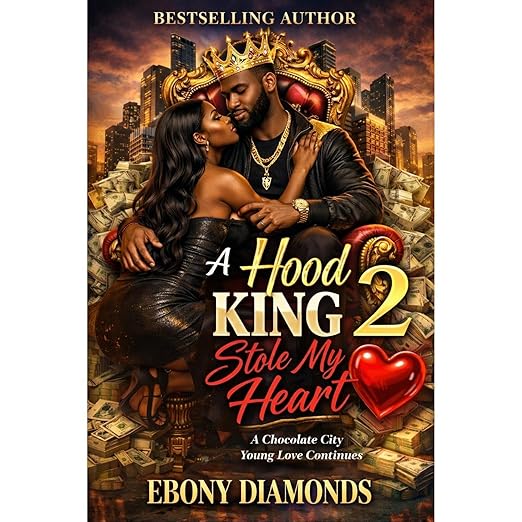
Keisha and Black's story picks up in A Hood King Stole My Heart 2 at exactly the rupture point where the first installment left things: Keisha's own choices have driven Black away, and the distance between them feels irreparable. Ebony Diamonds wastes no time re-establishing stakes. Within the opening chapters of this audiobook, an attempt on Keisha's life reorganizes Black's priorities entirely, and what follows is a narrative structured around threat and response, where every moment of emotional softening is interrupted by the escalating enemy list that has made the lives of these four friends dangerous.
The sequel structure Diamonds employs here is one of the more demanding in urban fiction: continuing a romantic conflict that was driven by character flaw, not external circumstance, while simultaneously ratcheting up the external pressure enough to justify a second volume. The challenge is keeping both threads active without letting the action overwhelm the personal stakes, or letting the personal stakes stall the momentum. Diamonds navigates this with reasonable success through the mid-section of the book, where the interplay between romantic tension and genuine danger produces the series' strongest passages.
Keisha Faces Real Accountability After the Attempt
The decision to frame Keisha's transformation through an attempt on her life is a high-stakes authorial move, and Diamonds uses it to earn something the first book had been building toward: a version of Keisha that can receive protection without reading it as a threat to her autonomy. The standoffish self-protection that defined her in book one is shown here to have real consequences, and the story does not let her off the hook for it. That accountability is one of the more honest elements of the characterization in this installment, and it keeps the romance from tipping into pure wish fulfillment.
The four-friend ensemble structure adds texture to what could otherwise become an overly focused two-person dynamic. As the enemy list grows and targets multiply, the narrative broadens to give each of the four distinct vulnerabilities and distinct investments in the outcome. Lives are lost, as the synopsis promises, and Diamonds handles those losses with a matter-of-factness that is consistent with the series' tone: grief exists in this world, but it does not stop the forward motion of the story. Some readers will find this approach appropriately unsentimental; others may want more space given to the emotional aftermath of the violence.
Virtual Voice Levels the Emotional Confrontations
Readers who finished the first installment with investment in Keisha and Black's resolution will find this second volume delivers on the accumulated tension. The revelations in the back half of the book, dark lies surfacing and secrets dismantling assumed alliances, give the narrative the structural payoff that a strong second act requires. Diamonds has a clear sense of where the series is going, and the pacing of the reveals reflects that clarity of intention.
The Virtual Voice narration functions adequately for the plot-driven sections of the book, maintaining clarity and consistent pacing through the action sequences and dialogue exchanges. Where the AI narration shows its ceiling is in the more emotionally complex confrontations between Keisha and Black, moments that in human hands would carry the full weight of two people working through something genuine. The Virtual Voice performance levels these exchanges, delivering the words correctly but without the spontaneous inflection and micro-variation that make recorded fiction land as felt experience rather than recited text. Listeners already familiar with Virtual Voice productions will know what to expect; those new to it should factor this into their decision.
Book Two Demands You've Read the First
This is book two of a continuing series, and it does not function as a standalone entry. The emotional context for Keisha's transformation only carries weight if you know who she was in book one, and the enemy dynamics that drive the plot have history that the sequel does not fully reconstruct for new readers. Listeners who arrive here without having read or heard A Hood King Stole My Heart will be able to follow the plot mechanically but will miss the emotional depth that the series has built toward this point.
Fast Pacing Answers the Question, Not Cleanly
The question the synopsis poses, will they make it out together or go their separate ways, is answered by the end of this volume, though not with the clean resolution that implies. Diamonds leaves enough open to sustain further installments without the ending feeling artificially incomplete. Readers who dislike cliffhanger-adjacent conclusions should know that this is a series that builds across multiple volumes and is structured accordingly.
The question of pacing in serialized urban fiction is worth addressing directly for this installment. A Hood King Stole My Heart 2 moves at the speed its genre demands: threats escalate quickly, revelations arrive on a compressed timeline, and the emotional stakes are kept continuously high rather than allowed to breathe and build across extended quiet sections. For readers who prefer that urgency, Diamonds delivers it consistently. For readers who want extended scenes of emotional processing between the action beats, the pacing may feel relentless in ways that prevent full connection with the quieter emotional moments. The series is built for momentum, and this installment does not break that contract with its audience.
Fans of Book One Get a Satisfying Continuation
This audiobook is for readers who have already engaged with the first installment and want to see Keisha and Black's story through to its next stage. It will reward listeners who enjoy urban fiction that balances street-level tension with genuine romantic stakes and character accountability. The Virtual Voice narration is a consideration: listeners who find AI narration a significant barrier to immersion should weigh that against their investment in the story. Those already comfortable with Virtual Voice productions, or who prioritize plot and character over performance, will find this a satisfying continuation of the series.
At a Glance
- Performance: Virtual Voice handles this urban fiction sequel with the functional adequacy typical of AI narration; emotional peaks in Keisha and Black's tense dynamic are delivered without the spontaneous variation a human reader would bring.
- What it covers: Loyalty and protection in dangerous circumstances, secrets and betrayal among friends, love tested by violence
- Feel: Tense and propulsive, with moments of raw emotional exposure
- Our call: Ebony Diamonds delivers the escalating stakes promised by a second installment, though the Virtual Voice narration clips the emotional ceiling the story reaches for.