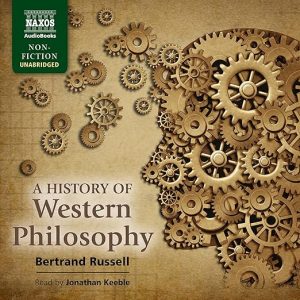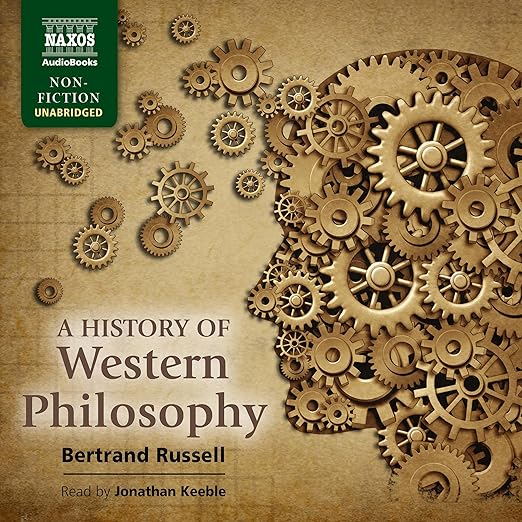
Bertrand Russell wrote A History of Western Philosophy in the 1940s, and it has never been displaced as the standard introduction to its subject, which says something important about how rarely a scholar manages to be both comprehensive and compulsively readable. The audiobook format suits this particular text well, because Russell writes as a man with opinions, not as a neutral surveyor, and Jonathan Keeble's narration honors that personality without amplifying it into performance.
The Verdict, Briefly
Russell's method throughout this book is to place each philosopher and school within their specific historical and cultural moment. He does not treat the history of philosophy as a succession of abstract positions to be evaluated in isolation. He treats it as a human story, shaped by political upheaval, religious authority, economic change, and individual temperament. This approach, which was considered somewhat heterodox among professional philosophers, is precisely what makes the book accessible to general readers while remaining intellectually serious.
The range is genuinely comprehensive, moving from the pre-Socratics through Plato and Aristotle, on to medieval philosophy, then the Renaissance and Enlightenment, and finally to the early twentieth century. Russell covers Heraclitus, Parmenides, Socrates, Descartes, Locke, Hume, Kant, Hegel, Marx, Nietzsche, and many more, and in each case his commentary combines summary with critique. He is not interested in being fair in the sense of withholding his own judgment. He is interested in being honest about what he thinks each thinker got right and wrong, which gives the book a vitality that more reverential surveys lack.
One listener described it as wise, clever, dry, witty, challenging, and entertaining, adding that more concise listings exist for who said what, where, and when, but few actually place the ideas we still debate today in their proper historical context. Another, who identified as almost forty years old and previously frustrated by condescending philosophy texts, called this his first successful attempt at reading anything meaningful about philosophy. That second response points to something crucial: Russell is rigorous, but he writes for an intelligent general reader, not for graduate students trying to establish credentials.
What Makes A History of Western Philosophy Worth Hearing
Jonathan Keeble's narration is well matched to this material. Russell's prose runs long and complex, with sentences that require a reader to hold multiple clauses in mind before arriving at the main point. Keeble handles this syntax with patience and intelligence, never rushing, never losing the thread. The 38-hour runtime is long, but the structure of the book, divided into three major parts across dozens of chapters, gives listeners natural stopping points rather than forcing them to navigate an undifferentiated wall of content.
The audiobook format also does something specific with Russell's wit. He is genuinely funny in the dry, offhand way of a man who finds human intellectual history simultaneously fascinating and slightly absurd. In print, those moments can slip past. Keeble's measured delivery makes them land more reliably, because the slight tonal shift signals that something sharp is coming before it arrives. Listeners who enjoy the company of a rigorous intelligence that refuses to take itself too seriously will find this extended listen unusually pleasurable.
The historical contextualization that Russell provides is also, arguably, more useful in the current moment than it was when the book was written. Understanding how Plato's political philosophy relates to aristocratic Athenian society, or how Descartes' dualism emerged from the religious anxieties of seventeenth-century France, gives contemporary listeners tools for thinking about ideas that still circulate, often without attribution, in political and cultural discourse.
Points to Consider
Russell has an agenda, and serious philosophy students should know this upfront. He is an analytic philosopher with strong empiricist sympathies, and his treatment of idealist and Continental traditions, particularly his handling of Hegel and Rousseau, reflects those biases in ways that professional philosophers have criticized. This does not make the book wrong, but it makes it partial in the way that all histories written from a strong point of view are partial.
The sections on medieval philosophy are widely considered the weakest in the book. Russell's skepticism toward religious philosophy is less concealed here than elsewhere, and some listeners and critics feel he rushes through material that deserves more patience. Conversely, his treatment of ancient Greek philosophy is considered exemplary, and his chapter on Aristotle in particular is a model of how to make difficult technical thought accessible without distortion.
At 38 hours and 3 minutes, this is a serious commitment. Listeners who want a shorter introduction might consider one of the many podcast series or lecture courses available on Western philosophy. But those who commit to Russell's version will emerge with a genuine panoramic view that shorter treatments cannot provide. The length is not padding; it is the cost of taking the subject seriously.
Who Should Listen to A History of Western Philosophy
The ideal listener for this audiobook is someone with a longstanding curiosity about philosophy who has not found a good point of entry. Russell's book works precisely because it does not require prior knowledge while rewarding close attention. It is also worth the investment for listeners who have studied specific philosophers in depth but lack a sense of how those figures fit into a longer historical conversation.
Listeners who should approach with caution include those who want professional-level philosophical rigor without authorial bias, those who are primarily interested in non-Western philosophy traditions, and anyone who finds the prospect of 38 hours with a single author daunting. The latter group might sample a few chapters first: Russell's voice is either something you find immediately companionable or something you find slightly insufferable, with very little in between.
Good to Know
Is this audiobook appropriate for someone who has never studied philosophy formally?
Yes, and it may be the single best entry point available. Russell writes for an educated general reader rather than a specialist, and he explains each philosopher's key ideas clearly before evaluating them. Listeners with no philosophy background consistently report that this book finally made the subject click for them in a way that more academic introductions failed to do.
At 38 hours, is the audiobook worth committing to, or is it better to read the print edition?
Both formats have genuine merit, but the audiobook rewards the commitment in a specific way. Jonathan Keeble's measured narration makes Russell's long, clause-heavy sentences easier to follow than they can be on the page, and his delivery highlights Russell's considerable dry wit in a way that print can undersell. Listeners with long commutes or regular exercise sessions find the runtime manageable across a few weeks.
Does Russell's audiobook cover all the major Western philosophers, or are notable figures missing?
The coverage is extensive, running from the pre-Socratics through the early twentieth century. Major figures including Plato, Aristotle, Descartes, Hume, Kant, Hegel, and Nietzsche all receive substantial treatment. The primary limitation is that Russell's analytic perspective means some Continental and idealist thinkers receive less sympathetic coverage than specialists would prefer.
How does this audiobook compare to podcast philosophy courses or lecture series?
Russell offers something distinct: a coherent single perspective that ties philosophical development to historical and political context over a very long arc. Podcasts and lectures tend to treat philosophers more individually. Russell's book rewards listeners who want to understand how ideas developed in relation to each other across centuries, rather than encountering each thinker in isolation.