Key Details
- Read by: Rich Miller is credited for the full recording, one reader carrying a one-volume university survey from Kiev to the successor states.
- At its heart: Kievan origins, empire and autocracy, the Soviet century, post-Soviet transition, the nationalities question
- Vibe: Measured, dense and lecture-paced
- Short version: The standard one-volume survey delivered whole, asking roughly what a semester would ask of you.
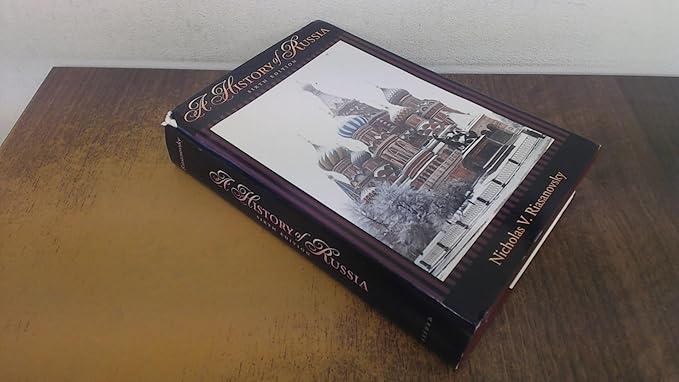
Eight hundred and sixteen pages, by one reviewer's count, become thirty-three hours and sixteen minutes in this audiobook. That works out to roughly twenty-five pages an hour, which is the arithmetic of a genuinely unabridged reading rather than a condensation, and it is the first useful thing to know. Nicholas V. Riasanovsky's survey, running from the origins of the Kievan state to the post-Soviet successor states, is a university textbook, and nobody involved has tried to turn it into anything else.
A commitment on that scale sits closer to a semester than to a book, and Caitlin's four-star notice makes the comparison explicit. This was the assigned text for a class running eight weeks, and the review is candid about how that went: "It was very detailed and could drift into the boring realm at times, but it was also 816 pages long so what would a person expect?" The question is fair. It is also the right frame for the recording.
Three Editions Feed One Aggregate Rating
Begin with the editions, because they matter more here than anywhere else. The description on this listing refers to "this sixth edition" and the release is dated November 11, 1999. Richard Diamond, writing in 2011, states outright, "I am reading the 4th edition." Jon L Albee, writing a decade later in 2021, describes a book "now in a ninth edition." Three separate editions, at minimum, feeding one aggregate score. No scandal lives in that fact, given a textbook revised across decades, but it does mean the 4.3 on display is an average across books that are not, in any strict sense, the same book.
Richard Diamond also identifies the method more precisely than the publisher's copy manages, describing an author who "brings in the works of others with whom he disagrees and lets the reader decide," who cites specialists and yields to them where their expertise runs deeper. That is historiography rather than narrative: an argument about how we know what we know rather than a story about what happened. Jon L Albee reaches the same place from the reader's side, calling it "an engaging textbook treatment" and noting that "Culture and society get special attention," a distinction that separates a chronicle of rulers from a book with an actual population in it.
One Volume Carries Kiev to the Post-Soviet Present
Justin Donie, writing back in 2007, called this "the state of the art in single volume Russian Histories" at a moment when, in that reviewer's account, meaningful histories of the country had been genuinely hard to obtain. The verdict is nineteen years old now and the book has been revised repeatedly since, yet the shape of the recommendation holds. One volume. One reader. The whole span.
The span is very much the point. The description promises the building of an empire, Soviet Russia, the successor states, and, in a chapter the sixth edition added, the post-Gorbachev era. It names the nationalities question and Yeltsin's rise among its contemporary threads. A single account that starts with Kiev and finishes with post-Soviet capitalism hands you the connective tissue that specialist books quietly assume you already possess, and that connective tissue is precisely what a general reader lacks.
Method is what justifies the length rather than a shorter survey. The copy says the work draws "on both primary sources and major interpretive works," which is the difference between a book that tells you what happened and one that shows its working. Sustained argument of that kind suits listening better than most people expect, precisely because you cannot skip ahead to a summary box or let your eye slide down a page to the conclusion. The format enforces the sequence the author built. For a book whose whole value is the sequence, that constraint works in your favor rather than against it, which is not something you can say about most reference works in audio.
Thirty-Three Hours, and Not One Word on Miller
Rich Miller narrates, and here an absence has to be declared. Across five reviews spanning 2007 to 2021, not one word addresses the recording. Nobody names Miller, nobody comments on pace or diction, and the notices that describe a reading experience describe pages: 816 of them, a fourth edition, a college class, an eight-week course. A commitment of this size is an extraordinarily long time to spend with a voice you have never sampled, and the listing offers no help whatsoever in deciding.
Apparatus is the second issue, and a real one. The description advertises "helpful updated biblipgraphies and reading source lists" as a feature of the edition. Both are things a recording cannot deliver in usable form. If you are listening in order to build a reading list, or to chase a citation into a specialist monograph, you will need the text open beside you. This is a reference work as much as a narrative, and roughly half of what makes it a reference goes missing here. The typo in that quoted phrase belongs to the listing, incidentally, and it sits a few lines below a second one promising coverage of Russia's "social, economic, cultural, political and miliary events." Two errors in one paragraph selling a scholarly reference is careless, though neither of them touches the audio.
Then what the copy does not update. It promises to carry "the study of Russia straight into the new millennium" and offers the rise of Yeltsin and the country's attempts to market capitalism as its contemporary material. All of that was contemporary in 1999. Anyone arriving for an account of the last quarter century will not find one in whatever edition this recording was made from, and the listing never says which edition that is. EROC72, the lowest visible score at three stars, still concedes that "It is a well written book with a good take on Russian History in my opinion," which tells you the objections here are about scope and currency rather than quality.
General Readers Get a Complete One-Volume Reference
Nobody should start here casually. This is a textbook, it behaves throughout like a textbook, and the honest audience is a student assigned it, a serious general reader who wants the standard one-volume account rather than a popular narrative, or somebody with a punishing commute and genuine appetite for institutional history. The test is simple enough. If a general reference is a thing you want in your ears rather than on a shelf, this qualifies, and it qualifies without asking you to accept a single shortcut along the way.
Two kinds of listener should stay away. The first wants Russia explained through story, character and scene, a perfectly reasonable thing to want and not remotely what this offers. The second needs current analysis, because the most recent material named anywhere on this listing belongs to the 1990s. Everyone else is looking at a complete, unabridged one-volume account read straight through, where the only real cost is the calendar and the only real risk is a narrator you have not yet heard.
Before You Listen
Which edition is this audiobook based on?
The listing never says, which is a genuine problem. If you need a particular edition for coursework or citation, confirm before buying, because revisions to this title have added whole chapters covering the post-Soviet period. Treat the version question as unresolved rather than assuming the recording matches whatever your syllabus specifies.
Does this audiobook cover recent Russian politics?
No. The newest material the description names is Yeltsin's emergence and an early push toward market capitalism, plus one chapter on the post-Gorbachev era. The listing itself dates to November 1999. Anything from this century falls outside what the recording contains.