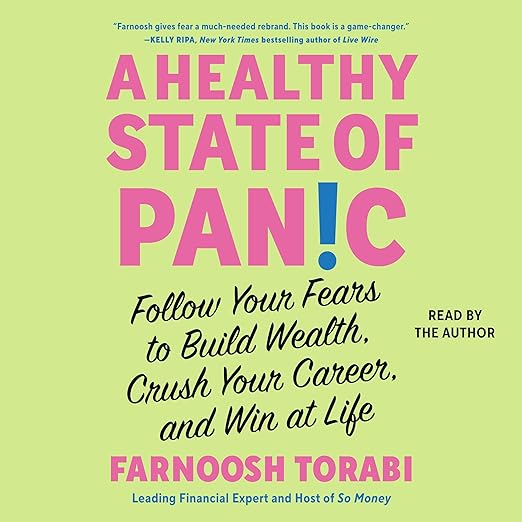
Farnoosh Torabi's audiobook A Healthy State of Panic opens with a premise that runs directly against the dominant self-help convention: fear is not the enemy of good decisions, it is one of the most reliable sources of information available to you. Torabi, the creator of the So Money podcast and a longtime financial journalist, structures the book around nine specific fears - rejection, loneliness, missing out, being exposed, uncertainty, money, failure, endings, and loss of freedom - and argues that each of them, examined rather than suppressed, points toward something real and actionable. She narrates the audiobook herself across nine hours, and the decision to do so is not incidental. The voice that listeners familiar with the So Money podcast will recognize - precise, warm, occasionally sharp - is the voice this argument needs.
Named a Newsweek Best Book of 2023 and drawing comparisons to other fear-and-resilience titles aimed at women navigating financial uncertainty, this audiobook is broader in scope than the title might suggest. Yes, there is a chapter on the fear of money. But the fear of rejection and what it reveals about where you are and are not valued; the fear of loneliness and how it builds the capacity for independence; the fear of losing your freedom and how it sharpens advocacy - these are life-framework arguments, not personal finance tactics.
Fear Carries a Signal Worth Decoding
The structural cleverness of the nine-chapter framework is that each fear gets two treatments: first as it tends to manifest (the paralysis, the avoidance, the catastrophizing), and then as it can function if redirected (the self-discovery, the clarity, the motivation). Torabi is careful to distinguish this from toxic positivity - she is not arguing that fear is secretly good all along. She is arguing that fear carries a signal, and that the signal is worth decoding rather than muffling. The Iranian immigrant upbringing she describes in the opening chapters is the context for understanding where this argument comes from: growing up in a household where fear was managed through hypervigilance and preparation, not denial, left her with a different relationship to anxiety than the mainstream American self-help tradition tends to assume.
The financial chapters are the most specifically useful for listeners who came to the book through the So Money podcast. The fear of money chapter is particularly sharp on how financial anxiety often encodes a deeper question about worth and legitimacy, not just about numbers, and Torabi's approach to untangling those strands is more nuanced than the typical budgeting book allows for. One reviewer noted that the book is so much more than about money, and while that observation might frustrate listeners expecting a pure personal finance guide, it is the book's real strength.
Zero Distance Between the Narrator and the Person
Torabi's podcast experience is audible in every chapter. She structures the audiobook the way she structures interviews: a clear opening frame, specific stories to anchor the abstract argument, concrete takeaways, and a closing that connects back to the opening premise. The pacing is conversational without being loose, and she handles the more personal material - her immigration background, her early career insecurities, her specific financial fears - with the same lack of defensiveness that makes So Money work as a long-running show. Reviewers described her as truly authentic, and in the audio format, that quality is especially apparent. There is no distance between the narrator and the person who lived the experiences being described.
At nine hours, the audiobook is long enough to develop its argument fully but short enough that no single chapter overstays its welcome. The nine-fear structure provides natural stopping points, which makes it well-suited to the listening patterns of people who use podcasts rather than dedicated reading sessions as their primary audio consumption mode - a design choice that is probably not accidental given Torabi's background.
Clarity Replaces Dread When Endings Are Approached
The fear of endings chapter is the least expected and most interesting section for listeners who came in thinking of this as a career and money book. Torabi's treatment of endings - professional, relational, and structural - as something that can be approached with clarity rather than dread is more philosophically interesting than the chapter title suggests, and it broadens the book's usefulness beyond its stated audience of women navigating financial decisions.
Also worth noting is how Torabi handles the tension between immigrant caution and American risk-taking. Her parents' insistence on safety as the primary value is presented with understanding rather than as something to be simply overcome, and the book's argument for embracing fear is more sophisticated for acknowledging that caution has its own legitimate history and logic. For listeners who come from similar backgrounds, this nuance is the book's most distinctive quality.
Between Jen Sincero's Upbeat and Suze Orman's Prescriptive
Listeners who found Jen Sincero's approach too relentlessly upbeat or Suze Orman's advice too prescriptive will find Torabi operating in a middle register - emotionally engaged but analytically grounded. The book is most directly useful for women in their twenties through forties who are navigating the intersection of identity, career, and financial decision-making, but the fear-reframing framework has broader application than any single demographic. Listeners expecting a traditional personal finance audiobook with chapters on budgeting, debt management, and investment allocation should know this is primarily a psychological framework book; the financial specifics are woven in as illustrations rather than as the main event.
The Short Version
- Read by: Farnoosh Torabi's self-narration is the right call - her podcast background gives her a natural conversational authority that makes the nine-fear framework feel like advice from a friend rather than a self-help script.
- At its heart: Reframing fear as information, immigrant identity and financial resilience, self-advocacy and financial freedom
- Vibe: Candid and motivating, with real humor and genuine warmth
- Short version: A personal finance audiobook that earns its emotional weight by putting the author's own story at the center, rather than using anecdotes as decoration around abstract principles.