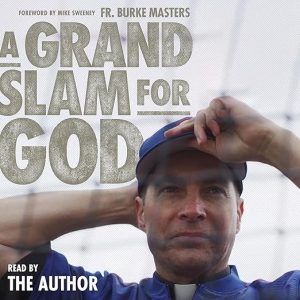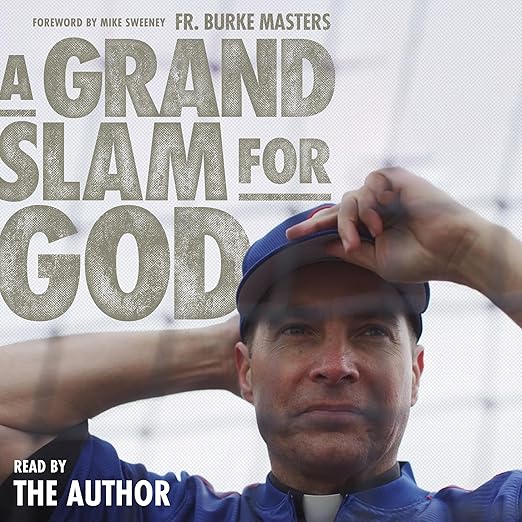
Burke Masters was in the on-deck circle at Mississippi State when the grand slam that helped send his team toward the College World Series became one of the defining images of his young life. I found myself picturing that moment clearly while listening to him describe it in his own voice on this audiobook. The stadium noise, the particular weight of that achievement, the sense that everything was finally on track toward the Major League career he had been building toward his whole life. And then the pivot that he never expected, which is what makes this memoir worth every one of its five hours.
A Grand Slam for God is a memoir narrated entirely by Fr. Burke himself, which immediately separates it from most religious biography audiobooks on the market. When someone reads the story of their own life, the material carries a quality that professional narration simply cannot replicate. You hear the places where the telling is still slightly tender, the memories that have not been fully processed into polished narrative, the moments of genuine emotion that a professional voice actor would smooth over in service of production quality. Masters does not over-polish. He tells his story with the honesty that listeners who have followed his digital ministry on YouTube will recognize immediately and value.
Not Triumphant, But Grateful
The memoir covers significant biographical territory: a childhood outside Chicago, the arc of a promising college baseball career at Mississippi State, and then the arrival of a question that would not leave him alone. The call to Catholicism was not something Masters grew up with. His conversion, followed by a deepening vocation to the priesthood, came from a direction he had not anticipated and against personal plans he had built carefully over years of athletic and academic work. That disruption is what gives the memoir its emotional power. This is not the story of someone fulfilling a destiny they always sensed waiting for them. This is the story of someone being redirected in ways that cost them something real and permanent.
Masters is genuinely honest about the doubt and loss that accompanied his conversion and his priestly calling. He does not present the path as obvious or painless. The sections dealing with personal grief, the specific sacrifices of priestly celibacy, and the sustained uncertainty of discernment are handled with a directness that reviewers have consistently noted as the book's great strength. One reader described being brought to tears of both joy and sadness, which captures the emotional register the memoir inhabits: not triumphant, but grateful. The difference between those two states matters enormously in a book like this one.
Masters Sounds Like Someone Who Was There
The self-narration by Burke Masters is the audiobook's decisive advantage over any other format. His voice carries the accent and cadence of someone who grew up in the Midwest and played competitive college baseball, which gives the athletic chapters a texture that a professional narrator could not authentically replicate. When he describes the physical experience of a grand slam or the competitive dynamics of a college program, he sounds like someone who was there because he was. And when he describes the interior experience of discernment, the slow and often painful process of understanding a vocation you did not ask for, he sounds like someone still close enough to that experience that it has not yet become abstract or safe.
Reviewers who had followed Fr. Burke's digital presence for years noted that the memoir revealed aspects of his story they had not known despite years of familiarity with his public work. That is one meaningful measure of a successful memoir: it gives even the already-engaged audience something genuinely new. The audiobook format delivers that with a particular intimacy that print simply cannot match when the author is this present in the narration.
Doubt Chosen Every Day, Not Inherited
Listeners without any familiarity with Catholic theology or the specific shape of priestly formation will find some of the ecclesiastical material slightly opaque. The seminary experience, the vows, and the particular nature of priestly identity are described from the inside rather than explained carefully for outside observers. This is not a barrier to following the story's broader arc, but it does mean that the full emotional resonance of certain chapters is more accessible to listeners with some prior context about what the priesthood involves and what it actually costs a person to commit to it fully.
The memoir is also frank about topics that some listeners may not expect from a priest's autobiography: romantic relationships before his conversion, the specific nature of the losses that accompanied his decision to pursue ordination, and the kind of doubt that makes faith something actively chosen every day rather than passively inherited. The honesty is the book's great strength, but listeners expecting an uncomplicated devotional narrative will find the memoir more complicated and more honest than its title might suggest going in.
Sporting Memoir Meets Spiritual Autobiography
Baseball fans curious about the interior life of someone who walked away from professional prospects for a religious vocation will find this audiobook a rare combination of sporting memoir and spiritual autobiography. Catholics and Christians with an interest in priestly vocation will find it moving and candid in equal measure. Listeners of any background who have had to surrender a deeply held life plan and rebuild around something they did not choose will find the memoir's emotional truth resonating well beyond the religious specifics. Those seeking a strictly devotional listen may find its honesty about doubt and sacrifice more challenging and ultimately more rewarding than they anticipated.
Key Details
- Performance: Burke Masters narrates his own story with natural authority and occasional raw emotion, making the self-narration the only logical choice for this deeply personal memoir.
- What it covers: Vocation over ambition, faith over certainty, the priesthood as unexpected calling
- Feel: Warm, honest, occasionally funny, and genuinely moving
- Our call: Fr. Burke Masters delivers a memoir that works equally well for baseball fans, Catholics exploring priestly vocation, and anyone who has had to surrender a deeply held plan in favor of something they did not expect.
Good to Know
Does A Grand Slam for God require Catholic background knowledge to follow and appreciate the audiobook?
No prior theological knowledge is required to follow the memoir's arc. The baseball-to-priesthood journey is narrated as a personal story rather than a doctrinal argument. Some seminary and ordination material will land with more resonance for Catholic listeners, but the memoir's core emotional journey is accessible to anyone who has wrestled with a major life decision.
Is Burke Masters a trained narrator, or does the self-narration feel rough compared to professional audiobook productions?
Masters is a communicator by vocation with years of video content and public speaking behind him, and it shows throughout the audiobook. The narration is not technically perfect in the way a professional studio production would be, but it is warm, clear, and authentically his. The moments where his voice carries visible emotion are a feature of the experience, not a flaw.
How much of this audiobook focuses on baseball versus the religious vocation narrative?
The baseball material establishes the stakes of what Masters gave up and provides the memoir's central metaphor. It occupies a relatively modest portion of the total runtime. The memoir's center of gravity is the conversion experience and the priestly vocation, with the baseball career serving as the life plan that faith redirected rather than as the primary subject.
Is A Grand Slam for God appropriate for non-Catholic or non-religious listeners?
Yes. The memoir is honest about doubt, loss, and having one's plans overturned, which are universal themes that do not require shared religious convictions to resonate. Reviewers have described it as equally compelling for baseball fans and spiritual seekers, and the audiobook's emotional honesty works well across denominational lines.