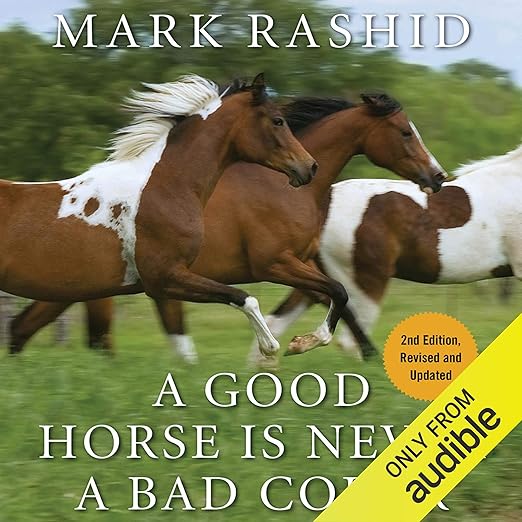
I came to Mark Rashid's work late. I had heard the name for years in conversations about horse training, always in the same breath as phrases like communication-based and willing partnership, and I had the vague literary person's skepticism of self-help adjacent categories that I should probably examine more honestly than I do. Then I listened to A Good Horse Is Never a Bad Color during a stretch of evenings when I needed something that slowed time down rather than compressed it, and I understood why this book has retained its readers across multiple decades.
Rashid is not primarily a writer. He is a trainer, and a very good one, and this book is fundamentally a record of his observations accumulated across years of working with horses that had been given up on or written off because of their breed reputation. The title is his central argument stated plainly: the horse's color, its breed, its reputation, none of these things determine its trainability or its nature. What determines the outcome is the quality of communication the human brings to the relationship. The new edition that this audiobook represents includes added introductory notes for each chapter, written to contextualize how Rashid's thinking has developed since the book's original publication, and Mike Chamberlain integrates them smoothly into the listening experience.
How A Good Horse Is Never a Bad Color Holds Up
The book's specific subject, stated explicitly in the synopsis, is the training of Arabs, Appaloosas, and Paints, three breeds that carry accumulated stereotypes in the horse-training world. Arabs are often labeled as high-strung and difficult. Appaloosas have a reputation for stubbornness. Paints are sometimes dismissed as pretty but unserious in performance contexts. Rashid takes these reputations seriously enough to address them directly, not by claiming they are pure fabrication, but by examining how the stereotypes self-perpetuate. A horse that has been approached with the assumption of difficulty will often behave difficult, because the human's anticipatory tension creates exactly the conditions that produce the unwanted behavior. The bias shapes the outcome it claims merely to describe.
This is not a radical training philosophy in 2025 in the way it may have been when Rashid first published, but the book's value is not in the novelty of the argument. It is in the quality of the stories that carry the argument. Rashid uses case histories of specific horses he worked with to demonstrate rather than simply assert his principles, and the cumulative effect of those demonstrations is the book's actual achievement.
Why A Good Horse Is Never a Bad Color Works as an Audiobook
One reviewer described the method as resembling Aesop's fables: the story is the teaching, and the wisdom in it can be extracted and applied beyond the horse-training context to human relationships and daily life struggles. That description is exactly right and explains why the book's readership extends well beyond people who currently own horses. The reader who described themselves as having ridden only a few dozen times in their life, and not at all in thirty years, found the book mentally slowing and genuinely instructive about patience and the nature of communication. Another reviewer, who actively owns and trains horses, found it valuable for the philosophy and the specific techniques equally.
That range of responses speaks to something Rashid is doing structurally that most genre-specific books cannot manage: he is writing about horses in a way that makes the horse a vehicle for understanding something more general about the relationship between expectation and behavior, between dominance and communication, between what an animal needs and what a human assumes it needs. The added chapter introductions in this edition make that bridge between specific technique and general principle more explicit than the original did, which makes the new edition more rewarding even for readers who encountered earlier versions.
Weak Spots in A Good Horse Is Never a Bad Color
One reviewer noted that if you are looking for excitement, this is not your book. That is accurate and also entirely beside the point. A Good Horse Is Never a Bad Color is deliberately paced. Rashid writes in a register that invites attention rather than demanding it, and Chamberlain reads with a corresponding unhurriedness that suits the material throughout the eight-hour runtime. The experience passes with the quality of time spent outdoors rather than time spent in transit. Listeners who can surrender to that pace will find it genuinely restorative in a way that more kinetic audiobooks cannot provide. Those who need their audiobooks to maintain a certain narrative velocity may find the early chapters slow to establish momentum, though they tend to settle into the rhythm once the individual horse stories take over from the framing material.
The Right Listener for A Good Horse Is Never a Bad Color
A Good Horse Is Never a Bad Color is obviously valuable for anyone involved in horse ownership or training, but the audience the reviews consistently describe extends well outside the equestrian world. Readers who responded most deeply to the book's deeper theme, that judgment based on superficial category closes off possibilities that patient observation would open, come from a wide range of life contexts where that principle applies with equal force. This free audiobook rewards listeners who approach it as a philosophy of engagement rather than a narrowly technical training guide. Those who need their equestrian nonfiction to be more prescriptive and less narrative may want to seek out a different resource for specific barn questions, but those looking for the kind of wisdom that transfers from one domain to another will find Rashid an unusually generous guide.
The Short Version
- Read by: Mike Chamberlain reads Rashid's measured prose with appropriate warmth and patience, matching the book's unhurried, observational temperament without adding sentiment the text does not request.
- At its heart: Communication over control, the bias built into breed reputation, patience as a training philosophy with implications beyond horses
- Vibe: Quietly instructive and deeply calming, like a long afternoon at a well-run barn
- Short version: Rashid's philosophical approach to horse training holds up across decades, and the audio format suits his storytelling-through-demonstration method better than the printed page often does.
A Few Questions About A Good Horse Is Never a Bad Color
Is A Good Horse Is Never a Bad Color useful for someone who does not own horses and has limited equestrian experience?
Consistently, yes. Multiple reviewers who have little or no recent riding experience found the book valuable for the general principles about communication, patience, and the way expectations shape outcomes. The horse training context is the vehicle for those principles rather than a prerequisite for accessing them. Rashid himself draws explicit connections to human relationships at multiple points throughout the book.
Does Mike Chamberlain's narration distinguish between Rashid's authorial voice and the dialogue of the people he describes?
Chamberlain keeps the narration close to Rashid's own measured register throughout, which is appropriate for a book where the author's observational voice is the primary texture. He makes sufficient tonal distinctions for human dialogue to be clear without theatrical voice acting that would feel out of place in this kind of reflective nonfiction. The performance serves the material's quiet confidence rather than imposing a separate interpretive layer on top of it.