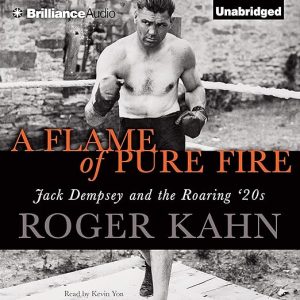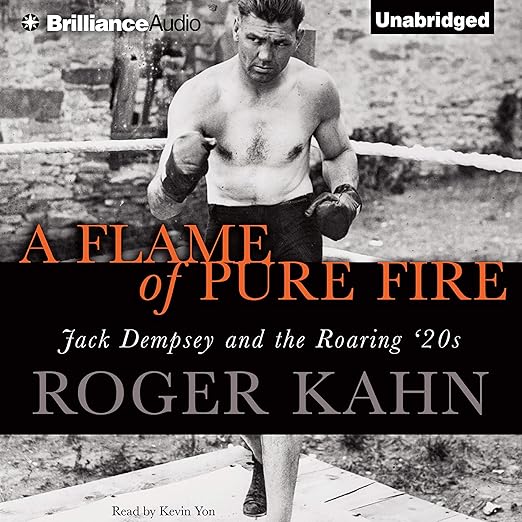
Seventeen hours and six minutes is a lot of time to spend on one fighter, and Roger Kahn does not spend it on one fighter. The audiobook is sold as the story of Jack Dempsey, heavyweight champion of the world through most of the Roaring Twenties, and Dempsey is certainly in it, but the description gives the real design away in its closing sentence: Kahn is after how a tumultuous decade shaped the man, and how the champ marked American history back. That is cultural history wearing a sports jacket. Anyone buying this for round-by-round accounting will spend much of the runtime somewhere other than ringside.
First, the Big Picture
Dempsey works in this book the way a good social historian uses any famous body, as the place where a decade becomes visible. The June 2014 five-star lists who else turns up along the way: Warren Harding, Calvin Coolidge, Charles Lindbergh, Babe Ruth, and a supporting cast of other boxers. That is not name-dropping. Kahn is mapping the machinery that made a prizefighter into a national figure at the precise moment America was inventing mass celebrity, and he needs the presidents and the aviator and the ballplayer in frame to show what Dempsey was competing against for attention. The same response notes the cost of that method, which is that a listener who came only for the boxer waits a while between fights.
Kahn's affection for his subject shows on nearly every page and does not read as flattery. The publisher's copy calls Dempsey a fighter perfectly suited to his time, with fierce good looks and a matchless dedication to the kill, and that formulation is doing real work rather than selling tickets. The argument running underneath the whole book is that the man and the decade fit each other so exactly that neither can be explained without the other. A brutal, glamorous, unregulated era wanted a brutal, glamorous, unregulated champion and got one. Kahn admires him and keeps the seams visible anyway, which is the harder thing to pull off across seventeen hours.
What Makes A Flame of Pure Fire Worth Hearing
Prose is the reason to take this in audio rather than in print, and also the reason to sample first. Kahn writes in a literary register built on rhythm, and long sentences with that much internal architecture either sing when read aloud or collapse into recitation. Kevin Yon inherits seventeen hours of them, plus the specific problem of the fight sequences, which have to accelerate without turning into commentary. Listen to a fight passage before you commit rather than to the opening chapter. The opening is exposition and almost any competent reader survives it; the fights are where a narrator's choices about pace become audible, and where this recording will either convince you or not.
Kahn's set pieces are the payoff for the patience the rest of the book asks. The March 2018 five-star, filed by somebody who has bought the book twice after lending the first copy away, names two of them outright: the Long Count, and the moment Dempsey went through the ropes. Both are episodes that any sports fan half knows and almost nobody knows properly, and both are exactly the sort of material that rewards a writer willing to spend three hours on the buildup. The reputation of those chapters is the single most reliable signal on the whole listing about what the book does well.
A Few Reservations
Two responses give the format problem away without meaning to. The December 2013 four-star wanted deeper fight information and fewer pages on people who never stepped into a ring, and closes by wishing for photographs, which no recording can supply and which the description never promises. Another response mentions ordering the title as an ebook. So the written column is grading a text and an object, not this file. One hundred and eighty-eight people have logged a rating here, five have written something, and not one of those five spends a word on the reading. On a seventeen-hour performance that silence is a real gap in what the page can tell you.
The description is the other thing to notice, because it runs to under five hundred characters for a seventeen-hour book. Two short paragraphs, a nickname, a decade, and a promise about American history. Anyone deciding whether to commit two working days of listening gets almost nothing from the publisher about structure, about how much of the runtime is boxing, or about where the book starts and stops in Dempsey's life. That thinness, on a title released in 2009 with a solid grade average behind it, is the sort of thing a buyer should price in before clicking rather than discover in hour three.
Should You Listen to A Flame of Pure Fire?
Anyone drawn to the 1920s as a period, with boxing as the way in, will get more from this than a boxing specialist will. The same goes for readers of literary sports journalism, the tradition where the game is the occasion rather than the subject, and for anyone curious about how American celebrity was assembled before television existed to assemble it. Seventeen hours is a real commitment, but the book is built in movements rather than in a single accelerating line, so it takes interruption well and rewards a slow schedule.
Nobody should come here for technical analysis of Dempsey's fighting. The record is clear enough about that through its own reception, and Kahn's interests lie in promotion, money, myth and the crowd rather than in footwork. Anyone wanting a career summary with statistics and a chronological ledger will find this exasperating by the second hour. The right listener is the one who hears that a prizefighter's story is being used to explain a country and thinks that sounds like a good trade.
Frequently Asked Questions
How much of the audiobook is actually about boxing?
Less than the category suggests. The description commits Kahn to showing how the 1920s shaped Dempsey and how Dempsey marked American history, which is a two-way argument requiring long stretches on politics, money, promotion and celebrity. The fights are set pieces inside that frame rather than the frame itself.
Does the audiobook include the photographs that print editions of boxing books usually carry?
No, and nothing on this record mentions a companion download of any kind. That matters more here than in most nonfiction, because fight books lean on images of the men and the crowds. Anyone who wants to see the faces will need a print copy or an image search alongside the listening.
Is any prior knowledge of Jack Dempsey needed before starting?
None. The copy presents him as world heavyweight champion across the Roaring Twenties and nicknames him the Manassa Mauler, and Kahn builds the rest from the ground up. Familiarity with the decade helps more than familiarity with boxing does, and even that is optional.