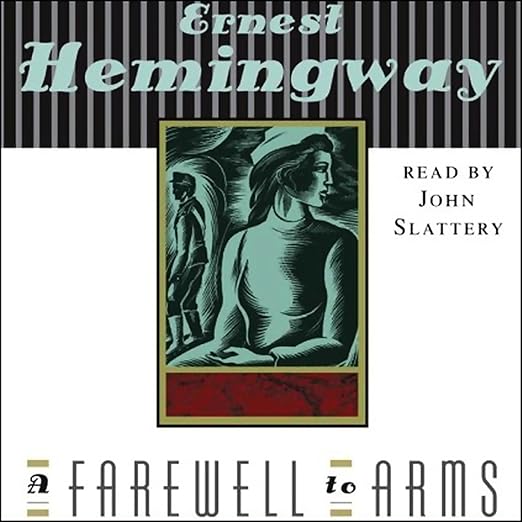
What does a one-star review measure when the person who wrote it calls the story one of Hemingway's best? On this audiobook page it measures a hardcover. The lowest vote here belongs to a reader in the Netherlands who bought the Macmillan Collector's Library edition, found it was fifteen by ten centimeters, smaller than almost any paperback, with type close to unreadable, and said so at length. The complaint is entirely fair. It also bears not at all on the eight hours and thirty-two minutes John Slattery spends reading the novel for Simon and Schuster Audio.
Hemingway wrote this one at thirty, and the description is right to call it the best American book to emerge from the first war. An American driving ambulances on the Italian front, an English nurse, and a retreat from Caporetto that turns from military maneuver into something closer to a flood. Love and war are not two subjects here; the same stripped, level sentences carry both, which is why the book still hurts. One respondent describes that language as sparse, economical and impactful, with every word chosen so that nothing gets wasted.
Where the responses get interesting is on the question the novel refuses to answer. One reader, returning to it after more than sixty years, writes that the reason anybody would volunteer to join the Italian Army to supervise ambulance drivers, or cross into Spain to fight a war that was not theirs, has never made sense. The same paragraph then answers its own objection: that was Hemingway, and his position was that the evils of war are everybody's business. That exchange, conducted inside a single review, introduces the book better than the jacket copy does.
Another response works the comparison most first-time readers stumble into. Fiction set in the second war, it argues, almost always runs on good against evil: the heroism of the Allies, the Nazis, the Holocaust standing behind every decision as justification. A soldier in that war never had to ask what the objective was. Hemingway's driver has nothing of the kind, and the moral weather of the whole novel comes out of that absence. Loyalty and desertion, as the description puts it, are a genuine struggle here precisely because neither one is obviously right.
Highlights
John Slattery reads the entire eight hours and thirty-two minutes, one voice for the American driver, the English nurse, and the priests, doctors and officers surrounding them. Hemingway's dialogue is famously bare, long exchanges of short lines with almost no attribution attached, and that is a specific technical problem for a solo reader: keep the speakers apart or the listener loses track of who is talking. At eight and a half hours it runs short given the book's standing, which suits a novel whose entire method is subtraction.
Subtraction is exactly why it works read aloud. Hemingway writes to be heard: repetition, rhythm, the rain that keeps returning, dialogue that carries its meaning in whatever nobody says. On the page an eye can skim past the plainness and miss it entirely. In a recording the pauses are physical, and the moments where a character changes the subject instead of answering a question land the way they were built to land. The ending, which does almost nothing on paper, is close to unbearable spoken at ordinary speed.
Five responses arrive here from four countries, the United States, Canada, Mexico and the Netherlands, spread across eighteen years between December 2006 and October 2024. One of them runs five words and simply calls this one of Hemingway's finest books. That reach says more about the novel's standing than a 4.3 ever could, and it deserves to be set beside the fact that the lowest of those five votes is a complaint about the physical size of an object.
What to Watch For in A Farewell to Arms
Two of the five responses name the format they were using, and neither is this one. The highest-rated entry states that it read the novel in its Kindle edition. The lowest describes a hardcover from the Macmillan Collector's Library, six inches by four, with letters too small to read comfortably, looking more like a pocket bible than a novel. A third signs itself as a Kindle customer. On a page selling an eight and a half hour recording, the visible verdicts belong to a screen and a very small hardback.
Mechanical damage runs through the description as well. Somewhere in the pipeline the dashes became hyphens, welding together words that were never meant to touch: the horrors of the battlefield-weary, demoralized men marching in the rain, and then desertion-this gripping semi-autobiographical work. Read literally, the sentence announces a battlefield that is weary. What the copy originally said was surely that the battlefield is where the weary men are. A small thing, and exactly the kind of small thing that tells you nobody read this page back.
On content, expect the war to occupy more running time than the romance, and expect Caporetto to be the part that stays. The reader who first opened this novel more than sixty years ago reports that the only scene still intact in memory was the night flight up the lake into Switzerland, which tells you where the book puts its weight. Hemingway does not stage battle for excitement; the horror is procedural, men and mud and orders that stop making sense. The love story is tender and also of its period, and the ending is softened for nobody.
Is This One for You?
Anybody who wants a war novel that declines to explain the war is the target audience, along with listeners who have been told Hemingway is dry and want to test the claim in the ear, where the rhythm becomes impossible to miss. At eight and a half hours this is also a manageable route back into a classic that was assigned at school and never finished. And readers who live on the second world war shelf will find one response here explaining why the first war produced such different fiction, better than most essays manage it.
Choose another edition if a physical book is what you actually want, because the loudest disappointment on this page concerns paper, type size and dimensions, none of which touches a recording. A second reason to look elsewhere: if the period attitudes toward women in a love story of this vintage will stop you, the novel makes no accommodation and offers no apology. Everybody else gets eight and a half hours of the book that built Hemingway's reputation, in the form his sentences were made for. Judge the recording by the recording, not by a hardback that will not fit a coat pocket.