Key Details
- Read by: Wanda McCaddon brings her characteristic precision to Tuchman's dense prose, making nearly thirty hours of medieval history consistently listenable.
- At its heart: The chaos of plague and war, the gap between chivalric ideals and brutal reality, how catastrophe reshapes civilization
- Vibe: Expansive and grave, intellectually demanding but never dry
- Short version: One of the great works of popular history in audio form, demanding but enormously rewarding for listeners prepared to commit.
I started A Distant Mirror on a long train journey and finished it three weeks later, fitting chapters around morning commutes and weekend walks. Twenty-eight hours and thirty-eight minutes is not a casual undertaking, and Barbara W. Tuchman's account of the fourteenth century demands more than passive attention. But I kept returning to it, which is the truest measure of a long audiobook's success. There is something about Tuchman's way of moving through history, her ability to hold the large and the intimate in the same sentence, that becomes genuinely addictive once you have settled into the rhythm of it.
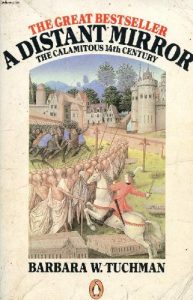
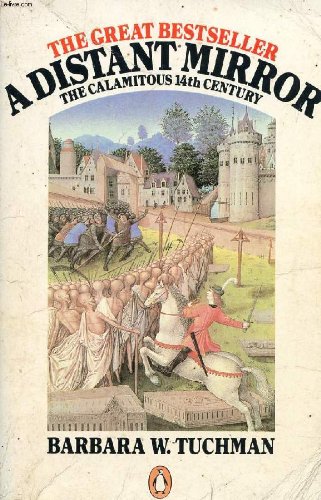
A Distant Mirror was first published in 1978 and remains one of the best-argued cases for why popular history, written with genuine literary ambition, can do things that academic history cannot. Tuchman takes Enguerrand de Coucy VII, a French nobleman of unusual range and accomplishment, as her guide through a century defined by the Black Death, the Hundred Years' War, the collapse of feudal certainty, and the slow unraveling of the medieval world's organizing assumptions about God, society, and the nature of suffering.
First, the Big Picture
What Tuchman understood, and what makes A Distant Mirror feel continuously relevant regardless of when you read it, is that the fourteenth century offers something more useful than historical spectacle. It offers a mirror, as the title insists: a period of catastrophic disruption that illuminates the mechanisms by which civilization absorbs and responds to shock. The plague that killed between a third and a half of Europe's population, the religious authority that could not explain it, the chivalric code that offered idealism while armies burned villages, the peasant revolts that followed from accumulated desperation: all of it reads with an uncomfortable familiarity.
Tuchman's method is to anatomize this century through the life of a single figure while simultaneously ranging across the whole of French and English society. That double movement between biography and panorama is technically demanding to sustain over eight hundred pages of prose, and she sustains it with remarkable control. The biographical thread gives you an emotional anchor; the panoramic passages give that anchor historical context and weight. Neither would work as well without the other, and the balance between them is part of what distinguishes this book from conventional medieval history.
The Best Parts of A Distant Mirror
Wanda McCaddon is one of the most accomplished narrators working in serious nonfiction, and her performance here is exemplary. The challenge of narrating Tuchman's prose is that it operates simultaneously at multiple registers: analytical, descriptive, occasionally ironic, and always literary in the sense that the writing itself carries meaning beyond its informational content. McCaddon reads with intelligence rather than mere competence. She understands when a sentence is performing an argument and when it is conjuring an image, and she differentiates accordingly.
At twenty-eight hours, the question of narrator stamina is real. McCaddon does not flag. Her consistency across the full runtime is remarkable, maintaining the attention and care of the opening chapters through the book's densest passages about the complexities of medieval Church politics and the grinding logistics of fourteenth-century military campaigns. For listeners who find long narrative history in audio a test of patience, McCaddon's performance is genuinely one of the things that makes the commitment worthwhile. She is the right guide for this particular journey.
A Few Reservations
The blurb notes that Tuchman reveals both the great rhythms of history and the grain and texture of domestic life, and that second quality is what I found most unexpected and most valuable on first encounter. The fourteenth century, as Tuchman renders it, is not only a place of spectacular catastrophe. It is a world of specific smells, specific anxieties, specific pleasures, and specific social rituals, all of which she recovers from primary sources with the patience of a detective.
Those domestic details do what the grandest historical arguments sometimes cannot: they make the dead feel genuinely present. When Tuchman describes what it meant to eat during a siege, or how a nobleman's household managed the logistics of travel, or what a medieval wedding actually involved, the century comes alive not as backdrop but as lived experience. That quality is preserved in the audio version; McCaddon reads those passages with an attentiveness that suggests she understands their importance to the whole. The intimacy of the domestic detail is what allows the historical scale to feel human rather than merely enormous.
The Right Listener for A Distant Mirror
This audiobook asks a great deal of its listeners and gives back more than it asks. Readers who approach it as a vacation listen or background audio will find it impenetrable; it requires and rewards focused attention. Those who give it that attention will find one of the most sustained and intelligent works of historical writing available in audio form, narrated by someone fully equal to the material.
Listeners new to Tuchman would do well to start here; this is her most ambitious and most fully realized book. Those already familiar with her work will find the audio version a genuine re-encounter with a text that has more to say than a single reading can exhaust. The twenty-eight hour runtime is not a barrier but a measure of how much Tuchman put into this book. Every hour earns its place, and the cumulative effect of the full experience is something that shorter histories simply cannot deliver.