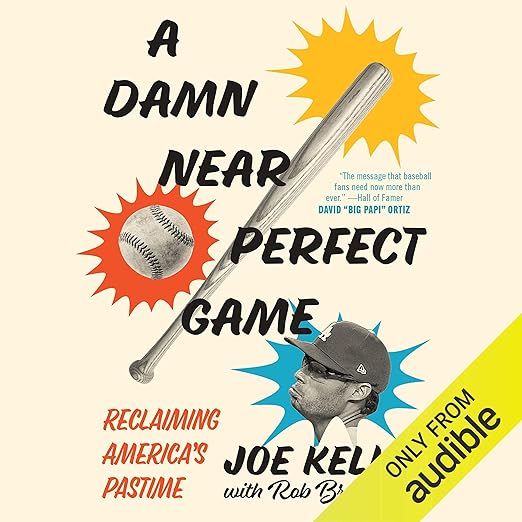
Baseball spent the last few years growing a pitch clock, shrinking the defensive shift and arguing about the designated hitter, and somewhere in the middle of it a relief pitcher decided to say out loud what gets said privately in every clubhouse in the league. That is the premise of this six-hour-and-fifty-one-minute audiobook, and Joe Kelly is a good choice to deliver it: a two-time World Series champion, a fireballer with a long memory, and, by the description's own account, the most memeable player in the sport according to ESPN.
A Closer Look at A Damn Near Perfect Game
Kelly's angle is access without seniority. He is not a franchise icon dispensing wisdom, and August 2023's four-star puts the description more usefully than the marketing copy does, calling this a book about a major league journeyman relief pitcher who writes about his upbringing and shares intimate details of his life. That double register is what makes the book work. The complaints about the sport come from somebody who has been optioned, traded, hurt and doubted, not from a podium.
Rules take up the largest share of the argument, and Kelly is specific rather than nostalgic. Pitch clocks, restrictions on defensive shifts, the designated hitter, overused analytics, sign-stealing and stale outreach to new fans all get their turn, and the recurring theme is that the sport keeps sanding down the human parts. He wants players allowed to fight, to flip bats, and to talk, which is not a subtle position but is at least a coherent one. He also aired it directly to commissioner Rob Manfred, and the account of that meeting is one of the book's better set pieces.
Bouton's Ball Four is the comparison the description reaches for, and it is a large claim to make about a book of opinions. Kelly does not have Bouton's diary structure or his season-long arc, so the resemblance is really about tone: a working player describing the industry from inside it without the usual protective vagueness. Judged on tone the comparison holds. Judged on construction it flatters the book considerably.
What Makes A Damn Near Perfect Game Worth Hearing
Stories are the reason to pick this up rather than the reform agenda. The bench-clearing brawl with Tyler Austin of the Yankees, the pouty face aimed at the sign-stealing Houston Astros, and the mariachi jacket worn to the White House with the champion Dodgers are all here in the author's own telling, and the versions you have seen in highlight clips turn out to be the compressed ones. A tour that runs from the bullpen through the front office to the commissioner's office is a genuinely unusual route through the sport.
Emotion is the part nobody expects from a book marketed on brawls. April 2023's five-star admired the authenticity, laughed out loud repeatedly, and then reports crying at a letter Kelly wrote to his children, calling the whole thing brave, honest and touching. That reader also mentions thinking a little harder before shouting at the television. Both reactions come from the same book, which is a better recommendation than either would be alone.
Casting is the decision to weigh here. This is a first-person memoir by a player whose entire public identity is a voice, a face and a reputation for saying the unsayable, and it is read by L.J. Ganser rather than by Kelly. That is a real fork. A hired reader delivers a cleaner, more controlled performance and interprets the persona from outside it; the author would have delivered the persona itself, with all the timing and profanity that implies. Neither choice is wrong, and buyers who came for the voice they know from clips should understand which one they are getting.
Things to Know Before Starting A Damn Near Perfect Game
Ramblings is the word the page's dissent uses, and January 2024's two-star deserves a hearing because it is the most analytical response on the listing. It concedes Kelly is likeable and funny, then argues the book is simply a collection of thoughts, opinions and ideas: some sensible, such as marketing players better, making games more accessible and letting players show emotion, and some not. Sometimes Kelly sounds like a hippie wanting to change everything, that reader writes, and at other times like an old fart. Structure, not sincerity, is the complaint.
Rob is a name worth chasing. June 2023's five-star praises Joe and Rob for absolutely killing it and delivering the message flawlessly, which reads as credit to two collaborators. The byline names only Joe Kelly, and the only other Rob anywhere on this record is the commissioner, who appears as the recipient of Kelly's complaints rather than as a co-writer. A reader who worked on the book may well be missing from the credits, and the record offers no way for a buyer to check.
Profanity is not incidental to this book, and the description itself asterisks a word while promising that players should be allowed to say it. An audio edition has no asterisks available; whatever is on the page is spoken. Anyone planning to play this in a car with children, or expecting the sanded-down version of a player known for exactly the opposite, should plan accordingly. The 4.1 average across two hundred ratings is the clearest signal that this book divides people.
Who Joe Kelly Is Writing For
Diehards who argue about the pitch clock, follow the labor politics, and remember the Astros scandal as a live grievance will enjoy this enormously. So will fans of the clubs Kelly played for, which the response column reflects, including August 2025's five-star, which needed only two words of approval. Anyone who has ever wanted to know what players actually say about the front office will get a straight answer.
Steer clear if you want a career retrospective, a statistical argument, or a book that builds toward a thesis, since this one arrives as a series of positions delivered at speed. Steer clear too if you need your sports memoirs polite, because the whole point of the exercise is that Kelly is not.
Seven hours is exactly right for a book like this. Long enough to hear the case for letting baseball be loud again, short enough that the repetition the page's dissent identifies never quite becomes a problem, and unpolished in a way that suits the argument being made.
Frequently Asked Questions
Does Joe Kelly narrate his own audiobook?
No. L.J. Ganser reads it. For a memoir whose selling point is a famous personality saying unfiltered things, that is worth knowing before you buy, since the delivery comes from a professional interpreting the persona rather than from the player who built it. The material itself is unchanged.
How much of this audiobook is complaint versus storytelling?
Close to an even split, with the anecdotes carrying the better half. The brawl with Tyler Austin, the pouty face at the Astros and the mariachi jacket at the White House sit alongside sustained arguments about pitch clocks, shifts, analytics and how the sport markets itself to new fans.
Is the language suitable for listening with children in the car?
Probably not. The description asterisks profanity while arguing that players should be free to use it, and audio has no way to soften what appears on the page. Expect clubhouse language throughout. Younger baseball fans are better served elsewhere unless you are comfortable with that register.