Quick Take
- Narration: Scott Brick delivers one of his characteristic authoritative performances. A strong fit for Kriegel’s novelistic biographical prose across a demanding 21-hour runtime.
- Themes: The making of the modern sports celebrity, the AFL-NFL merger era, addiction and the complexity of the American athlete
- Mood: Novelistic, richly detailed, and culturally sweeping
- Verdict: The definitive external account of Namath’s life and legend. More critical and more historically grounded than Namath’s own memoir.
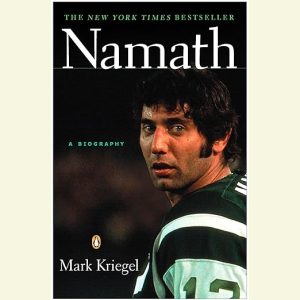
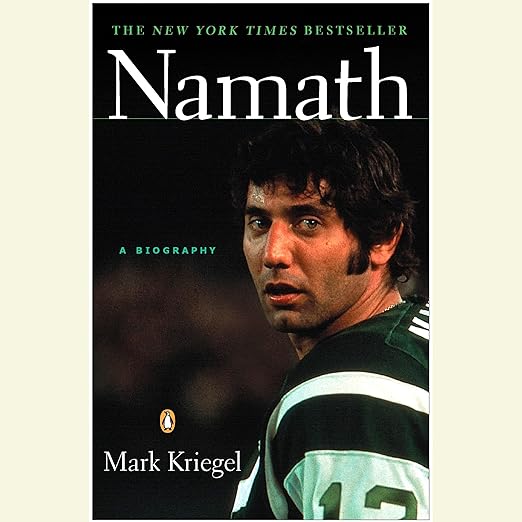
I finished this one over the course of a week of morning listening sessions, and by the end I understood something I had not fully understood before: why Joe Namath matters beyond the guarantee. Mark Kriegel, a novelist and former sports columnist, writes biography with a novelist’s attention to scene and character. The result is one of the better sports biographies in the audio format. At twenty-one hours and thirty-four minutes, narrated by Scott Brick for Penguin Audio, this is a substantial commitment, and it earns that commitment fully.
Kriegel’s central argument is that Namath was not simply a great quarterback who won a famous Super Bowl. He was the first of a new type: the athlete as cultural spectacle, the first sports hero to understand that celebrity was itself a career, that image and endorsement and tabloid presence were as real as touchdowns. Between Babe Ruth and Michael Jordan there was Joe Namath. That framing is not hyperbole. It is a genuine historical claim, and Kriegel makes it stick across five hundred pages of reported biography.
Our Take on Namath: A Biography
Scott Brick is among the most prolific professional narrators in the business, and he brings consistent quality to Kriegel’s densely written material. The twenty-one-hour runtime demands a narrator who can modulate energy across the full arc of a life, and Brick manages the shift from Namath’s steel-town origins in Beaver Falls, Pennsylvania, through the Alabama years under Bear Bryant, the Jets championship, the celebrity apex, the injury and addiction years, and the eventual sobriety. Kriegel’s novelistic prose means there are set pieces that require genuine performance rather than simply reading, and Brick handles them with the assurance of someone who has narrated at the highest professional level for many years.
Why Listen to Namath: A Biography
The AFL-NFL rivalry context is handled with particular depth. One reviewer described the book as filling in the historical dimensions of the period that individual game narratives cannot capture: the economics, the television deals, the institutional politics that made the 1969 Super Bowl more than a football game. Namath’s progressive views on racial integration, his relationship with media at a time when athletes were expected to be cooperative and deferential, his willingness to be openly commercial in ways that the establishment found vulgar: Kriegel situates all of this within the specific cultural moment of the 1960s and early 1970s rather than treating it as personal quirk. The guarantee itself, the most famous three words in Super Bowl history, is understood here as both athletic confidence and a carefully calibrated media event.
What to Watch For in Namath: A Biography
The book’s length reflects Kriegel’s thoroughness rather than padding, but listeners accustomed to tighter commercial biography may feel the weight of certain early chapters. The mill-town Pennsylvania sections and the Alabama years are rendered in novelistic detail that pays off later but requires patience up front. One reviewer noted a lack of photographs in the print edition, which matters less in audio but reflects the book’s priority on narrative over visual documentation. The biography is more critical of its subject than Namath’s own account, All the Way, which some listeners will prefer and others will resist. Kriegel is not hostile to Namath, but he is not bound by Namath’s self-presentation either, and the distance between those two relationships to the material produces a genuinely different book.
Who Should Listen to Namath: A Biography
Anyone who listened to All the Way and wants the perspective of a skilled biographer working from archival research and reported interviews will find this essential. NFL history enthusiasts interested in the AFL-NFL merger era will find more depth here than almost anywhere else in audio. Listeners drawn to the question of how sports celebrity was invented and institutionalized in American culture will find Kriegel’s framing genuinely illuminating beyond the football content. Those who want a quick, action-paced account of the guarantee and the Super Bowl victory should look for a shorter format. This is a long, careful biography that takes the full life seriously, which means it spends time in Beaver Falls and Tuscaloosa before it gets to New York, and it earns that patience with what it builds.
Frequently Asked Questions
How does Namath: A Biography differ from All the Way, Namath’s own memoir?
Kriegel writes from the outside as a biographer with access to people and sources that Namath’s own account does not include. The biography is more critical and historically grounded, while All the Way carries Namath’s own voice and self-understanding. Both are worth hearing as genuinely complementary rather than redundant accounts of the same life.
Is Scott Brick’s narration suitable for a 21-hour biographical audiobook?
Yes. Brick is one of the most experienced narrators in the format, and his ability to sustain consistent quality across long runtimes is well-established. Kriegel’s novelistic prose plays to Brick’s strengths, and the set-piece scenes in particular benefit from his performance quality.
Does the biography cover Namath’s post-football life, including his sobriety and later years?
Yes, though the biography was published in 2004 and therefore does not extend to the most recent period of Namath’s life. The arc through his alcoholism, marriage, and the beginning of his recovery is covered with the same depth as the football career.
How much of the audiobook focuses on the AFL-NFL rivalry and its historical context?
Substantially. Kriegel treats the AFL-NFL dynamic as central to understanding Namath’s significance. The guarantee mattered partly because it came at a moment when the AFL’s credibility against the established NFL was genuinely in question, and that institutional context runs throughout the book’s middle section.