Quick Take
- Narration: Virtual Voice AI narration delivers the content clearly but lacks the grit and weight this subject deserves, serviceable but emotionally flat.
- Themes: Boxing training methodology, mental toughness and discipline, sport as life philosophy
- Mood: Practical and motivating, with a coaching-manual energy
- Verdict: A solid three-part breakdown of boxing training, strategy, and mindset that works best for intermediate fighters looking to sharpen their mental approach, less so for readers wanting deep technical instruction.
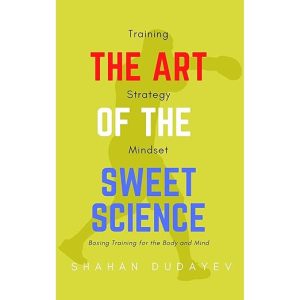
I came to this one on a rainy Tuesday afternoon when I was deep in a reading jag about combat sports memoirs and training philosophy. Shahan Dudayev’s The Art of the Sweet Science landed on my list not through any particular recommendation but through that familiar drift that happens when you follow curiosity down a rabbit hole. I expected something narrow and technical. What I got was something more deliberately structured than I anticipated, and more philosophical in its final third.
At under five hours, this audiobook has the compression of a coaching seminar. Dudayev wastes almost no time on preamble. The three-part structure he announces at the outset (training, strategy, mindset) is followed faithfully, and there is something refreshing about an author who lays out exactly what they are going to say and then says it.
Our Take on The Art of the Sweet Science
Dudayev writes from the inside. He is not a journalist explaining boxing from the press row but a practitioner who has logged hours in the gym and in front of opponents. That credential shows in the specificity of the training section, where he breaks down conditioning approaches, power punching mechanics, and speed drills with a matter-of-factness that suggests hard-won knowledge. One reviewer, a veteran of the sport, noted that the information leveled them up despite years in the game. That reaction rings true to me: the book is written for people who already know the basics and are chasing a tighter, more deliberate practice.
The strategy section is where some listeners may feel the limitations of the audio format most acutely. One reader noted wishing for diagrams to visualize the movement concepts discussed. That is a fair critique. When Dudayev walks through how to fight taller opponents, how to set up counterpunches, and how to neutralize pressure fighters, the content is sound, but the lack of a visual component means certain passages require more active mental reconstruction than they would on a whiteboard.
Why Listen to The Art of the Sweet Science
The mindset section is the book’s most universal offering and, in my view, its strongest. Dudayev’s treatment of ego as something to be managed rather than eliminated is nuanced for a book of this brevity. He does not dismiss confidence but asks readers to understand when ego serves the fighter and when it betrays them. The framing of boxing preparation as preparation for war is not original, but Dudayev uses it with enough self-awareness to avoid the genre’s worst macho posturing. One reviewer described it as a book that helped them clean up their routines both in the gym and in the ring called life. That is exactly the kind of crossover appeal the mindset section earns.
Reviews at 4.6 stars across more than 200 ratings suggest a readership that is largely satisfied with what the book delivers on its stated terms.
What to Watch For in The Art of the Sweet Science
The narration is handled by Virtual Voice, and that is the element most likely to test your patience if you are someone who responds to vocal performance. The content is intelligible and paced reasonably, but there is no texture to it. Boxing as a subject has a rhythm, a violence, a physicality that a well-cast human narrator could bring to the prose. That dimension is simply absent here. One reader with no prior interest in steroid use or powerlifting described finding the information useful for context, which suggests the book reaches some readers outside its core demographic, but most listeners will be coming with existing investment in the sport.
At 96 minutes, this is also notably shorter than many audiobooks in the combat sports space. That brevity means some topics are handled at a summary level that more experienced practitioners might find thin. One reviewer called the information basic for anyone already familiar with anabolics, though that note applies more to adjacent titles in this space than to Dudayev’s training focus specifically. Within boxing, the training and strategy sections have real density relative to their length.
Who Should Listen to The Art of the Sweet Science
This audiobook is built for the committed amateur boxer or martial artist who wants a structured mental framework to complement their physical training. It is also worth a listen for coaches working with developing fighters who want a compact resource to recommend. Casual fans curious about boxing as a subject will find the strategy and mindset sections approachable, but the training details will likely outpace their interest. If you are brand new to combat sports and want an entry point, there are more narrative-driven titles that will hold your attention more naturally. If you have already put time on the heavy bag and you are hitting a ceiling in your development, this three-section breakdown offers a disciplined way to diagnose where you are losing ground.
Frequently Asked Questions
Is this audiobook suitable for someone with no boxing background?
Dudayev frames the training section as accessible to beginners, but the book reads most naturally to intermediate practitioners who already understand basic terminology and want to sharpen their approach rather than learn from scratch.
Does the Virtual Voice narration affect the listening experience significantly?
It does. The AI narration is clear and paced reasonably, but boxing as a subject benefits from vocal energy and rhythm that Virtual Voice cannot provide. The content holds up, but the delivery is flat compared to a skilled human narrator.
How does this compare to other boxing training audiobooks in terms of depth?
At under five hours, it is more compact than most. The three-part structure (training, strategy, mindset) is tightly organized, but each section is necessarily high-level. Listeners wanting granular technical depth may want to supplement with longer titles in the genre.
Does the mindset section apply beyond boxing, or is it sport-specific?
Multiple readers noted the mindset content translating to other areas of their lives. The ego management framework and discipline philosophy are grounded in boxing but phrased broadly enough to carry over to other performance contexts.