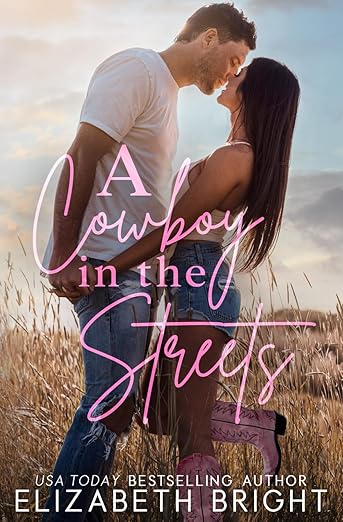
A cowboy who is a single dad and a female head trainer trying to prove herself in a world that does not always welcome her, Elizabeth Bright is working with familiar archetypes here, and she knows it. What lifts A Cowboy in the Streets above the familiar is the care she takes with the professional dimension of the relationship. This is not a romance where the workplace is a convenient backdrop for two people circling each other. The workplace is where the entire tension lives, and Bright takes that premise seriously enough to make it feel earned.
Our Take on A Cowboy in the Streets
The premise sets up a genuine power dynamic that Bright handles thoughtfully. The heroine is the head trainer at Lodestar Ranch, a position she has worked hard to earn in an industry that tends to treat women's expertise as provisional, something to be tested rather than assumed. Adam Hale is her boss, gruff and burdened, carrying a ranch and a child and the emotional residue of a broken heart. The attraction is immediate in that way slow burns always are, obvious to the reader long before either character will admit it, but Bright earns the slow build by making the professional stakes feel real. The heroine is not simply waiting for Adam to notice her. She is trying to do a job well, and that ambition is treated with respect rather than as a romantic obstacle to be cleared by the third act.
Why Listen to A Cowboy in the Streets
Oliver Clarke's narration does considerable work here. The title's play on context, not at the ranch, not her boss, gestures at the rodeo scene that functions as the novel's central turning point, and Clarke calibrates Adam's voice to walk the line between commanding and emotionally available. A gruff ranch owner voiced without nuance becomes a flat archetype. Clarke finds the tenderness underneath the bluster early enough that the emotional investment builds steadily. The single-father dimension is handled with particular care in both the writing and the narration, Adam's son is not a plot device but a source of genuine character complexity, and the heroine's growing connection to the child is one of the novel's quieter and more effective emotional beats. A romance that earns its ending through accumulating tenderness rather than manufactured misunderstanding is worth noting. The rodeo setting also works harder than it might in a less carefully observed Western romance. Bright understands that ranch culture is a world with its own hierarchies and codes, and the heroine's position within it, as a professional woman doing skilled work in an environment skeptical of her, is drawn with enough specificity that her need to prove herself feels rooted rather than generic. That specificity is what distinguishes A Cowboy in the Streets from the broader Western romance category.
What to Watch For in A Cowboy in the Streets
At 408 pages adapted to just over eight hours of audio, the pacing is deliberate. Readers who want their Western romances fast-moving and tension-forward may find Bright's approach more patient than they prefer. The synopsis's note that this is a Special Edition paperback is also worth flagging, the audiobook is based on that edition, so listeners coming from a prior version of the text may notice differences. There are no listener reviews to draw on for this release, which means the reception data is thin. The overall rating sits at 4.5 stars from a modest early sample, suggesting a positive initial response, but listeners should factor in the limited feedback when calibrating expectations.
Who Should Listen to A Cowboy in the Streets
Western romance listeners who appreciate workplace tension treated with genuine seriousness, readers who have enjoyed Bright's other work and want a focused, single-setting story, and anyone who finds the grumpy-boss-capable-heroine dynamic reliably satisfying when it is executed with real emotional stakes rather than perfunctory convention. Listeners who prefer faster-paced romance with less professional groundwork may find the early chapters slower than they would like, but the patience is rewarded.
- Voice: Oliver Clarke handles the gruff-hero-meets-capable-heroine dynamic with warmth and restraint, he avoids the trap of making Adam's roughness read as hostility.
- Big ideas: Competence in a male-dominated industry, single parenthood, slow-burn workplace tension
- Atmosphere: Warm and slow-burning, with genuine tenderness beneath the Western setting
- Worth it?: A well-constructed Western romance with a premise that promises emotional payoff and characters developed enough to deliver it.
Frequently Asked Questions
How does Oliver Clarke handle narrating a female first-person protagonist?
Clarke is cast as the sole narrator for a book told from a female perspective, which requires careful calibration. His reading conveys competence and emotional interiority without overperforming the femininity, which is the right call for a protagonist defined by professional credibility and self-sufficiency.
Does the rodeo scene the synopsis teases function as the book's major turning point?
It is framed that way in the synopsis, the moment where the power dynamic shifts and the heroine reminds Adam that outside the ranch, the professional rules change. Whether Bright uses it as a full pivot or as one escalation among several is something listeners will discover, but it is structurally positioned as the moment the relationship changes register.
How explicit is the romance content?
The synopsis and genre tags suggest a romance with genuine heat, consistent with the contemporary Western romance market. The grumpy-to-tender arc and the single-father subplot suggest the emotional investment is substantial alongside the physical, but listeners who want to calibrate content levels should note the lack of detailed reviews at this stage.