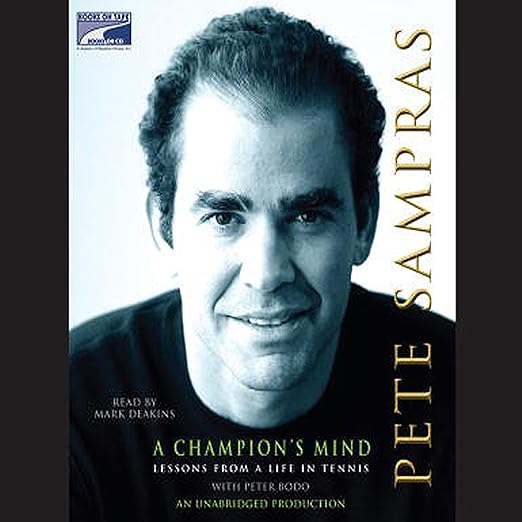
- Narration: Mark Deakins brings restrained gravitas to Sampras's famously private voice, a reasonable if unproven fit outside his usual nonfiction terrain.
- Themes: tennis greatness, private discipline made public, rivalry and grief
- Mood: Reflective and measured, occasionally intense
- Verdict: Worth the listen for tennis fans wanting Sampras's own account of the mental game behind his fourteen Grand Slam titles.
Two hundred eighty-six weeks. That's how long Pete Sampras held the world's number one tennis ranking, a record that still anchors his case as the greatest player of his era, and it's the kind of hard statistic that opens A Champion's Mind before Sampras turns to the far more private material this audiobook is actually built around. Narrated by Mark Deakins, this memoir marks the first time Sampras, famously reserved even at the height of his fame, talks at length about what he calls the Gift, the pressure of competing under constant media scrutiny, and the personal cost of a single-minded devotion to tennis that started before he was even a teenager.
H. Ruiz Calls the Memoir a Fifteenth Grand Slam
Reviewer sanjay s chandragiri identified exactly what makes this memoir work: Sampras was best known publicly for his calm demeanor on and off the court, and in his own telling, that composure was the actual product of a strong mental game, the real differentiator separating him from equally talented rivals. The reviewer points specifically to Sampras walking through his first Grand Slam victory, the 1990 US Open, won at nineteen years old, as one of the book's clearest windows into how that mental discipline actually operated under real pressure.
Reviewer H. Ruiz offered a memorable framing, calling the book itself a kind of fifteenth Grand Slam, and noted the almost paradoxical pattern where quiet, soft-spoken people often turn out to be the most compelling writers and storytellers once they finally open up. That paradox is the entire appeal of A Champion's Mind: a man who spent two decades letting his racket do the talking finally explaining, in his own words, what was happening underneath the composed exterior the public saw.
Sampras returns throughout the book to what he calls the Gift, his own term for a natural talent that arrived early and completely, and much of the memoir wrestles with the strange burden of having enormous ability paired with an equally enormous expectation to use it perfectly, every match, for two decades straight. Fourteen Grand Slam singles titles is a staggering number by any measure, and Sampras is candid about how little relief winning actually provided, since each victory simply reset the expectation for the next one rather than offering any lasting satisfaction.
The book moves in a roughly chronological structure, tracking Sampras from early promise through the specific tournament victories and losses that shaped his mental approach, rather than organizing itself thematically around abstract lessons pulled out of order. That choice keeps the memoir grounded in specific, verifiable tennis history rather than drifting into generic self-help territory, which is a real risk for any successful athlete's memoir once it starts generalizing lessons for a broader audience beyond the sport itself. Deakins tracks that chronology cleanly, giving each career phase a slightly different register without ever losing the throughline connecting teenage prodigy to seasoned champion, right through to a locker room he was ready to leave on his own terms.
Deakins Avoids Both Humility and Self-Mythologizing
The specific match-by-match detail is where this memoir earns its runtime. Sampras revisits a devastating early loss to Stefan Edberg that pushed him toward what he describes as a near-monastic commitment to his own potential, a grueling four-hour-plus battle against Alex Corretja during which he became seriously ill mid-match, and the complicated, genuine friendship underneath his fiercest rivalry, with Andre Agassi. The book closes with his final professional match, the 2002 US Open final, giving the memoir a natural emotional arc from teenage prodigy to a champion walking away entirely on his own terms.
Mark Deakins brings a measured, unshowy register to material that could easily tip into either false humility or triumphant self-mythologizing in less careful hands. His other narrative nonfiction work leans toward material requiring intellectual gravitas without over-theatricalizing, and that same restraint suits Sampras specifically well here, since Sampras's own public reputation for underplaying his emotions makes an overly dramatic narrator the wrong choice for this particular memoir.
The book's account of constant media scrutiny is one of its more surprising throughlines, given how thoroughly Sampras cultivated a reputation for blandness during his playing days specifically to avoid exactly that kind of attention from the press. He addresses head-on the criticism he faced for being, in the media's own framing, boring compared to more outwardly emotional rivals, and reframes that same restraint as the deliberate discipline that let him actually perform under pressure match after match, rather than a personality deficiency the coverage often suggested it was.
Real Grief Sits Beside Real Triumph Here
This is Sampras processing real grief alongside real triumph, including the death of a longtime coach and confidant, and the book doesn't treat that loss as a minor aside on the way to the next tournament victory. Listeners expecting a purely triumphant highlight reel of Grand Slam wins should know the memoir spends real time in harder emotional territory, illness, loss, the isolating pressure of being expected to win every single time he stepped onto the court.
H. Ruiz's review notes, fairly, that Sampras likely had real editorial help shaping this material into a cohesive memoir, which is true of the overwhelming majority of athlete memoirs and not a mark against this one specifically. What matters more is whether Sampras's own voice, private and reserved for two decades of public life, comes through clearly in the final product, and per multiple reviews, it does, particularly in the sections dealing with specific rivals and specific matches rather than generalized reflections on fame.
Compared to memoirs by more outwardly expressive athletes, A Champion's Mind reads as notably restrained even in its moments of genuine emotional disclosure, which is either a feature or a limitation depending on what a listener wants from a sports memoir. Readers who found Andre Agassi's Open compelling specifically for its raw, sometimes uncomfortable candor should adjust expectations accordingly; Sampras processes similar territory, pressure, identity, grief, but through a noticeably more guarded lens consistent with the man reviewers describe throughout this book.
Granular Enough to Test Casual Tennis Fans
Tennis fans who watched Sampras's career unfold in real time, particularly through the 1990s rivalry with Agassi, are the most obvious audience, and they'll get the most specific value from the match-by-match recollections throughout. Sports memoir readers generally, especially anyone interested in the psychology of elite performance under sustained public pressure, will find plenty here beyond just tennis-specific content and statistics.
Casual sports fans with no particular attachment to tennis history may find the match-by-match detail more granular than they bargained for, though Sampras and Deakins both keep the emotional throughline clear enough that you don't need to remember every tournament bracket to follow why each match mattered to him personally.
Questions Listeners Ask
Does the A Champion's Mind audiobook require deep tennis knowledge to enjoy?
Some familiarity helps for the match-by-match sections, but Sampras and narrator Mark Deakins keep the emotional and psychological throughline clear enough for general sports memoir fans to follow without deep tennis expertise.
Is the A Champion's Mind audiobook more about tennis technique or personal reflection?
It leans toward personal reflection, covering the mental discipline, grief, and pressure behind Sampras's on-court success rather than functioning as a technical breakdown of his playing style.