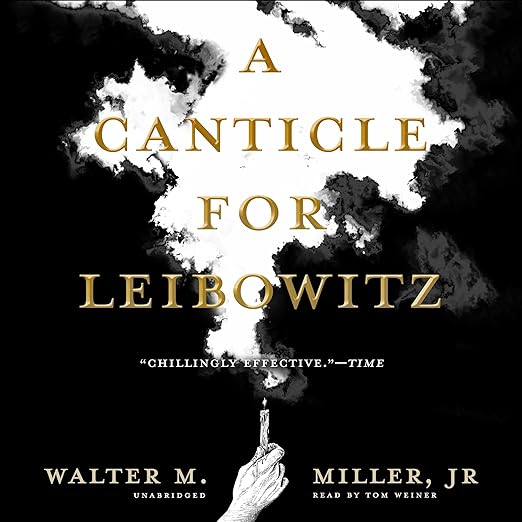
Key Details
- Performance: Tom Weiner handles the novel's three tonal registers, medieval solemnity, satirical comedy, and cold-war urgency, with calibrated authority.
- What it covers: Historical cyclicality, faith versus scientific progress, institutional memory
- Feel: Grave and darkly ironic
- Our call: Ten hours that cover 1800 years of human folly, this Hugo winner rewards patient listeners who want speculative fiction that asks the largest possible questions.
I first read A Canticle for Leibowitz in college, in a battered paperback that had clearly passed through several sets of hands before mine. What I remember most from that first encounter is the sensation of scale, the way Miller compresses 1800 years into three acts and makes each century feel both distant and uncomfortably familiar. When I came to the audiobook recently, I wasn't sure the listening experience would hold up against a novel I already knew well. Tom Weiner's narration proved me wrong within the first twenty minutes.
Published in 1959 and winner of the 1961 Hugo Award for Best Novel, A Canticle for Leibowitz is a post-apocalyptic novel in three sections. In the first, set roughly six centuries after a nuclear holocaust called the Flame Deluge, monks in the American desert carefully preserve the relics and writings of the Blessed Isaac Leibowitz, a weapons engineer who became a saint. In the second, civilization has partially recovered. In the third, it's doing what it always does.
What We Made of It
The novel's greatest formal achievement is its refusal to resolve the question it raises. Are humans damned to repeat the cycle? Miller doesn't say. The Church persists across all three acts as the only continuous institutional memory, and Miller, himself a convert to Catholicism after World War II, treats that persistence with genuine complexity. The monks are fallible, bureaucratic, sometimes absurd. The faith is real. Neither the institution nor the belief system gets a free pass.
Tom Weiner navigates the novel's three distinct tonal registers with care. The first act has the quality of a medieval hagiography, deliberate, even solemn, and Weiner honors that pacing without losing the dry comedy that runs underneath it. The third act, which returns to nuclear crisis, is the most urgent, and Weiner calibrates the shift accurately.
What Makes A Canticle for Leibowitz Worth Hearing
Audio is particularly well-suited to the Latin elements of this novel. Miller uses Latin headings, prayers, and ecclesiastical terminology throughout, and hearing them read aloud gives them a weight and rhythm that scanning them on a page doesn't always produce. Weiner handles the pronunciation with authority, and it contributes meaningfully to the novel's atmosphere of preserved knowledge in a world that has forgotten why it matters.
Multiple reviewers describe returning to this book across decades, one notes reading it since finding it at a flea market in 1980. That kind of endurance is unusual for science fiction from the 1950s, most of which has aged in ways that require historical patience. A Canticle for Leibowitz doesn't. The question it asks about whether humanity is capable of learning from its own catastrophes is, if anything, more pressing now than it was when Miller wrote it.
What Might Not Land
The three-act structure means you're essentially listening to three connected novellas, each set centuries apart with no shared characters except for one recurring mysterious figure whose identity is one of the novel's sustained ambiguities. Listeners who expect continuous narrative development across all three sections may find the structure jarring. It's more thematic than linear, each act demonstrating the same human pattern in a different historical context.
The novel's humor is easy to miss in summary and essential to the actual experience. The first act in particular is genuinely funny, the bureaucracy of canonization, the accidental relic, the monks' cheerful incomprehension of what they're preserving, and Weiner lets that comedy breathe without forcing it.
The Right Listener for A Canticle for Leibowitz
This audiobook rewards listeners who approach speculative fiction as literature, who want the genre to ask large questions and sit with ambiguous answers. It's an essential text for anyone interested in post-apocalyptic fiction's intellectual history, in science fiction's engagement with faith, or in the problem of institutional memory over long spans of time.
Less suited to listeners who want action-driven narrative or who find the first act's medieval monastery setting slow. The novel demands patience in its opening section before the larger architecture becomes clear. Those who give it that patience rarely regret it.
A Few Questions About A Canticle for Leibowitz
Do I need religious background to appreciate A Canticle for Leibowitz?
No, though some familiarity with Catholic practice and terminology adds texture. The novel treats the Church's institutional continuity as a structural device, not a devotional argument. Secular readers who engage with the material on its terms consistently find it as rewarding as readers with religious backgrounds.
Is A Canticle for Leibowitz suitable to listen to without having read it before?
Yes. The three-act structure is clear enough that first-time listeners can follow the design without print reference. The novel becomes richer on re-encounter, but it works completely as a first listen.
How does Tom Weiner handle the Latin passages throughout the novel?
Weiner delivers the Latin chapter headings, prayers, and ecclesiastical terms with confident pronunciation and appropriate weight. The Latin is never treated as an obstacle, it's part of the novel's atmosphere of preserved knowledge, and the narration honors that function.
Is this the same story as the 1983 sequel Saint Leibowitz and the Wild Horse Woman?
No. That sequel, completed by Terry Bisson after Miller's death, extends the story but is a separate work. A Canticle for Leibowitz is entirely self-contained across its three acts and was Miller's only novel.