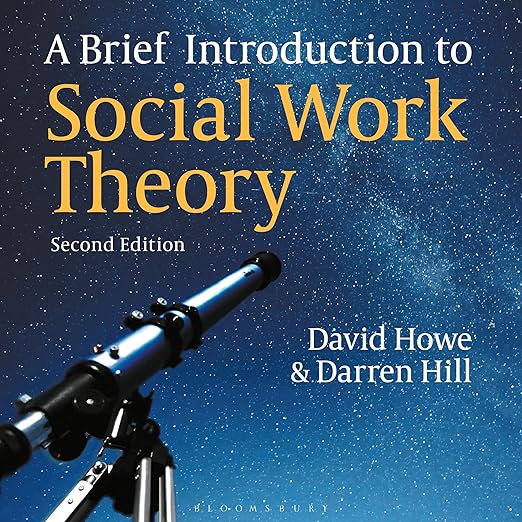
- Read by: David Thorpe delivers a clear, professionally measured performance suited to academic content: accessible without being condescending, which is exactly what this material requires.
- At its heart: Social work theory, reflective practice, historical development of welfare frameworks
- Vibe: Scholarly but grounded, structured and deliberately paced
- Short version: A solid audiobook companion for social work students and practitioners wanting a systematic overview of theoretical frameworks, though the format limits interaction with the case studies.
The premise of A Brief Introduction to Social Work Theory by David Howe and Darren Hill is deceptively simple: social workers make complex judgments about vulnerable people's lives, and understanding the theoretical frameworks behind those judgments makes for better practice. The audiobook version, narrated by David Thorpe and running 12 hours and 25 minutes, extends this argument into audio, and holds up reasonably well for a text that was originally designed with lectures and placement supervision in mind.
The challenge with translating academic social work theory into audiobook format is real. The case studies and reflective questions that Howe and Hill pack into each chapter work differently when you cannot pause to annotate or return quickly to a specific section. Thorpe's narration is clear and steady, but this is a listening experience that rewards pausing and replaying rather than treating as background audio. If you approach the audiobook as a structured study companion rather than a passive listen, it delivers on its promise.
Social Work Theories as Star Constellations
What separates this book from generic practice guides is its insistence on historical grounding. Howe and Hill do not simply catalog approaches: they trace how each major theoretical tradition in social work emerged from specific social and political conditions. The psychodynamic tradition arrives from one historical context, behavioral approaches from another, systems theory from another still. Understanding that these frameworks were responses to real problems at specific moments in history helps the practitioner understand why certain approaches persist even when newer evidence might question them, and why theoretical fashions shift over time.
This historical lens is the book's most useful contribution, and Thorpe narrates it with sufficient clarity that the through-line remains intact across 12 hours. The organizing metaphor the authors use, that social work theories are like star constellations offering patterns by which to navigate complexity, captures the partial, constructed nature of any single theoretical lens without suggesting that all frameworks are equally valid in all situations. Whether this metaphor clicks or feels forced often depends on how much prior professional experience you bring to the material. For practitioners with some years in the field, it tends to resonate quickly.
David Thorpe Narrates Twelve Hours for Practitioners
The case for the audiobook format here is strongest for practitioners rather than students. A qualified social worker with years of experience will recognize the theories being described and use Thorpe's narration as a way to refresh and restructure existing knowledge during commutes or downtime. For students preparing for placement or coursework, the audiobook works best as a supplement to the print edition rather than a replacement: the reflective questions and case studies call for active engagement that audio alone struggles to support.
That said, the book covers territory that genuinely matters. Howe and Hill move through behaviorism, cognitive approaches, task-centered practice, crisis intervention, person-centered work, and social systems perspectives with enough specificity to be genuinely informative. Listeners new to the field will gain a functional map of the theoretical landscape. Experienced practitioners will find formulations they recognize alongside some they have perhaps not named explicitly in their own practice. The 12-hour runtime accommodates all of this without feeling padded, though some chapters will be more immediately useful than others depending on the listener's current practice context. A mental health practitioner will engage differently with the cognitive and systemic chapters than a child protection worker will, and the audiobook's breadth means it rarely reaches the specificity that practitioners in either field will eventually need from specialist texts.
Thematic Organization That Leaves Connections Unstated
Two structural choices shape the listening experience significantly. First, the book is organized thematically by theoretical tradition rather than by client population or practice setting. This is the right call for a survey text, but it means the connections between theories and specific practice contexts require some work from the listener. When Howe and Hill discuss systemic approaches, they are describing a framework applicable across child protection, mental health, and family work, but the audiobook rarely draws those connections explicitly. Listeners will need to do that mapping themselves.
Second, the reflective questions at the end of each chapter are read aloud by Thorpe but obviously cannot be answered in the audio format. Treat these as prompts to pause and think rather than as content to absorb passively. The book's value in this respect is as a catalyst for reflection, not as a set of answers. Practitioners who listen with that frame in mind will extract considerably more from the 12 hours than those who treat it as a passive survey of facts.
Best Used Alongside the Print Edition
Social work students in early training who want an accessible audio overview of the theoretical landscape will find this a functional starting point, best used alongside rather than instead of the print text. Qualified practitioners looking to refresh their theoretical grounding, particularly those interested in why their field's frameworks developed as they did, will find it more satisfying as a standalone audio experience. Those expecting clinical specificity or detailed case-management guidance will need to look elsewhere: this is a map, not a manual. Listeners with no prior connection to social work or allied professions may find the extended treatment of theory-in-practice less immediately useful, though the historical framing remains genuinely interesting as an account of how ideas about welfare and human need have shifted across the twentieth century.
Does the audiobook include the reflective questions and case studies from the print edition?
Yes, David Thorpe reads the reflective questions and case study prompts aloud. The limitation is that the audio format does not allow you to write responses or easily revisit specific sections the way a print reader can, so the audiobook works best as a study supplement rather than a standalone resource for active learning exercises.
Is the A Brief Introduction to Social Work Theory audiobook suitable for someone new to the field?
It can work as an entry point, especially for listeners who learn well through listening rather than reading. Howe and Hill define their terms carefully and provide historical context for each theoretical tradition, which helps new listeners orient themselves. That said, the academic density of the content means many listeners will benefit from pairing the audiobook with a print copy.
At 12 hours, does the audiobook feel padded or appropriately paced?
The pacing reflects the textbook's comprehensive scope rather than filler. Howe and Hill cover a substantial range of theoretical traditions with meaningful depth, and Thorpe's narration moves through the material steadily without rushing. Listeners seeking a quick overview might find it dense, but those investing in genuine theoretical understanding will appreciate the thoroughness.
Does this audiobook cover recent developments in social work theory, such as anti-oppressive or trauma-informed frameworks?
The book addresses the social context of practice and engages with questions of power, inequality, and advocacy: elements relevant to anti-oppressive frameworks: but listeners should check the edition date for the most current coverage of trauma-informed practice, which has evolved significantly in recent years. The audiobook's historical framing means its core content remains valuable even as the field continues developing.