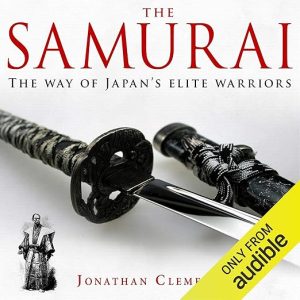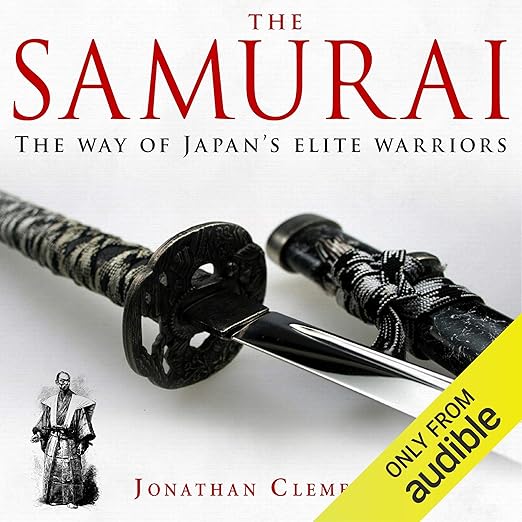
How does a warrior caste that dominated a nation's culture for five hundred years actually end, not in one dramatic final battle but in a slow demolition by trains, telegraphs, and modern conscript armies? That's the question Jonathan Clements is really answering across this twelve-hour audiobook, tracing the samurai from their emergence as a distinct warrior class in medieval Japan through the civil wars of the seventeenth and eighteenth centuries to their eventual dissolution as Japan modernized. Clements works as a genuine specialist in Japanese history, and the synopsis's billing of him as a leading expert holds up in the density and confidence of the material itself.
Jonathan Keeble narrates, and reviewer missQT9_mo's description of Clements avoiding the dry textbook prose that a five-century, single-subject history could easily fall into applies just as well to Keeble's delivery. This entry sits within Clements's larger Brief Histories series, single-subject historical surveys built for readers who want real scholarly depth without committing to an exhaustive, multi-volume academic treatment, and at twelve hours, brief is doing some relative work here; it's compact for the subject's five-century scope, not short in any absolute sense.
Treating Samurai Legend as Part of the Record
Reviewer ernesto's description of the book finding 'a remarkable balance between history and literary fiction' gets at something real about how Clements handles his sources: samurai history is inseparable from centuries of legend, dramatized accounts, and later romanticized retellings, and rather than pretending to strip all of that away for a purely factual account, Clements treats the mythology itself as part of the historical record worth examining, why certain stories got told and retold, what they reveal about how each era wanted to remember the samurai.
The book's structure follows the caste's actual arc rather than imposing an artificial one, moving chronologically through five hundred years of cultural and political dominance, into the brutal internal wars that nearly tore the country apart, and finally into dissolution as Japan's headlong rush into industrialization and a mechanized military made the traditional warrior class obsolete almost overnight. That final section, the actual end of the samurai as a functioning caste rather than a symbol, is where Clements does some of his sharpest, least mythologized work.
Clements also doesn't shy from the caste's less flattering realities, internal betrayals, brutal succession politics, the way samurai identity got weaponized during the very civil wars that nearly destroyed the class from within. That willingness to sit with contradiction, a warrior code built around loyalty producing some of Japanese history's most notorious betrayals, keeps the book from reading as hagiography even while clearly respecting its subject's genuine cultural significance, and it gives the middle third of the audiobook real narrative tension rather than a simple march toward modernization.
Keeble's Gravitas Threads Romance and Academic Distance
Keeble brings a specific kind of gravitas to serious historical material, the same quality that's made him a strong fit for large-scale, high-stakes fictional epics elsewhere in his narration career, and that weight suits a subject this culturally loaded well. Samurai history invites either breathless romanticization or dry academic distance, and Keeble's measured, authoritative delivery threads between both, treating the material with the seriousness it deserves without either mythologizing or flattening it.
Reviewer missQT9_mo notes Clements packs this into what reads as roughly three hundred print pages, which is genuinely compact for a subject spanning five centuries, and that density translates into a listening experience that moves briskly from era to era without much padding. For anyone who wants real historical substance on the samurai without committing to a multi-volume academic series, the combination of Clements's expertise and this format's relative efficiency is a real practical advantage.
The book's twelve-hour runtime also gives Clements room to trace how the samurai's image itself changed across different eras of retelling, not just what samurai actually did but how later generations, including modern Japan and the wider world, chose to remember and mythologize them. That's a more sophisticated project than a straightforward chronological survey, and the extra length pays for that added layer of analysis rather than padding out the same material.
The Brief Histories series format itself has real appeal for listeners who want to sample serious history across multiple subjects without a huge time investment in any single one; twelve hours is substantial on its own, but relative to a full academic monograph on the same subject, it's an efficient way to get real depth on the samurai specifically before deciding whether to go deeper with more specialized texts.
Puerto Rico Babe39's Grandson Calls It Luke Skywalker
Want battle-by-battle tactical detail on every skirmish of the samurai wars? That's not really what this delivers. Clements is working at more of a cultural-throughline altitude, tracking how the samurai's role and self-image shifted across five centuries, rather than producing a blow-by-blow military chronology of specific campaigns. Listeners craving granular tactical or campaign-level military history specifically may want to pair this with a more narrowly focused text on a particular war or era.
The synopsis itself runs notably thin for a book this substantial, just a few sentences compared to the twelve-hour runtime behind them, so anyone judging the audiobook purely on the marketing copy is working with less information than the actual content warrants. The reviews, thin as they are in number, consistently point toward a richer, more literary treatment than the bare-bones synopsis description suggests on its own.
Puerto Rico Babe39's brief review, noting a grandson's enjoyment under the title Luke Skywalker, is a reminder that this material has genuine crossover appeal to readers drawn in by pop-culture samurai and warrior-monk archetypes, even though Clements's actual approach is scholarly rather than pop-adventure in register. Anyone coming to this expecting something closer to genre fiction pacing should recalibrate; the pleasures here are those of serious history, not adventure narrative.
None of this diminishes the book's value for a general history audience, but it's worth setting expectations accurately: this is cultural and institutional history at scale, not a tactical war chronicle told campaign by campaign.
Purists Should Know Clements Weaves in Legend
History listeners interested in Japan specifically, or in warrior-caste and military-culture history more broadly, comparable to how a reader of Roman military history might approach the legions, will find real depth here from a genuine specialist in the field. It's also a strong pick for anyone who has enjoyed other entries in Clements's Brief Histories series and wants the same approach applied to one of the most culturally mythologized subjects in Japanese history. Listeners who appreciated the balance ernesto described between rigorous history and the unavoidable presence of legend within samurai storytelling will find that same balance sustained consistently across the full twelve hours, not just in an introductory chapter before settling into drier, more conventional academic territory.
Purists wanting a strictly archival, legend-free military chronicle should know upfront that Clements weaves centuries of dramatized retelling directly into his account rather than filtering it out, a choice that serves cultural history better than narrow fact-checking. That's a deliberate authorial choice worth knowing before pressing play, not a surprise to discover three hours in.
In Brief
- Narration: Jonathan Keeble brings genuine gravitas to five centuries of material without tipping into dry academic distance.
- Themes: The samurai warrior caste, feudal Japan's civil wars, modernization ending a five-century tradition
- Mood: Sweeping, authoritative, immersive
- Verdict: Recommended for serious history listeners after cultural throughline, not a battle-by-battle military chronicle.
Good to Know
Does this audiobook focus on battles and military tactics?
Not primarily. Clements works at more of a cultural and political altitude, tracking how the samurai's role and identity shifted across five centuries rather than detailing individual campaigns.
Is Jonathan Keeble's narration suited to serious history audiobooks?
Yes. His measured, authoritative delivery brings genuine gravitas to the material without either romanticizing or flattening a culturally loaded subject.
How long is A Brief History of the Samurai audiobook, and is that too long?
It runs twelve hours and one minute, compact for a subject spanning five centuries, though still a genuine time commitment rather than a quick primer.
Is this audiobook part of a larger series?
Yes. It's an entry in Jonathan Clements's Brief Histories series of single-subject historical surveys.