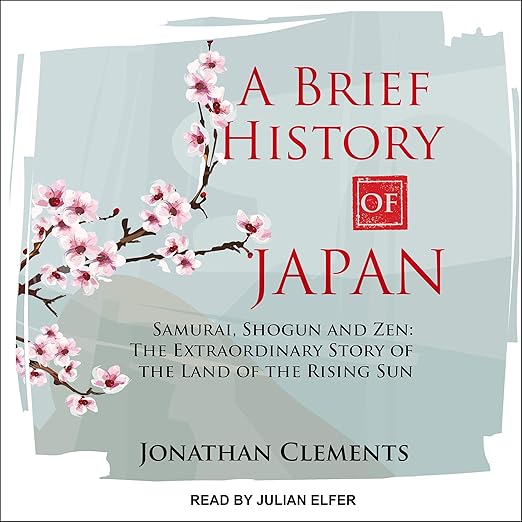
Before You Press Play
- Performance: Julian Elfer brings an easy, measured authority to Clements's prose, well-suited to a history that moves fast and covers vast stretches of time without becoming breathless.
- What it covers: National identity and isolation, cultural paradox, Japan's relationship with the outside world
- Feel: Intelligent and accessible, with occasional flashes of wit that keep the survey format from feeling dry
- Our call: A well-structured introduction to Japanese history that works beautifully as a framework for further reading, most valuable for travelers, newcomers to the subject, and those who want context rather than depth.
I started A Brief History of Japan on the train home from a long day, somewhere around chapter two, and found myself still listening when I got off at my stop and walking slower than necessary so the chapter could finish. That is not a dramatic claim, it simply reflects what a well-executed survey history can do when the writing is sharp and the narrator is comfortable. Jonathan Clements is a Japan specialist whose previous work includes biographies of key historical figures and translations of medieval texts, and that depth shows in the confidence with which he moves through twenty-six centuries of history in under nine hours.
The book opens with a disclosure that I found quietly important: much of Japan's early written history was destroyed in the eighth century CE and replaced by two mythological chronicles. Clements is upfront about what this means for the reliability of early period narratives, and he approaches the reconstruction of pre-eighth century history with appropriate epistemic modesty. That kind of intellectual honesty in a popular history survey is rarer than it should be, and it set the tone for what followed, a book that wears its learning lightly but does not pretend to more certainty than the evidence supports.
Clements organizes his account around the recurring pattern of Japan as a place that defies simple categorization. He traces the country's earliest engagements with China and Korea, through which most of the cultural foundations of Japanese civilization arrived, through the feudal era, the extraordinary two centuries of self-imposed seclusion under the Tokugawa shogunate, the violent modernization of the Meiji period, the catastrophic ambitions of the early twentieth century, and the compressed reinvention of the postwar era. Each period gets enough space to breathe without the book collapsing under its own weight.
The paradoxes Clements identifies, a democracy with an emperor as head of state, a society known for safety built on seismic and volcanic instability, a technologically advanced nation whose geography is predominantly wilderness, are not rhetorical flourishes. They are structural features of the country's history, and Clements traces them back through specific decisions and circumstances rather than presenting them as simply mysterious. The section on the Kamikaze storms that repelled Mongol invasion attempts is particularly well handled, connecting the weather events to the development of the divine emperor mythology that would have consequences nearly seven centuries later.
Highlights
Reviewer Matthew Rapaport described this as "a concise summary of twenty-six centuries of history," and that description is accurate and, depending on your expectations, either exactly what you need or an indication to look elsewhere. Clements is not providing a granular account of any single period. He is providing, as reviewer Dr. Katherine Arenz put it, "a great framework to use to study further." The storytelling approach, which blends documentary pacing with selective narrative moments, prevents the book from reading like a textbook, but the breadth of coverage means that individual topics get limited space.
For travelers preparing to visit Japan, this is near-ideal preparation. For readers who already have a working knowledge of Japanese history and want depth on the Meiji Restoration or the dynamics of the postwar economic miracle, this will feel thin. The book knows what it is, and does it well. The question is whether what it is matches what you need.
What to Watch For in A Brief History of Japan
Julian Elfer is not a narrator whose name you will necessarily recognize immediately, but he is consistently solid across the eight-plus hours of this audiobook. His delivery has the quality of measured confidence, he handles the Japanese names and terminology without either stumbling or calling attention to them, and his pacing through the denser political sections maintains engagement without rushing. For a topic where mispronounced names can become a significant distraction, his preparation is evident and appreciated.
Reviewer Vivian T noted buying this book for family members who had visited Japan and wanted to return, which suggests the book functions not only as preparation but as a way of deepening an already existing relationship with the country. That is a meaningful use for a survey history: not just as an introduction but as a retrospective frame that helps you understand what you actually saw.
Is This One for You?
Listen if you are traveling to Japan, have recently returned, or have a general interest in East Asian history and want an accessible point of entry. Listen if you enjoy popular history that moves quickly and sustains a conversational tone without sacrificing accuracy. Skip if you want detailed coverage of specific eras, the Edo period, the Meiji Restoration, or postwar reconstruction each merit dedicated books if that is your interest. Skip also if you want the kind of granular primary source engagement that academic history provides; this is written for a general audience and pitched accordingly.
Frequently Asked Questions
Does A Brief History of Japan cover the early mythological period or stick to documented history?
Clements addresses both, but with clear intellectual honesty about the distinction. He notes early in the book that most pre-eighth century records were destroyed or replaced by mythological chronicles, and he reconstructs the earlier period from fragments and external sources while being transparent about what is certain versus inferred.
Is this a good audiobook for someone about to visit Japan for the first time?
Yes, it is well-suited for that purpose. Multiple reviewers have used it exactly this way. At under nine hours, it provides a clear chronological framework and enough cultural context to make what you see more legible without requiring weeks of preparation.
How does Julian Elfer handle the Japanese terminology and names?
Elfer handles the Japanese names and terms with evident preparation and without making them a point of friction. Listeners sensitive to mispronounced foreign-language terms will likely find his approach satisfactory, though perfection in a language as phonologically distinct as Japanese is always relative.
Is this part of a series, and do other volumes on Asian countries exist?
Yes, A Brief History of Japan is part of the Brief History of Asia series from Tuttle Publishing. Jonathan Clements has written comparable volumes on other Asian countries and regions, so readers who find his approach effective may want to look at companion titles.