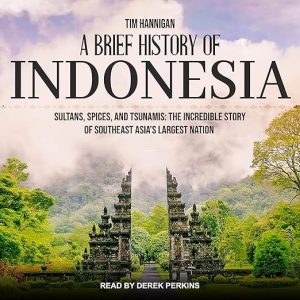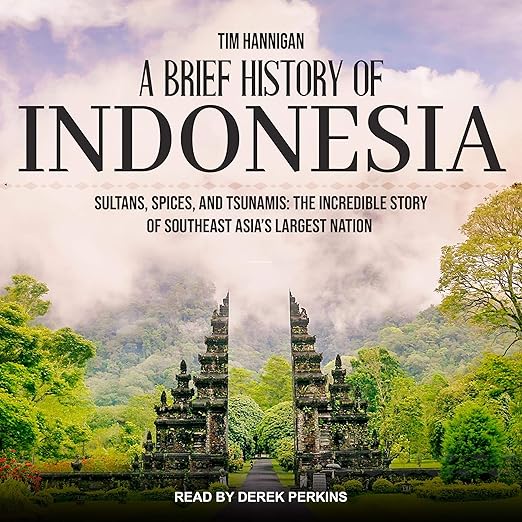
I finished A Brief History of Indonesia on the final leg of a long flight somewhere over Central Asia, and arrived at my destination with a substantially different understanding of the country I was about to visit than I'd had when I boarded. Tim Hannigan's book is exactly what it says it is: a brief history, which means it covers an enormous amount of ground at a pace that favors narrative momentum over exhaustive depth. For a country with over 17,000 islands, more than 300 ethnic groups, and a history stretching back more than a thousand years, brief is the only honest approach for an introductory text. What Hannigan achieves is to make that brevity feel like a feature rather than a limitation.
Derek Perkins narrates with the reliable authority he brings to history and travel nonfiction. His pacing accommodates the density of the material, which covers everything from the Majapahit Empire and the arrival of Islam to the Dutch colonial system, the traumatic 1965-66 transition from Sukarno to Suharto, and the emergence of modern Indonesia as a democratic state. The timeline is long. Perkins keeps it navigable.
What Tim Hannigan Delivers
Hannigan is at his most vivid in the sections covering the European age of discovery and the centuries-long struggle to control the nutmeg, cloves, and pepper that made certain tiny Indonesian islands the most economically valuable places on earth. The anecdote about a single Indonesian island being exchanged for the island of Manhattan in 1667 is the kind of fact that reorients your sense of what was important to seventeenth-century empires. The Dutch East India Company, the VOC, was at its height the most powerful commercial enterprise in human history, and it built that power almost entirely on what it could extract from the archipelago.
Hannigan doesn't flinch from the violence of this period, but he also doesn't turn the colonial history into a flat morality exercise. One reviewer who visited Indonesia and used the book to answer questions that arose during the trip found that Hannigan treats delicate historical matters objectively from a European perspective, which is probably the fairest description of his approach. He is honest about the brutality of the colonial system and also genuinely interested in what Indonesia was before Europeans arrived, which gives the narrative a depth that purely colonial-lens histories lack.
The most contested period in Indonesian history is the transition from Sukarno's government to Suharto's New Order in 1965-66, which was accompanied by mass killings that remain politically sensitive in Indonesia today. One reviewer noted that Hannigan tries to split the middle on this event and that the transition was more radical than a neutral framing suggests. That criticism has validity. Hannigan does not fully reckon with the scale of the violence or its political character. For a book of this scope and intended accessibility, however, the treatment is more honest than many comparable histories manage.
Hannigan's stated goal is a narrative of kings, traders, missionaries, soldiers, and revolutionaries rather than a political analysis, and within that frame the 1965-66 section functions adequately while signaling to interested listeners that more specialized reading is warranted. Several reviewers recommended the book as the ideal primer before moving to deeper scholarly work, which is perhaps the right way to position it.
Where Tim Hannigan Loses Some Ground
Multiple reviewers read this book before or during travel to Indonesia and found it genuinely useful for contextualizing what they saw and experienced. The final section on modern Indonesia, covering the reformasi period after Suharto's fall in 1998 and the country's emergence as a functioning democracy with the world's largest Muslim population, provides context that is particularly relevant for understanding contemporary Indonesian politics and culture.
The nine hours and thirty-five minutes of this free audiobook is the right investment for anyone planning a trip to Indonesia, studying Southeast Asian history, or simply curious about a country that is by almost any measure one of the most underrepresented in English-language popular history. Hannigan writes with the affection of someone who has spent real time in the country, and the result is a history that functions as an invitation to look further.
Who Should Pick Up A Brief History of Indonesia
One reviewer described the book as great for those who know little to nothing about the country, including inquisitive teenagers, which captures its register accurately. This is an entry point, not a destination. For the Dutch colonial period, Adam Hochschild's work on related European colonial systems provides useful comparative context. For the 1965-66 mass killings specifically, more specialized academic histories fill what Hannigan reasonably leaves aside. For the contemporary political situation, journalists covering Southeast Asia will take you further than any single historical overview can. What Hannigan provides is a continuous narrative thread through an enormously complex history, told with enough anecdote and color that the thread never becomes a chore to follow. That is a genuine and undervalued service, and Perkins's steady narration ensures it translates to audio without losing its readability.
Quick Take
- Performance: Derek Perkins delivers a confident, even-paced reading that keeps the centuries-spanning narrative organized and the extensive cast of historical figures intelligible.
- What it covers: Spice trade and colonial violence, religious and ethnic plurality across 17,000 islands, the construction of a modern nation from radical diversity
- Feel: Engaged and anecdote-rich, broad in scope but grounded in story
- Our call: The best accessible English-language history of Indonesia in audio form, essential listening before visiting the country and genuinely rewarding even if you never go.
Frequently Asked Questions
Is this a good audiobook to listen to while actually traveling in Indonesia?
Very much so. Multiple reviewers listened during or just before trips and found it directly useful for understanding what they were encountering. The book is organized so that historical context becomes legible in real locations.
Is there a more detailed audiobook on Indonesian history for readers who want to go deeper after this one?
This book is explicitly an introduction and positions itself as such. Hannigan's narrative framing favors accessibility over scholarly depth, so readers wanting more on specific periods, such as the colonial economy or the 1965 transition, will need to supplement with focused academic work.