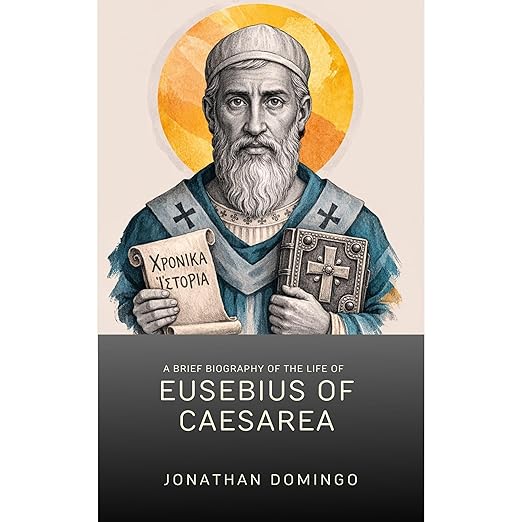
Eusebius of Caesarea stood at one of the most seismic junctures in human history: the moment Christianity shifted from a persecuted underground faith to the official religion of the Roman Empire. Jonathan Domingo's audiobook, the third entry in his Eight Early Christians Everyone Should Know series, takes that extraordinary biography as its subject and delivers it in just over an hour, which is either a constraint or a liberation depending on how you approach short-form historical audio. What emerges is a tightly focused portrait of a man who understood, perhaps better than anyone alive, that the document you preserve becomes the history that survives.
First, the Big Picture
Eusebius earned the title Father of Church History not through theological innovation but through archival obsession. Working from the remarkable library at Caesarea, which he helped build and expand, he gathered letters, testimonies, and documents that would otherwise have been lost. Domingo conveys the significance of that work without getting lost in bibliographic detail. The biography is organized around the major phases of Eusebius's life: the scholarly formation in Caesarea, the Diocletianic persecution and its aftermath, the relationship with Constantine, and the theological controversies of the early fourth century, particularly those around Arianism, in which Eusebius played a complicated role.
The narrator on this entry is a Virtual Voice production, which places some limits on the emotional range available. For a biography of an ancient historian who is known primarily through texts rather than dramatic personal narrative, the synthetic narration is adequate without being remarkable. The material is dense enough in intellectual substance that a neutral delivery does not particularly undercut it. Listeners who want voice performance and emotional coloring should note this going in.
Domingo's prose is clear and appropriately accessible for what positions itself as an introduction. He does not assume the reader comes with specialist knowledge of late Roman Christianity or Patristic scholarship, but he does assume they bring genuine curiosity. The treatment of the Diocletianic persecution, the last and most severe of the Roman persecutions of Christians, is particularly effective. Eusebius was present for this in a way that shaped both his theology and his historical method: he recorded the martyrdoms he witnessed with the same documentary care he brought to ancient letters, and that firsthand dimension gives his Ecclesiastical History a character unlike most surviving ancient texts.
Why Listen to A Brief Biography of the Life of Eusebius of Caesarea
The relationship between Eusebius and Constantine is the book's most intellectually interesting thread. Eusebius became a close ally of the emperor, wrote his biography, and was present at the Council of Nicaea. This proximity was not without its complications. His Arianizing sympathies, or at least his resistance to the hard Trinitarian language that Nicaea eventually endorsed, put him in a theologically awkward position after the council's decisions were enforced. Domingo handles this complexity honestly rather than flattening Eusebius into a straightforward hero of orthodoxy. The portrait that emerges is of a man navigating enormous institutional pressures with the tools of a scholar and the instincts of a political survivor.
The audiobook's brevity, at one hour and twenty-one minutes, means Domingo covers this ground quickly. Listeners who come with background in early church history will find the treatment stimulating as a summary and will likely want to move directly to primary sources. Those without prior exposure will find it a genuinely useful orientation to a figure who is central to how Western Christianity understands its own origins but who is largely unknown outside academic circles. In either case, the short runtime makes this an easy investment.
The series framing matters here. As the third entry in Eight Early Christians Everyone Should Know, this biography assumes that listeners approach it as part of a cumulative educational project rather than as a standalone deep dive. The connections Domingo draws to earlier Christians and the way he situates Eusebius in the broader arc of the early church benefit from that series context. Taken alone, the biography works, but it resonates more fully alongside the other entries.
A Few Reservations
The Virtual Voice narration is the clearest limitation on this audiobook experience. At its best, the synthetic delivery is neutral and readable. At its most noticeable, it flattens inflection in ways that make abstract theological discussion sound more uniform than it needs to. For a biography focused on a historian of ideas rather than a dramatic narrative life, this is manageable. But listeners who respond strongly to voice performance as a primary listening pleasure should know that this title will not offer that.
Domingo occasionally moves through significant events quickly in order to maintain the accessible, introductory register. The theological debates around Arianism, for instance, are summarized rather than fully excavated. This is appropriate given the book's scope, but listeners who want serious engagement with the fourth-century Christological controversies will need to go further than this volume. Domingo's introductory approach is consistent and deliberate, and it does what it sets out to do.
The rating for this title rests on a single review, which means the five-star score reflects enthusiasm from one reader rather than a broad consensus. That reader found the biography both accessible and emotionally engaging, noting Eusebius's dramatic historical position with genuine appreciation. That assessment aligns with what the book delivers, but prospective listeners should not weight the star count heavily given the small sample.
The Right Listener for A Brief Biography of the Life of Eusebius of Caesarea
Listeners with an interest in early church history, Roman history of the fourth century, or the origins of Christian institutional structures will find this a productive hour. It works well as part of the Eight Early Christians series and also as a standalone introduction to a pivotal figure. The short runtime makes it accessible even for casual curiosity.
Skip this one if you need immersive narration or emotional storytelling. The Virtual Voice production suits informational listening rather than experiential audio. Listeners who want to know who Eusebius was and why his preservation of early documents still shapes Christian historical memory will find this audiobook a solid starting point.
At a Glance
- Subjects: Early church history, documentary preservation, faith and imperial power
- Tone: Scholarly and precise, informational rather than dramatic
- Bottom line: A compact, rigorously focused introduction to one of Christianity's most consequential historians; Virtual Voice narration suits the informational register without adding warmth.