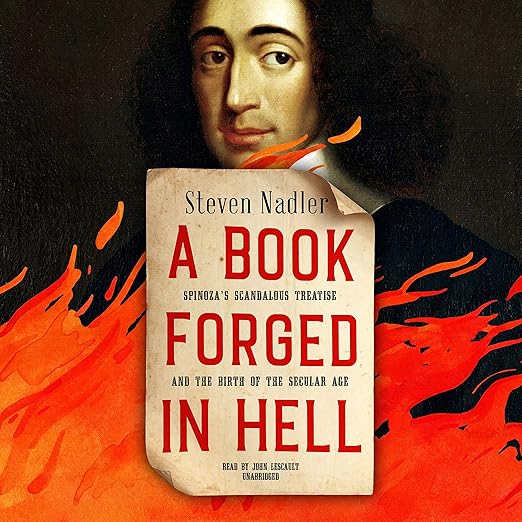
I had finished a long week and was in no mood for something that required close attention. I put on A Book Forged in Hell expecting to half-listen while cooking dinner and ended up standing in my kitchen with the stove off, pulled completely into Steven Nadler's account of one of the most consequential intellectual provocations in Western history. By the time Lescault read out the contemporaneous denunciations, godless, full of abominations, a book forged in hell by the devil himself, I had abandoned any pretense of multitasking.
Spinoza's Theological-Political Treatise appeared in 1670 and promptly scandalized everyone. Catholics, Protestants, and Jewish authorities found common ground only in their shared hatred of it. Yet the arguments Spinoza made in that text, that the Bible is a work of human literature rather than literal divine revelation, that religious authorities have no legitimate role in governing civil society, that democracy and toleration are the only rational basis for political organization, became foundational to the Enlightenment and, eventually, to modern secular liberalism. Nadler's project is to explain both why the Treatise was so dangerous and why it mattered so much.
Nadler is a Spinoza scholar of considerable standing, and what makes this book exceptional is that he doesn't write for other scholars. He writes for readers who may have heard Spinoza's name without knowing why it matters, and he builds the intellectual and historical context from the ground up. The Dutch Golden Age, Spinoza's excommunication from the Amsterdam Jewish community, the specific theological disputes convulsing Protestant Europe in the 1660s, all of it comes into focus through Nadler's careful framing before the Treatise itself is examined.
The book is structured in a way that mirrors the Treatise's own logic. Nadler first establishes what Spinoza was arguing against, the orthodox readings of biblical prophecy, miracle, and divine law, before showing what he was arguing for. This sequential approach means the Treatise's radicalism accumulates over the course of the audiobook rather than being announced upfront. By the time Nadler reaches Spinoza's argument for democratic toleration and the separation of religious and civil authority, the listener understands exactly how explosive that position was in 1670 and why it remains contested today.
Never Boring for Nine Hours of Philosophy
One reviewer noted that the book prompted them to think carefully about questions Nadler doesn't fully address, specifically Spinoza's treatment of evil and suffering within a deterministic framework where everything follows from natural law. That's a fair observation. Nadler's focus is on the political and theological arguments, not the full arc of Spinoza's metaphysics. Listeners who want to go deeper will need to read the Ethics as well. But within its defined scope, A Book Forged in Hell is exceptional: it makes a genuinely difficult philosopher accessible without simplifying him.
John Lescault's narration is very good. He has the kind of voice that communicates academic seriousness without the pomposity that sometimes accompanies it. His pacing is unhurried in a way that actually suits the material, Spinoza's arguments deserve time to breathe, and Lescault gives them that. Philosophy audiobooks live or die by whether the narrator sounds like they understand the ideas, and Lescault passes that test. One listener described it simply as never boring, which, for nine hours of 17th-century philosophy, is a genuine achievement.
Banning, Burning, and Five Printings Anyway
The sections covering the reception of the Treatise are as fascinating as the analysis of its arguments. Nadler documents the coordinated effort by religious and civil authorities across Europe to suppress the book, banning it, burning it, and attempting to discredit Spinoza personally through rumors of dissolute living and secret atheism. None of it worked, of course. The Treatise circulated in underground editions throughout Europe and went through five printings before the end of the 17th century. The very effort to destroy it helped establish its influence.
Nadler also draws explicit lines from Spinoza's arguments to later Enlightenment thinkers and to the founding documents of modern liberal states. The comparison to Thomas Paine's Common Sense in the synopsis is apt. Spinoza's claim that Scripture must be interpreted using rational historical-critical methods rather than dogmatic tradition anticipates biblical scholarship by two centuries. His argument that religious freedom is a natural right and that a government which suppresses thought undermines its own stability sounds like it could have been written in Philadelphia in 1787.
Rigorous, but Narrower Than Spinoza's Full System
This is for listeners who love intellectual history and want to understand the actual arguments that shaped the Enlightenment rather than the simplified version that appears in survey histories. If you've read Jonathan Israel's work on radical Enlightenment and want a more accessible companion text, Nadler is your author. Listeners interested in the history of secularism, religious toleration, or the philosophy of religion will find this essential.
Be cautious if you're looking for a broad survey of Spinoza's philosophy. Nadler is focused specifically on the Treatise and its historical context; the Ethics and the full architecture of Spinoza's metaphysical system are largely outside the book's scope. But for what it attempts, A Book Forged in Hell is one of the best philosophy-adjacent audiobooks available, rigorous, historically grounded, and written by someone who clearly finds his subject inexhaustible.
Do I need prior knowledge of Spinoza to follow this audiobook?
No. Nadler builds the necessary context from scratch, including Spinoza's biography, the Dutch intellectual environment, and the specific theological debates that made the Treatise so explosive. Listeners with no prior philosophy background have found it accessible, though it rewards attentive listening rather than casual background play.
Does John Lescault's narration handle the philosophical terminology clearly?
Yes. Lescault maintains a measured, clear pace through dense material and gives the argumentative passages enough space to register. The narration never becomes mechanical even through nine-plus hours of intellectual history, which is a meaningful accomplishment for this kind of content.
How does this compare to reading Spinoza's Theological-Political Treatise directly?
Nadler is an ideal entry point. The Treatise itself is written in a formal geometric style that requires significant philosophical background to parse. A Book Forged in Hell explains what Spinoza is arguing and why, which makes a subsequent reading of the primary text far more productive. Multiple reviewers describe coming to Nadler first and then tackling the Treatise with much greater understanding.
Does the book address whether Spinoza was actually an atheist, as his contemporaries claimed?
This is one of Nadler's central concerns. He argues that Spinoza's position is more nuanced than simple atheism, his identification of God with nature (often called pantheism or panentheism) was a genuine philosophical position rather than a cover story. But Nadler also acknowledges that the functional effect of Spinoza's arguments was to remove God from any direct role in natural events or human history, which his contemporaries reasonably found indistinguishable from atheism.