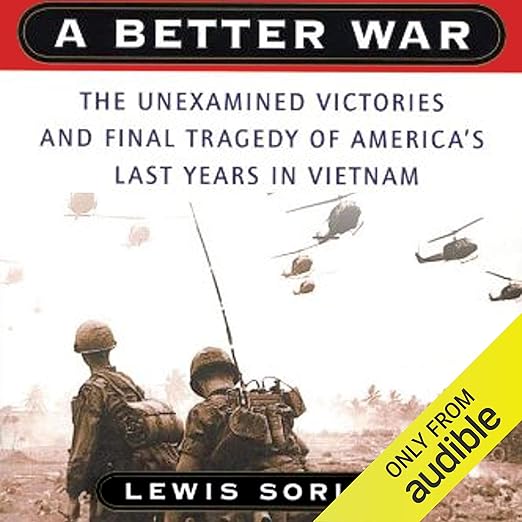
Lewis Sorley's A Better War arrives in audiobook form as one of the most persistently argued revisionist histories of the Vietnam conflict, and Basil Sands narrates it with the kind of measured, unhurried authority the material demands. The book's central claim is not comfortable for anyone who has settled into a fixed narrative about Vietnam: that the war, at the ground level, was being won in the years following Creighton Abrams's assumption of command in June 1968, even as it was simultaneously being surrendered at the negotiating table and abandoned in the halls of Congress. Sorley is not making a jingoistic argument. He is making an evidentiary one, and over 13 hours and 59 minutes, the audiobook gives that evidence serious room to breathe.
The broader context here matters enormously. By 1968, the Tet Offensive had shattered American public confidence even as it had failed militarily. The media narrative had calcified. What Sorley does, drawing on thousands of hours of tape-recorded allied councils of war and materials not previously available to historians, is open a window onto the specific tactical and strategic transformation that Abrams engineered when he replaced William Westmoreland. General Fred Weyand, Commander of the II Field Force, captured it succinctly: the tactics changed within fifteen minutes of Abrams taking command. This audiobook is the granular, documented account of what those changed tactics produced, and why their results were ultimately overridden by political events beyond any battlefield commander's control.
Abrams Pivots to Pacification, Then Washington Cuts Aid
Sorley's argument rests on the distinction between the early war and the later war, which he sees as not merely different in degree but different in kind. Where Westmoreland pursued a strategy of attrition through body counts, Abrams pivoted to pacification, village security, and the Vietnamization of the actual fighting. The Accelerated Pacification Campaign of late 1968, the drawdown of American combat forces alongside the building of South Vietnamese capability, the measured suppression of insurgent infrastructure through the Phoenix Program: these are not abstractions in Sorley's account. They are documented shifts, tracked through specific outcomes, specific provinces, specific months. The audiobook format serves this material well because Sands keeps the argument moving forward without letting the density of detail become numbing.
Where the book becomes genuinely painful is in Sorley's account of the congressional proceedings, the War Powers Resolution, and the eventual cutoff of military aid to South Vietnam that he argues made the 1975 collapse all but inevitable. One reviewer described reading this as "a sad experience," noting that Sorley makes "crystal clear that we lost a war we could have either won or exited with an honorable truce." That is the book's most difficult passage to sit with, regardless of where a listener stands politically. The human drama here, of principled soldiers serving effectively while the political ground shifts beneath them, is genuinely affecting and not easily resolved by any simple narrative.
Sands Never Editorializes Through Contested History
For listeners whose Vietnam education has been formed primarily by journalism of the era, Ken Burns's documentary, or the literary tradition of Tim O'Brien and Michael Herr, Sorley's account is genuinely disorienting in productive ways. He is not arguing that the war should have been fought at all, nor is he a simple apologist for military adventurism. He is a meticulous military historian asking a specific question: given that the United States was in Vietnam, what were commanders actually accomplishing in the later years, and how was that accomplishment related to the political outcome? The distinction between battlefield performance and policy outcome is the book's spine, and Sorley makes it rigorously.
Basil Sands is well-suited to this material. He does not editorialize, which is exactly right for a book this loaded with contested history. He reads the statistical passages cleanly, the oral testimonies with appropriate weight, and the moments of genuine human tragedy, like the stories of South Vietnamese soldiers and officers who fought and died for a cause that Washington eventually declined to sustain, with genuine feeling. The fourteen hours of listening never feel padded or repetitive, because Sorley's evidence is genuinely cumulative.
Cumulative Evidence, and a Thesis Left Contested
The book is dense and rewards careful listening rather than background-noise playback. Sorley's evidence is cumulative: single data points matter less than patterns he builds over chapters. Listeners who come expecting a straightforward narrative of combat will find instead a sustained argument about command philosophy, political decision-making, and the relationship between military performance and strategic outcome. That is not a weakness of the audiobook. It is precisely the book Sorley set out to write, and it is a more important book for being that rather than a simpler one.
It is also worth noting that Sorley's thesis remains contested. Historians who emphasize the structural weaknesses of the South Vietnamese government and the deep roots of nationalist sentiment on the communist side will read the same evidence differently. The audiobook does not engage those counterarguments at length, which is a genuine limitation. Listeners will get the strongest version of Sorley's case, not a dialectical exchange. Coming in with some awareness of the historiographic debate will enrich what you take from this listen considerably.
Validating and Sobering for Veterans and Families
This audiobook is for listeners with a serious interest in military history, Vietnam specifically, or the relationship between political leadership and military outcomes in democratic states under pressure. It is particularly valuable for anyone who has absorbed the prevailing media narrative of the Vietnam War without examining the specific operational record of the Abrams years. Listeners with a personal connection to the conflict, veterans or their families, will find Sorley's account both validating and, in its documentation of political failure, deeply sobering. This is not background listening. It is a sustained argument that asks something of the listener's attention and rewards it generously over nearly fourteen hours.
A Few Questions About A Better War
Is this audiobook accessible to listeners without a military history background?
The core argument is accessible, but Sorley's evidentiary method assumes some familiarity with Vietnam-era political and military context. Listeners new to the subject will benefit from reading a general history of the conflict first. Those with existing knowledge will find the audiobook immediately rewarding.
At nearly 14 hours, is this audiobook worth the full listen or better sampled in sections?
Sorley's argument is cumulative, meaning each chapter builds on what preceded it. Sampling will give you individual data points without the larger pattern they form. For the thesis to land with full force, the complete listen is the right approach, ideally spread over several sessions rather than compressed into one or two.