Quick Take
- Narrator: Eric Nutting delivers the quotes collection with calm, measured pacing appropriate for reflective listening, though the format limits what any narrator can do with 555 discrete statements.
- Subjects: Impermanence and acceptance, releasing material attachment, the nature of suffering
- Tone: Contemplative and steady
- Bottom line: A Buddhism-inspired quotes collection audiobook best used as a daily meditation prompt rather than a continuous listen, with some production quality concerns in the text that listeners should know about before purchasing.
One Quote at a Time, Never a Narrative
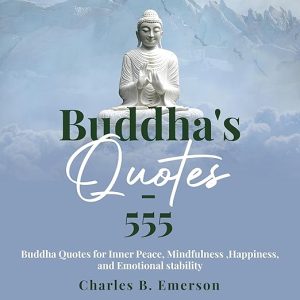
Charles B. Emerson's 555 Buddha Quotes: Buddha Quotes for Inner Peace, Mindfulness, True Happiness and Emotional Stability, narrated by Eric Nutting, operates on a specific and somewhat unusual model for an audiobook. The author describes using it as a daily practice: choose a quote that applies to your current situation, then meditate on it. This is a prescriptive listening format, not a narrative or argumentative one, and understanding that distinction upfront matters enormously for whether the two-hour fifty-eight-minute runtime will feel useful or frustrating to a given listener.
The philosophical premise behind the collection is straightforward and grounded in recognizable Buddhist teaching. Happiness achieved through material means is temporary, the satisfaction fleeting, the return to emptiness inevitable. Genuine equanimity comes from releasing the need to control outcomes and instead directing attention toward what is actually within one's power: how we feel, how we act, how we judge. Emerson frames these not as abstract doctrine but as practical orientations, which aligns with the way Buddhist ethics have historically been transmitted through aphorism rather than systematic theology. The collection draws from a wide range of attributed Buddha teachings across traditions.
555 Quotes Promised, Fewer Actually Delivered
The strongest case for this audiobook as a listening experience is the daily-prompt format that Emerson himself advocates. Played in full as a continuous audiobook, the quotes function more like a wash of related ideas than a developing argument, and the cumulative effect is one of quiet immersion in a particular contemplative vocabulary. Used as Emerson suggests, returning to the recording periodically and selecting a passage to sit with, the format is more focused and more useful. Eric Nutting's narration supports this second mode well: his delivery is measured and unhurried, giving each quote space before moving to the next, which respects the meditative intent without turning the recording into a guided meditation session.
The core value proposition here is accessibility. Engaging directly with Buddhist texts requires either translation navigation, scholarly context, or both. A curated collection of attributed quotes, delivered in clear English by a steady narrator, removes those barriers for listeners who want the wisdom tradition without the textual apparatus. At just under three hours, the audiobook can serve as an introduction to Buddhist aphoristic teaching for complete newcomers, or as a refresher resource for practitioners who want a contemporary-framed encounter with familiar teachings.
The reviews are honest about limitations that are worth taking seriously. Multiple reviewers identify text quality issues in the written version of the book: instances where words appear incomplete, quotations that seem to be repeated rather than distinct, and specific typographical errors where the letter r appears where the word your was intended. At least one reviewer argues that the title overstates the collection, suggesting the actual count of genuinely unique quotes is lower than the five hundred fifty-five promised. Whether these issues affect the audiobook experience specifically depends on how closely the audio tracks the written text, but they are worth flagging because they reflect on the underlying editorial quality of the material Nutting is working from.
Missing an Index, but Gaining a Spoken Distance
The production context matters here more than it does for most audiobooks. A quote collection that is not organized by theme or progressive development presents a different editorial challenge than a structured argument or narrative. One reviewer specifically noted the absence of categorical organization: if you wanted to focus on mindfulness passages specifically, there is no index or chapter structure that allows easy navigation to that subset. The quotes appear sequentially without thematic grouping, which limits the audiobook's utility as a reference resource and reinforces that the daily-single-quote approach is the more practical way to engage with it.
Emerson's framing in the introduction, that he gathered these quotes over years of meditation practice because he found them genuinely useful, gives the collection a personal endorsement quality that distinguishes it from a purely mechanical aggregation. The audio format adds something that the print version cannot offer: the voice creates a meditative distance between the reader and the content that can make familiar teachings land differently. Hearing a quote spoken aloud by another voice is a different cognitive experience than reading it silently, which is the underappreciated argument for this format specifically.
The three-star and one-star reviews both point to the same underlying concern about value relative to the promise of the title. Five hundred fifty-five quotes is a specific claim, and listeners who feel the count is inflated by repetition will reasonably feel misled. This is a genuine caveat, and listeners for whom the number is meaningful should manage expectations accordingly.
That said, the highest-rated reviews describe finding genuine value in the collection, particularly in the way it makes Buddhist teaching accessible without requiring any prior orientation to the tradition. For the listener who wants a quiet, contemplative audiobook resource drawn from a major wisdom tradition and is not bringing expectations about categorical organization or editorial rigor, the core offering is what it promises: a sustained encounter with attributed Buddhist thought delivered in a calm and respectful register.
Nutting's Calm Voice Suits Morning Micro-Sessions
This audiobook is most useful as a daily-session contemplative resource rather than a linear listen. Listeners who already have a meditation practice and want an audio prompt for reflection, or who are curious about Buddhist teaching and want a low-barrier entry point, will find the most use here. The calm narration by Eric Nutting and the short runtime make it accessible for background or morning listening in small segments.
Listeners seeking a rigorously organized or scholarly treatment of Buddhist ethics and philosophy should look elsewhere. The editorial concerns raised in negative reviews are real, and the absence of thematic organization limits its utility as a structured learning tool. Treat it as a contemplative companion rather than a textbook and its modest promise becomes more achievable.