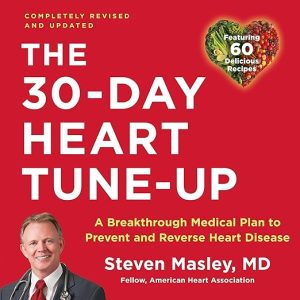
Robertson's Steady Authority Over Nine Hours
Heart disease remains the leading cause of death in the United States, and the standard medical response for decades has centered on cholesterol and blood pressure numbers. Dr. Steven Masley's argument in the 30-Day Heart Tune-Up audiobook is that both metrics are proxies and that the medical profession has been treating the indicators rather than the actual culprits: arterial plaque and gut health. That claim is provocative enough to warrant close attention, and Allan Robertson's nine-hour narration gives it a proper hearing. I came to this audiobook while trying to make sense of conflicting dietary advice following a family member's diagnosis, and the way Masley reframes the conversation around plaque rather than cholesterol opened a useful new line of thinking.
Robertson narrates with the steady professional competence that long-form health audiobooks require. His delivery is not the warm-and-engaging register of a bedside doctor but the measured, authoritative tone of a clinical educator, and for a book that needs its listener to trust its protocol recommendations, that authority serves the material well. Over nine hours, some narrators begin to feel like they are simply reading rather than communicating. Robertson avoids that trap.
Why Magnesium Matters for This Reviewer's Afib
Masley structures his argument in two phases. The first establishes the scientific case: why arterial plaque matters more than cholesterol alone, why gut bacteria affect cardiac outcomes, and why the standard clinical risk assessment misses the real mechanisms of heart disease. The second phase delivers the protocol: a diet designed around heart health, exercise recommendations to improve circulation, stress management techniques, a supplement plan, and sixty recipes incorporated into this updated edition.
The gut-heart connection is the most current element of the audiobook and the one that will feel most surprising to listeners who have not followed the microbiome research of the past decade. Masley explains how specific bacterial compositions in the gut affect systemic inflammation, and how that inflammation directly influences cardiac risk. This is not speculative: the field has accumulated substantial evidence, and the audiobook integrates this newer science with the earlier arterial plaque material in a way that feels coherent rather than bolted on.
One reviewer mentions being diagnosed with atrial fibrillation and finding Masley's section on magnesium and potassium supplements directly relevant. This kind of specific utility is the measure of success for health guidance audiobooks: not whether the overall framework is correct in every detail, but whether it gives individual listeners tools to engage more intelligently with their own health and their medical providers. By that standard, the supplement section and the dietary protocols deliver practical value that extends beyond the listening session.
Sixty Recipes You Cannot Cook By Ear
This is a revised and updated edition, and Masley does integrate newer research throughout, particularly on gut health and updated risk factor understanding. That said, any health audiobook should be read as a starting point for conversation with your own physician rather than a replacement for clinical guidance. Masley writes with confidence that occasionally shades into certainty on questions where the evidence is strong but not absolute.
The sixty recipes mentioned in the synopsis are embedded in the audiobook as description rather than as read-aloud cooking instructions. Listeners who want to cook from this book will need the print companion, because even the most conscientious narrator cannot make recipe steps easy to follow at normal listening speed. This is a limitation of the format rather than the audiobook specifically, but it is worth flagging for listeners who came primarily for the culinary element.
The supplement section is one of the audiobook's most practically useful elements. Masley goes beyond generic multivitamin recommendations to address specific deficiencies and conditions with targeted supplementation strategies. The reviewer who was diagnosed with atrial fibrillation and found the magnesium and potassium coverage directly relevant represents exactly the kind of listener Masley is writing for: someone with a specific cardiac concern who needs more precision than standard dietary guidance provides. That precision is one of the audiobook's meaningful differentiators within the crowded heart health publishing space.
The stress management section, which Masley includes as a fourth pillar alongside diet, exercise, and supplementation, is handled with more depth than many cardiovascular health books allocate to it. He connects stress responses to cortisol and inflammatory markers explicitly, grounding the recommendations in the same biological framework he uses throughout the audiobook. This consistency of scientific framing is one of the audiobook's structural strengths: Masley does not treat stress management as a soft lifestyle suggestion but as a physiologically grounded intervention with measurable cardiovascular effects.
For Physician Patients Who Want the Why
This audiobook reaches its widest useful audience among listeners who have received cardiovascular risk information from a physician and want to understand the underlying mechanisms rather than just following instructions. Masley writes for intelligent non-specialists: readers who can handle the scientific framing without needing it dumbed down, but who do not have medical training. The PBS lecture style that one reviewer describes, having watched Masley's show repeatedly before purchasing the book, carries through to the audiobook's tone.
Skip it if you are looking for a comprehensive nutritional science text with full academic citation apparatus. This is applied health communication, not a peer-reviewed monograph. But for listeners who want a coherent, evidence-informed framework for understanding and reducing cardiovascular risk over a thirty-day starting period, the audiobook earns its runtime. Allan Robertson keeps the nine hours moving, and the combination of scientific rationale and specific protocol makes this more actionable than most health audiobooks in the genre.
- Narration: Allan Robertson brings measured clinical authority to nine hours of cardiovascular health content, maintaining listener trust throughout the protocol sections.
- Themes: Arterial plaque as the real cardiac culprit, the gut-heart connection, evidence-based intervention over thirty days.
- Mood: Purposeful and practical, with the confidence of someone presenting a case they have spent years refining.
- Verdict: A well-structured cardiovascular health audiobook that outpaces the standard cholesterol-and-blood-pressure conversation with a more complete picture of heart risk.
Questions Listeners Ask
Does this audiobook explain the science behind arterial plaque, or is it primarily a recipe and exercise guide?
Masley devotes substantial time to explaining the mechanisms before moving to the protocol. The scientific case for why plaque and gut health matter more than cholesterol and blood pressure alone runs through the first half of the audiobook. The diet, exercise, stress management, and supplement recommendations in the second half are grounded in that explanatory foundation.
Is 30-Day Heart Tune-Up audiobook suitable for someone without a cardiac diagnosis, or is it aimed at patients?
Masley writes for both audiences. The audiobook addresses prevention as seriously as it addresses existing risk management, and one of his central arguments is that everyone, regardless of current diagnosis, can benefit from addressing arterial plaque and gut health. The protocols are scalable to varying health situations.
How does this audiobook handle the gut-heart connection, and is the evidence reliable?
The gut-heart material in this updated edition reflects research that has accumulated significantly over the past decade. Masley explains how microbiome composition affects systemic inflammation and therefore cardiac risk. This is a legitimate area of scientific investigation, and his treatment is accessible without being misleading about the current strength of the evidence.
Can I use the recipes in this audiobook format, or do I need the print version for cooking?
The print version or digital companion is necessary if you want to cook from the sixty recipes. Robertson narrates the recipe descriptions competently, but recipe instructions at normal audiobook pace are difficult to follow in real-time kitchen use. Treat the audiobook's recipe sections as orientation and motivation, then access the print content for actual cooking.