- Narration: Jim Jorgensen delivers a confident and steady performance that suits the self-help register. He keeps the motivational passages from tipping into infomercial territory, which is a real challenge for this genre, and brings consistent energy across the full eleven-plus hours.
- Themes: Law of attraction practice, money mindset, relationship magnetism
- Mood: Motivating and practical
- Verdict: A substantial Law of Attraction bundle that delivers more concrete technique than most entries in the genre, suited for listeners already invested in the framework who want a comprehensive audio resource.
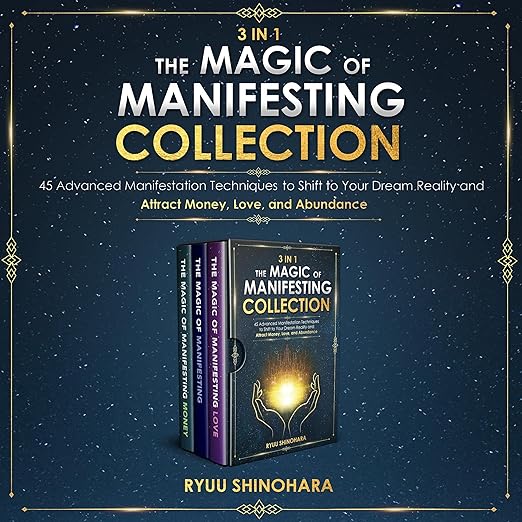
Ryuu Shinohara's Law of Attraction titles have built a dedicated readership on the premise that the genre's usual problem is vagueness: inspiring ideas with no usable mechanics beneath them. The Magic of Manifesting Collection, the first entry in the Law of Attraction Bundles series, addresses that problem by collecting three full books into a single audiobook narrated by Jim Jorgensen. At eleven hours and eighteen minutes, this is a committed listen, and the bundle format means listeners get three distinct angles on the same underlying practice: the foundational framework in book one, financial manifestation in book two, and relationship and attraction in book three. A PDF companion is included with the purchase and available in your library alongside the audio.
Hidden Money Blocks and Unconscious Resistance
Shinohara's distinguishing move in this series is the explicit acknowledgment of what he calls the "no woo-woo science" behind manifestation. He's positioning his framework against the purely metaphysical versions of Law of Attraction teaching and toward something grounded in behavioral psychology and mindset research. Whether that positioning holds up depends on how closely you examine the evidentiary claims, but the practical effect is that the techniques he offers feel more actionable than comparable titles because they're framed as habits and cognitive shifts rather than pure visualization exercises.
The first book's core argument is that most people who attempt manifestation are unconsciously manifesting resistance rather than outcomes. Shinohara calls out specific mistake patterns, which is more useful than most introductory Law of Attraction texts that simply describe the upside without diagnosing why practitioners fail. The second book, focused on money, introduces what he calls "hidden money blocks" and offers exercises for identifying which patterns are operating. The third book takes the same diagnostic-then-prescriptive approach to relationship and attraction, which keeps the trilogy coherent rather than feeling like three separate products bundled for commercial reasons.
Simchock Says This Beats Vaguer Manifestation Guides
Reviewer David Simchock, who described himself as having read all eight of Shinohara's books and now buying them for friends, positioned this collection specifically against The Secret and The Magic, noting that Shinohara's work felt more practically oriented. That comparison is useful. Listeners who found the Rhonda Byrne titles inspiring but frustratingly vague will find Shinohara's approach more systematized. The 45 techniques advertised in the title are distributed across the three books rather than compressed into a single list, which means the audiobook earns its length by spacing out the methodology rather than padding around it.
Jorgensen's narration is the right choice for this format. He brings consistent energy to material that could easily become repetitive across three books, and he navigates the transitions between introspective passages and technique descriptions with clear differentiation in pacing. Eleven hours of motivational self-help is a genuine endurance test for a narrator, and Jorgensen handles the distance without the flatness that often sets in during the final third of extended self-help titles. Reviewer mandyleah3's enthusiasm for "talk of manifesting" and reviewer SD's note that the book "broke down the way to look at things" and made the content "easy to follow" both point to the same quality: Shinohara and Jorgensen together make a dense practice framework feel accessible rather than overwhelming.
Jorgensen's Voice Turns Three Books Into One Course
The bundle format rewards the audio medium in a specific way. Listening across three sequential volumes builds the practice framework cumulatively in a way that reading three separate print books across weeks or months doesn't replicate. The continuity of Jorgensen's voice and the sequential structure mean that by the time you reach the relationship volume, you're applying a practiced familiarity with Shinohara's language and methodology. The listening experience is closer to an extended course than to three isolated readings.
The series's commitment to technique over inspiration also suits the audio format particularly well. Listeners who want something to implement rather than just absorb can pause, apply, and return to the audiobook as a running resource. At a 4.6 rating across nearly two hundred listeners, the collection has clearly found its audience among practitioners who want structured methodology alongside motivational framing.
Woo-Woo Science Claims Only Partly Hold Up
Listeners approaching this collection from outside the Law of Attraction framework will find the underlying metaphysics less convincing than the practical technique layer. Shinohara's claim to "no woo-woo science" doesn't fully hold up to scrutiny in the empirical sense. The framework is built on assumptions about how intention shapes outcome that behavioral science supports only partially and under specific conditions. Readers who need strong empirical grounding for their personal development practice will find the gaps between the science claims and the actual evidence more troubling than those who approach the practice on pragmatic terms.
The three-book structure also means some repetition of foundational concepts across the volumes. Shinohara re-establishes the core framework at the opening of books two and three, which is necessary for listeners who might pick up a single volume independently but adds some redundancy across the full eleven-hour arc for those listening to the bundle straight through.
Newcomers Should Start With Book One Alone
This bundle is best suited for listeners who are already oriented toward Law of Attraction thinking and want a more systematic and technique-dense resource than titles like The Secret or Abraham-Hicks material typically provide. The eleven-hour commitment and the three-domain structure, covering mindset, money, and relationships, make it a genuinely comprehensive audio resource for practitioners of the framework. Skeptics of the Law of Attraction will find little here to change their view. Newcomers would benefit from starting with book one independently before committing to the full bundle, since the methodology builds in layers across the three volumes and the early foundational concepts become load-bearing in the later technique sections.
Is this audiobook better suited for Law of Attraction newcomers or people already familiar with the practice?
It works for both, but the 45 techniques are labeled as advanced, which means practitioners with some existing familiarity with visualization and manifestation practice will get more from the methodology. Newcomers are better served starting with book one before committing to the full bundle, as the foundational concepts are introduced but not exhaustively explained.
Does the audiobook include access to the PDF companion mentioned in the listing?
Yes. The listing notes that the accompanying PDF is available in your library alongside the audio after purchase. The audio is complete and standalone, but the PDF provides supplementary material that reinforces some of the techniques described in the three books.
How does this audiobook compare to other Law of Attraction titles like The Secret?
Shinohara is more technique-focused and systematic than Rhonda Byrne's approach in The Secret. He frames his methods around specific patterns and exercises rather than primarily inspirational storytelling. Listeners who found The Secret motivating but wanted concrete mechanics to follow will likely find this audiobook more actionable.
Is Jim Jorgensen's narration consistent across all three books in this audiobook bundle?
Yes. Jorgensen narrates the full eleven-plus hours with consistent energy and pacing. The transition between books is smooth, and his delivery doesn't show the fatigue that sometimes affects narrators of extended self-help content. The listening experience across all three volumes feels cohesive rather than assembled.