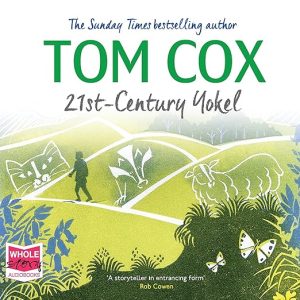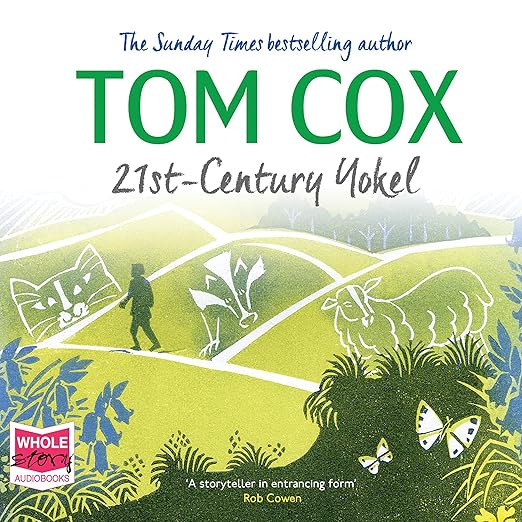
I started 21st Century Yokel during a week when I was deep in the kind of ambient anxiety that comes from too many news cycles and not enough sky. I had been told by a friend who knows my taste precisely that Tom Cox was the cure, and she was not wrong. I finished the ten-hour audiobook over four evenings, and each session left me feeling like I had been somewhere real: the Devon countryside, a veterinary emergency, a folk festival, a conversation with someone's Dad who communicates exclusively in capital letters. That last detail tells you everything you need to know about the texture of this book.
Cox's own description of 21st Century Yokel in the synopsis is the most honest marketing copy I have read in a long time: not quite a nature book, not quite a humour book, not quite a family memoir, not quite folklore, not quite social history, not quite a collection of essays. All of that is accurate. The book moves between modes with a confidence that less assured writers would mistake for lack of discipline, but Cox knows exactly what he is doing. He is exploring the way landscape and family shape identity in ways that cannot be disentangled, and the essay-as-genre is the only form capacious enough to hold that investigation.
Tender Crabbiness Only the Author Could Read
Cox narrates his own work, and this is one of those cases where that decision is not just defensible but necessary. The prose has a cadence that belongs entirely to the speaker, and any professional narrator would be rendering someone else's private frequency. The dry, slightly crabbish warmth that one reviewer described, what they called a tender sort of crabbiness, is present in every sentence, and Cox reads it with the confidence of someone who trusts his own jokes without explaining them. There is genuine wit here, the kind that lands quietly and then reverberates, and multiple reviewers described physically suppressing laughter in public while listening.
One reviewer compared Cox to the love child of Bill Bryson and David Sedaris crossed with the Nature Channel, which is slightly reductive but points toward something real. Cox is funnier in places than Bryson and more interested in the natural world than Sedaris, and his relationship to landscape is less touristic than either. He belongs to this countryside rather than visiting it, and that distinction matters enormously when the subject is how place shapes a person.
Capital-Letter Father, Animals Rendered Strange
Two things stand out in almost every review: Cox's father, and the animals. The portrait of his father, a man who speaks in capital letters and who carries the weight of a particular kind of English rural maleness without ever quite naming it, is apparently one of those literary achievements that arrives without fanfare and stays with you. Reviewers describe it as funny and full of admiration and respect, which is a difficult combination to pull off in memoir. Cox manages it because he is not trying to resolve his father into a lesson. He simply renders him accurately and trusts the reader to feel what is there.
The wildlife content, owls, badgers, beavers, otters, bats, the full Devon menagerie, is not the nature writing of someone performing communion with the natural world. It is the observation of someone who has lived alongside these animals long enough to find them mundane and extraordinary in equal measure. That double register, the familiar made strange, is one of Cox's most reliable literary moves.
Ten Hours of Meandering, Like a Walk
At ten hours and forty minutes, this is a long audiobook for what is essentially a collection of linked essays. Some listeners will find the meandering quality of the middle section, the way Cox circles back to the same landscapes and themes from different angles, slightly repetitive. That critique is fair if you are expecting linear progress. But the structural logic of the book is closer to a walk than a journey: you cover ground without necessarily advancing toward a fixed destination, and the value is in what you notice along the way. One reviewer noted that unless you really have somewhere to be, you will not put it down, and I found that accurate.
Cox's Attentive Ear Earns Its Authority
Cox also has something to say about the relationship between amateur passion and expertise that runs quietly through the book. He is not a credentialed naturalist or a trained folklorist. He is someone who has paid close attention to one place for a long time, and his authority comes from that attention rather than from institutional recognition of it. In a cultural moment that tends to value certification over knowledge, that stance is quietly radical and worth noting.
This is also a book that rewards being listened to rather than read. Cox's timing as a narrator, the pauses, the slight emphasis that makes a dry observation hit, are part of the work. The written text presumably works, but the audio version adds a layer that feels authored rather than incidental.
Listen for Landscape, Skip for Plot Momentum
Listen if you have ever found yourself moved by the specific weight of a landscape you belong to. Listen if you enjoy essay collections that take their time and trust the accumulation of small observations over the momentum of plot. Skip if you need a book to go somewhere, to build and resolve and conclude. Skip if the English countryside and its specific cultural textures feel remote to your experience and you are unwilling to be led into unfamiliar territory by a guide whose pleasures are quiet and particular.
Common Questions
How does Cox handle the balance between humor and genuine emotional depth in his narration?
This is one of Cox's great strengths as a writer and narrator. The humor never deflects from the emotional content; the two are braided together so that the funny moments are also the moving ones. His father's portrait in particular manages both simultaneously.
Is the ten-hour runtime appropriate given the essay format, or does it feel padded?
The runtime suits the material. Cox is building an atmosphere and a sense of place through accumulation rather than narrative momentum, and the length gives him room to do that without rushing. Listeners who want tightly plotted structure may find it slow, but those who enjoy the essay form will find it well-paced.