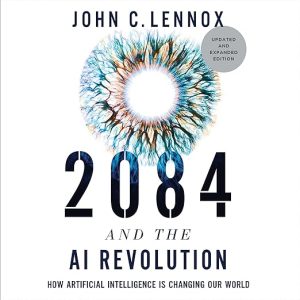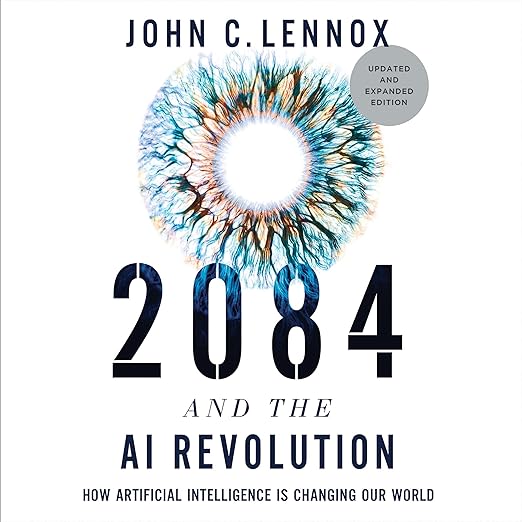
George Orwell's 1984 supplies the title's obvious reference point, and John Lennox uses that borrowed anxiety deliberately: if Orwell imagined a surveillance state enforced by human bureaucrats, this audiobook asks what the same fear looks like a century later, enforced instead by artificial intelligence, algorithmic surveillance, and machine learning systems that already shape daily life more than most listeners probably realize. Lennox, an Oxford mathematician and long-established Christian apologist known for public debates with prominent atheist scientists, narrates his own expanded and updated edition here, bringing both a working mathematician's technical grounding and a theologian's interest in what any of this means for the human soul.
Evidence-Based Scripture Answers Meet ChatGPT-Era Updates
The book's real project is bridging two audiences that rarely get addressed together: people anxious about AI's practical near-term effects on work, medicine, and manufacturing, and people wondering what a Christian framework has to say about superintelligence, the metaverse, and transhumanism. Lennox does not treat these as separate conversations; the synopsis explicitly promises evidence-based responses grounded in Scripture alongside a plain-language rundown of what current AI systems can and cannot actually do.
This updated and expanded edition folds in newer material specifically addressing large language transformers like ChatGPT, which matters for a book in a field that moves this fast; an AI book that hasn't been revised recently risks feeling dated within a year or two. Reviewer Melvin Martin called it 'the best book on AI' he had listened to yet, specifically praising how clearly Lennox separates what AI can do from what it cannot, all while maintaining that Christian perspective throughout rather than treating it as a separate closing chapter.
Richard Dawkins Debate Shapes This Balancing Act
Lennox's public profile extends well beyond academic mathematics; he has been Oxford's Emeritus Professor of Mathematics and has debated prominent atheist scientists and public intellectuals, including Richard Dawkins and the late Christopher Hitchens, on questions of science and faith. That specific debating background, defending a religious framework against skeptical, sometimes hostile interlocutors in real time, is directly relevant to a book attempting the same balancing act on paper: taking AI's genuine risks seriously while arguing a faith perspective has something substantive to add to the conversation.
The breadth of the topic list itself, spanning medicine, manufacturing, the military, advertising, automobiles, and education specifically, signals a book more interested in AI's total social footprint than in any single application, an ambitious scope for a single audiobook to cover credibly. That breadth is also the book's biggest structural risk: covering this many distinct domains in one seventeen-hour work means individual sections necessarily trade some depth for coverage, a tradeoff listeners should expect going in rather than discover partway through expecting a narrower, more specialized treatment of any one area.
Self-Narration Carries Decades of Public Debate
Self-narration by an author with this specific dual credential, working mathematician and public Christian intellectual, carries real weight; Lennox is used to explaining complex ideas to skeptical, mixed audiences from decades of public debate, and that experience is audible in how he paces difficult conceptual material. A professional narrator without his background could read the words accurately but would not bring the same lived familiarity with fielding hard, often hostile questions about faith and science simultaneously.
At seventeen hours, this is a substantial commitment, and reviewer Charles J. Hart described it as 'an in-depth look at AI from a plethora of perspectives,' adding that it isn't a casual listen, while also noting that Lennox carries his considerable academic credentials without any attitude of superiority. That combination, serious intellectual range delivered without condescension, is a real draw for listeners who want rigor but not gatekeeping.
Books positioned at the intersection of faith and emerging technology are a real, if smaller, publishing category, and most either lean apologetic to the point of dismissing legitimate technical concerns, or engage the technology seriously while treating faith as an afterthought. Lennox's specific credentials as a working mathematician help him avoid the first failure mode, and his decades of apologetics work help him sidestep the second, a genuinely rare combination in this specific niche.
The pace of AI development in the years since the original 2084 first published explains why an updated and expanded edition became necessary at all; a technology book that doesn't revisit its own claims periodically risks becoming a historical artifact rather than a current guide, and Lennox's willingness to substantially revise his own earlier work says something about his intellectual seriousness on the subject.
Questions and Charts Exist Outside the Audio
This is explicitly written from a Christian apologetics perspective, and listeners should know that going in rather than discovering it midway through; the synopsis is upfront that Lennox is building a case for what Christianity has to say about AI specifically, not offering a religiously neutral technology primer. Listeners looking for a purely secular treatment of AI ethics and policy will find the theological framing present throughout, not confined to a single section.
The companion PDF mentioned in the synopsis, containing questions and charts, is a real limitation for pure audio consumption; any chart-based content referenced in the narration will not translate fully without pulling up that separate document, so listeners who want the complete experience should plan to have it accessible while listening rather than relying on audio alone.
The book's engagement with AI regulation and governance, briefly noted in the synopsis as an urgent need for regulation and control, arrives at a moment when actual governments and international bodies are still actively working out what AI regulation should even look like. Some of the book's most current-events-adjacent material will likely age faster than its more philosophical and theological arguments, a normal tradeoff for any book engaging this directly with a fast-moving policy landscape rather than a reason to discount its core arguments.
218 Ratings and a Christian Lens on AI
This is a strong pick for Christian listeners specifically seeking a rigorous, non-alarmist framework for thinking about AI, as well as for anyone generally interested in AI ethics who wants a perspective outside the standard Silicon Valley or purely secular-academic conversation. Reviewer Tinman called it timely and helpful for navigating what feels like a genuinely strange new technological era, and the near-perfect rating average across 218 ratings backs that reception up.
The book's promise to address transhumanism and longtermism specifically, philosophical movements concerned with radically extending or transforming human capability and multi-generational future planning, situates it within a broader, increasingly mainstream debate about technology's ultimate trajectory, not just its near-term practical applications. Listeners already following that wider conversation from a secular vantage point may find Lennox's theological counterargument a useful perspective to weigh against, even without sharing his starting premises.
Listeners who want a purely technical or secular treatment of artificial intelligence, without any theological framework woven through the analysis, should look for a different title; the Christian perspective here is not incidental, it's the book's organizing lens. Anyone allergic to faith-based argument mixed into policy and technology discussion should choose accordingly.
In Brief
- Read by: John Lennox self-narrates with the pacing of a practiced public debater handling complex material.
- At its heart: artificial intelligence ethics, Christian apologetics, surveillance anxiety
- Vibe: Rigorous and earnest
- Short version: A substantial, faith-forward AI primer best suited to Christian listeners and open-minded skeptics alike.
Common Questions
Does this audiobook require a religious perspective to find it useful?
It's written explicitly from a Christian apologetics viewpoint, so listeners seeking a purely secular AI ethics treatment should look elsewhere, though the technical content itself remains broadly accessible.
Is John Lennox's self-narration effective for this audiobook's technical content?
Yes, his decades of public debate experience translate into pacing that handles complex material clearly without talking down to listeners.
Does this audiobook's companion PDF matter for the audio-only experience?
Some chart-based content referenced in the narration won't fully translate without it, so having the PDF accessible while listening is recommended.
How current is this audiobook's coverage of AI developments like ChatGPT?
This is the updated and expanded edition, specifically revised to address large language models and recent developments, so it's more current than the original edition.