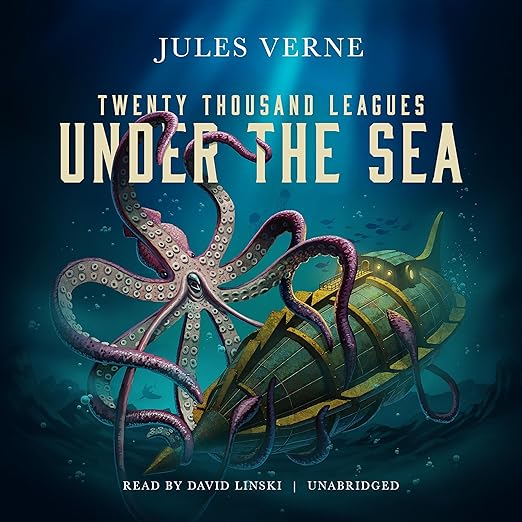
Professor Pierre Aronnax narrates his own adventure in prose, which hands David Linski a strange assignment on this audiobook: read a first-person account of chasing a sea monster that turns out to be a submarine, and make a great deal of 1860s marine biology sound like momentum rather than homework.
The Verdict, Briefly
The setup moves fast for a novel this dense with digression. Ships from several nations spot a mysterious sea monster in 1866, the United States government assembles an expedition out of New York to hunt it down, and Aronnax, a French marine biologist who happens to be in the city at the time, gets a last-minute invitation to join. He brings along his servant Conseil, and the expedition adds Canadian harpoonist Ned Land, and all three of them end up as reluctant guests aboard the very vessel they were sent out to destroy in the first place.
Captain Nemo's identity is the engine that keeps the back half of the book running, and this listing does not resolve it, on purpose. One reviewer flags this directly, noting that anyone wanting Nemo's backstory explained needs to go looking in Verne's Mysterious Island instead. That restraint reads as a real strength of the novel rather than an oversight; Nemo stays a genuine mystery for this entire book, never fully explained, which keeps him unsettling in a way a tidy backstory would undercut.
A couple of the attached reviews are worth flagging before relying on them for a sense of the audio experience. One describes a well illustrated edition with comic book style artwork reminiscent of Franklin Booth, pen and ink on scratchboard, full page illustrations, clearly a review of an illustrated print or graphic edition rather than this audio recording. Another, in Japanese, simply praises how nicely packaged the item arrived. Neither one tells a listener anything about pacing, tone, or how the text sounds read aloud.
Ned Land and Conseil round out the trio in ways worth knowing before starting. Land is a Canadian whaler and master harpoonist, a working tradesman's practical instincts set directly against the Nautilus's science-driven world, while Conseil is Aronnax's own faithful servant, along for the expedition mainly out of loyalty rather than ambition. That contrast, a scientist, a harpoonist, and a servant sharing one long captivity, gives the novel more than one register to work with even before Nemo enters the picture.
Why 20,000 Leagues Under the Sea Works as an Audiobook
David Linski has no confirmed prior narration credits turning up anywhere, so this is a genuine unknown rather than a known quantity. Verne's own habit of pausing action for geography, engineering, and marine biology asks a lot of any narrator: real patience for technical digression is one skill, and enough narrative drive to keep three captive men's genuine unease at the mercy of their captor from going flat, is a separate skill, and nothing in this listing confirms either one yet.
The reviews that do engage with the actual novel make a strong case for its staying power. One listener describes rereading it as an adult after loving it as a kid and finding it still holds up decades later, prophetic for its era and still gripping regardless. Another calls it, more than adventure alone, a human story, built around how much the reader or listener comes to understand about Nemo without ever getting a full answer.
That 'prophetic' label holds up under a little more scrutiny too: a novel imagining a fully functioning submarine years before submarines were a practical reality asks a listener to sit with real speculative ambition, not just an old adventure story. A separate reviewer describes the whole thing as an imaginary travel diary, informed in incredible detail by then-current science, which is a useful way to think about the book's odd double identity as both a thriller and a work of careful, invented reportage.
Points to Consider
Scientific density here is real, and reviewers say so themselves: one calls the book informed in incredible detail, at times too much detail, by then-understood science, which was cutting-edge marine biology and engineering speculation in Verne's own day and reads very differently a century and a half later. Treat this as a novel that rewards patience with period-accurate digression rather than one built for constant forward momentum. Listeners more used to modern genre pacing, where a chase rarely pauses for a lecture on marine science, should recalibrate expectations before starting.
Because two of the five attached reviews describe a different edition altogether, real audio-specific feedback on this exact recording is thinner than the review count suggests. Only three of the five actually discuss the novel itself, and none of the three comment on Linski's reading directly, so a short sample before committing to the full eleven-plus hours is a reasonable step for anyone unsure about the pacing. Worth remembering too: the badge on this listing shows 4.4 from five ratings, which works out to twenty-two of a possible twenty-five points, three shy of a clean sweep, a small detail that at least confirms real engagement from actual listeners even where their reviews wander off topic.
Should You Listen to 20,000 Leagues Under the Sea?
This suits classic literature listeners, fans of sea adventure and early science-adventure fiction, and anyone curious about the actual nineteenth-century text behind decades of loose screen adaptations. If you have only seen a film version and assume you already know the story, the novel's own patience with scientific wonder and its refusal to resolve Nemo cleanly will likely surprise you. It also rewards listeners who enjoy a slower, essay-adjacent kind of adventure writing, closer in spirit to a travel journal than a modern action thriller.
Fast, contemporary thriller pacing without digression is simply not on offer here, and neither is the illustrated artwork some reviews describe, since audio obviously cannot deliver that. For listeners willing to slow down for nineteenth-century scientific enthusiasm, the patience pays off, and the length stops feeling long roughly once the Nautilus itself starts to feel like a genuine place rather than a plot device carrying the expedition from one encounter to the next.
Before You Listen
Does this audiobook match the illustrated edition some of these reviews describe?
No, and that is worth knowing before reading the reviews attached to this listing. One describes comic-book-style artwork reminiscent of Franklin Booth's pen-and-ink work, clearly a print or graphic edition rather than an audio recording. Treat that review, and a second one that only praises packaging condition, as unrelated to what this specific audiobook actually sounds like.
Is the science in 20,000 Leagues Under the Sea badly dated?
By modern standards, yes, though that is part of its historical interest rather than a flaw to work around. One reviewer specifically calls the marine biology and engineering detail informed by then-understood science, cutting-edge speculation in Verne's own era. Listening to it as a snapshot of nineteenth century scientific imagination works better than judging it against current knowledge.
Does David Linski's narration suit Verne's technical digressions?
No confirmed track record exists to judge this from directly. Verne's prose regularly pauses adventure sequences for engineering and geographic explanation, which asks a narrator for real patience with technical material as well as enough energy to keep the expedition's own danger from going flat. Sampling a denser, scientific chapter is the most reliable way to judge the fit yourself.
Is this the right audiobook for someone who has only seen the 1954 Disney movie?
One reviewer makes exactly this point directly, calling the novel a must-read for anyone who has only watched that film adaptation, since a great deal of the book's incident never made it onto the screen. Expect more scientific digression and a more deliberately unresolved Captain Nemo than the movie version offers.