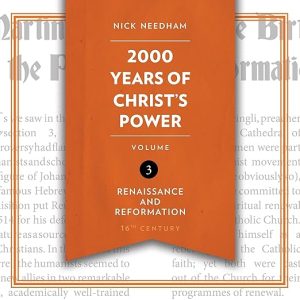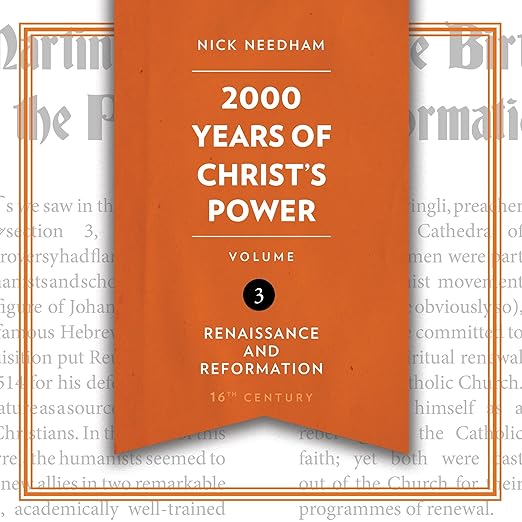
The Renaissance pushed back against the Middle Ages, and the Reformation grew out of that pushback into a passionate, often violent argument that split Europe into Catholics, Calvinists, Lutherans, and Anabaptists. This audiobook, the third volume of Nick Needham's intended five-volume history of the church, spends nearly twenty-one hours inside that argument, tracking reformers whose convictions got them killed alongside the institutions that killed them.
Cole Mayhugh Praises the Small Biographies Inside
Needham's approach threads theology, politics, biography, and original source material together rather than treating them as separate tracks, and one reviewer captured that blend precisely: “No one writes church history like what you find here.” The same reviewer singled out how the theological issues get properly explained rather than glossed over, calling it the most genuinely helpful part of the whole series.
Another listener, having worked through all four published volumes of the series so far, didn't hedge at all: “I commend this volume as the best in a series whose overall excellence is unsurpassed.” That's a meaningful endorsement from someone with the full run to compare it against, not just this single installment in isolation.
Cole Mayhugh's review also praises how much primary material makes it in, calling the volume “full of small biographies, interesting stories, political history, original writings and the like”, a combination that keeps the book from feeling like a dry procession of dates and doctrinal disputes. Needham seems just as interested in the people living through the Reformation as in the theology they were arguing over.
The essay-and-biography format Needham favors means individual reformers get real space to become people rather than names in a timeline, a structural choice that consistently draws praise from listeners already partway through the series and looking for the same treatment applied to this era's figures.
Because this is volume three of five, the book also functions as a bridge, closing out the Reformation era while clearly setting up the ground volumes four and five will need to cover next. Listeners already following the series get the satisfaction of watching Needham's larger project take shape in real time rather than encountering each volume as a fully isolated unit.
Peter Matthess Keeps an Enormous Cast Distinct
A third reviewer put it just as plainly: “This third volume was as good as the last two.” The reformation, in their words, “is a very important and interesting period to read about.” The book covers the era's theological, political, and social dimensions together, which is part of why it lands with readers who want more than a simple timeline of dates and doctrinal splits.
Peter Matthess narrates a genuinely enormous cast: named reformers, competing sects, and shifting political alliances across more than twenty hours, and the real test for a book like this is whether that cast stays distinct rather than blurring together. That clarity under density is really what decides whether twenty-plus hours of Reformation history stays gripping or turns into a slog partway through.
Nebti21 goes further still, describing Needham himself as “a raconteur whose deep love for his subject” comes through on every page. That kind of authorial warmth matters enormously for a project spanning five volumes and centuries of church history, since a drier historian could easily make this material feel like an obligation rather than a genuine pleasure to sit with.
The synopsis frames the payoff plainly: real lessons to be learned from “the vibrancy of people's lives and the courage with which they faced death.” That's a fair summary of what separates this from a drier academic treatment, Needham consistently keeps the human stakes of conviction in view rather than letting theology float free of the people actually living and dying by it.
Twenty-One Dense Hours Best Taken in Sittings
Starting at volume three means missing the earlier stretch of church history that Needham's series builds from, so newcomers should know they're arriving mid-project rather than at a true beginning. It's not quite like starting a novel halfway through, since each volume covers its own distinct era, but the connective tissue between volumes is real and worth having in place first.
At nearly twenty-one hours and covering multiple named movements, theological disputes, and political flashpoints, this is scholarly narrative history rather than a breezy overview. Go in ready for real density; this isn't the kind of church history that skims the surface to keep things moving quickly.
Given the runtime and subject density, this plays better as a multi-sitting listen than something to rush through in a weekend. The Reformation covered here spans multiple countries, competing theological camps, and overlapping political conflicts, and giving yourself room to absorb one thread before the next begins will pay off more than trying to power through in a couple of long sessions.
Beyond the political and theological detail, the human cost running underneath this era is genuinely heavy listening at points. Needham doesn't shy away from the reformers who paid for their convictions with their lives, and that unflinching honesty about religious persecution is part of what gives the history its weight rather than letting it stay comfortably academic.
Needham also seems careful not to flatten the era's genuine theological disagreements into a simple heroes-and-villains narrative, letting Catholics, Calvinists, Lutherans, and Anabaptists each get a fair hearing for their own convictions even when those convictions put them in direct, sometimes violent conflict with one another. That evenhandedness is part of what makes the volume feel like real history rather than advocacy for any single tradition.
Steadiness Under Names and Factions Is the Test
Church history enthusiasts already following Needham's series, and anyone who wants the Reformation treated with theology and biography given equal weight to politics, will find a lot to value here.
The narration itself deserves the final word: a book spanning this many reformers, sects, and political conflicts over twenty-plus hours needs a narrator who won't let names and factions run together, and that steadiness is really the deciding factor in whether this volume rewards the time it asks for.
It's also worth noting this isn't purely devotional listening. History buffs with no particular religious motivation may still find real value in the political and biographical detail alone, since Needham treats the era's power struggles with the same rigor he brings to its theology.
Given the emphasis on original writings and firsthand material noted above, listeners who enjoy primary-source-driven history, not just a historian's summary of events, should find real satisfaction in how directly Needham lets the Reformation's own voices come through rather than only paraphrasing them secondhand.