Key Details
- Narration: Ben Crawford narrating his own story is the only choice that could have worked; his voice carries the exhaustion, humor, and genuine love for his family in a way no hired narrator could approximate.
- Themes: Family under pressure, self-doubt and parental responsibility, what wilderness strips away and what it reveals
- Mood: Warm and honest, with sustained tension that earns its emotional resolutions
- Verdict: One of the most affecting family adventure memoirs I have encountered in years of reviewing nonfiction audio.
I was about four hours into this one when I had to pull over my car. Not because anything dramatic happened in the narrative, though plenty does, but because Ben Crawford had just described watching his six children sleep on the dirty floor of a women's restroom while a blizzard howled outside, and his thought in that moment was a single question that he puts plainly: Have I gone too far? And then he described Child Protective Services arriving the next morning, along with an armed sheriff, there to ask the same thing. I sat in a parking lot for ten minutes before I could continue, which is the clearest measure I know of how deeply this audiobook works.
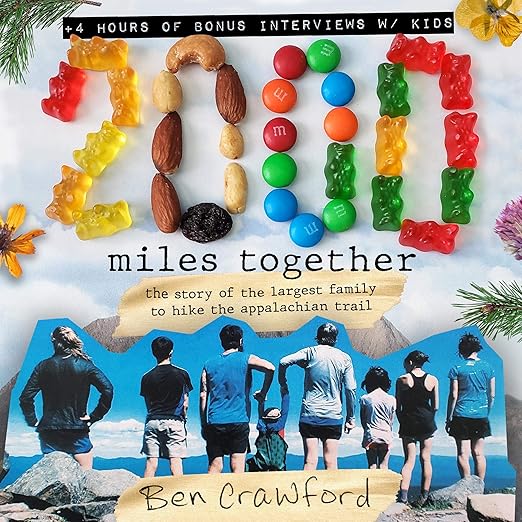
The premise is deceptively simple. Ben Crawford and his wife took their six children, including a two-year-old, on a thru-hike of the Appalachian Trail, all 2,000 miles of it, becoming the largest family ever to complete the journey. The synopsis lists what they faced: snowstorms, record-breaking heat, Lyme disease, overflowing rivers, rattlesnakes, forest fires, toothaches, a night spent with what he describes carefully as a cult. But what this audiobook is actually about is something more specific and more honest than any list of obstacles. It is about a man who was afraid that in reaching for a remarkable experience, he was gambling with his children's futures, and maybe with their love.
The Review
The audiobook includes over four hours of bonus content, interviews and insights from other Crawford family members, which is genuinely valuable rather than filler. But the primary narration is Crawford reading his own memoir, and that choice is what makes this work the way it does. His voice carries accumulated fatigue. You hear the weight of five months of hiking in how he tells certain stories. When he describes moments of doubt, there is no performed anguish; he sounds like a man who lived through something and is now trying to account for it honestly. One reviewer described the book as written from the heart, and in audio form that interiority becomes almost physical.
Crawford is not a professional narrator, and occasionally you notice that. But in a memoir this personal, the slight roughness of an amateur reader is not a weakness. It is part of what makes the account credible. This is not a polished product. It is a man telling you what happened to his family and what it meant, and that distinction matters enormously when the subject is as raw as this one.
The Best Parts of 2,000 Miles Together
What separates this from standard adventure memoirs is the unflinching attention to the relational stakes. One reviewer noted that the book does not shy away from the bad side of doing the AT as individuals and as a family, and that is accurate and important. Crawford describes the strain between spouses who are both exhausted and both convinced they are right. He describes children who are miserable and children who are thriving, sometimes the same child on the same day. He describes the moments when he questioned everything, not in the romanticized way of adventure narratives, but with the specific discomfort of a parent who genuinely does not know whether he is building something beautiful or doing damage.
The trail itself is rendered vividly but never fetishized. Crawford is always more interested in what the trail does to the people walking it than in the landscape itself. The gummy bears, mentioned in the synopsis, appear with enough frequency to become genuinely funny, a small recurring joke that carries real warmth through some of the darker passages.
The Caveats
Several reviewers reached for phrases about the book being more than a hiking memoir, and they are right. What Crawford has written is an account of what happens when you remove the structures that ordinary life uses to keep a family at a predictable distance from itself. There is nowhere to hide on the Appalachian Trail. There are no separate rooms, no separate schedules, no relief from one another. And what Crawford discovers, and what he is honest enough to document in all its complexity, is that proximity of that intensity can break things and also make things that could not have been made any other way.
The Right Listener for 2,000 Miles Together
Listen to this if you have ever hiked any portion of the Appalachian Trail or dreamed of it. Listen if you are a parent who has ever asked yourself whether the unconventional choice is the right one. Listen if you want a memoir that is honest about failure and ambivalence without being grim. At fourteen hours with the bonus material, this is a substantial free audiobook, but the pacing never sags. Crawford has a sense of narrative structure that many published memoirists lack. He knows when to linger and when to move, and that knowledge is the difference between a story that keeps you and a story you simply endure. Listeners who require pristine professional narration may occasionally be pulled out of the experience, but that is a small cost for what this recording offers. The audiobook is also notable for what it reveals about long-form family decision-making under conditions of sustained stress. Crawford and his wife make choices throughout the hike that readers will evaluate differently depending on their own relationship to risk and parenting. The book does not try to resolve that evaluation for you. It presents the choices as they were made, in real time, by two people who were both doing their best and both occasionally getting it wrong, and that honesty is what elevates this beyond the adventure memoir category entirely.
Do you need to have hiked the Appalachian Trail to appreciate this audiobook?
Not at all. Crawford assumes no prior knowledge of the trail and builds the context naturally. The book is ultimately about family and self-examination, not hiking technique, so it reaches listeners who have never set foot on the AT.
What is the bonus content in this audiobook edition, and is it worth the extra four hours?
The bonus content consists of interviews and insights from other Crawford family members, including the children. It adds meaningful perspective and is genuinely worth listening to, particularly if you find yourself invested in the family dynamics of the main narrative.
Is this audiobook suitable for younger listeners or is it primarily for adults?
The content is family-friendly and children as young as middle-school age would likely enjoy it, particularly those interested in outdoor adventure. The parental self-examination is more meaningful to adult listeners, but the narrative itself is accessible and engaging across a wide age range.