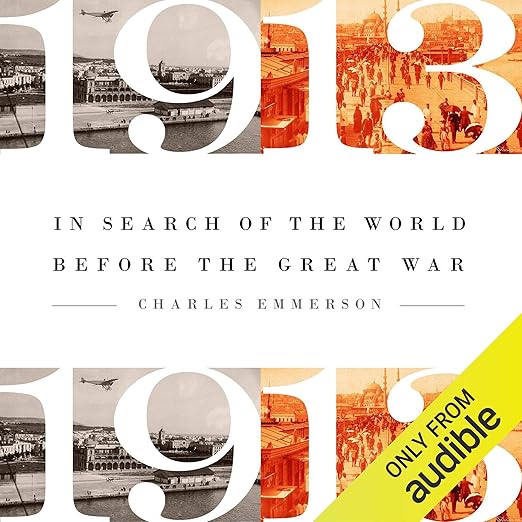
In Brief
- Voice: Kevin Stillwell reads Emerson's dense, city-hopping prose with steady authority, maintaining clarity across an enormous geographic and intellectual range.
- Big ideas: Globalization before its collapse, the contingency of historical catastrophe, modernity's debt to a world it destroyed
- Atmosphere: Panoramic and melancholic, the intellectual pleasure of a lost world rendered in careful detail
- Worth it?: A serious work of historical imagination that liberates 1913 from the shadow of 1914, essential for anyone who wants to understand what the Great War actually ended.
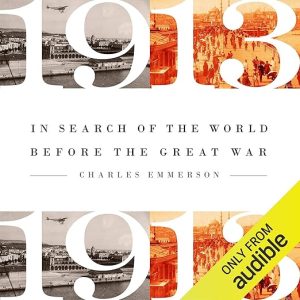
I came to 1913 in search of the world before the Great War on a long weekend when I had managed to clear my schedule entirely. I settled in with it over the course of a Saturday, moving between the couch and a walk in the afternoon, and finished it feeling the particular weight that good history produces: a sense that the world you thought you knew has been made strange and more interesting. Charles Emerson has written something genuinely unusual here. He refuses the retrospective narrative that treats 1913 as prologue.
The problem with how we usually think about 1913 is elegantly identified in the book's opening argument. Because 1914 was so catastrophic and so transformative, the year immediately preceding it tends to get sucked backward into that catastrophe's gravity. Everything becomes prelude. The unresolved rivalries, the fear of revolution, the tension in the Balkans: these get foregrounded, and the genuine vitality and complexity of that world gets lost. Emerson's project is restoration. He wants to show you 1913 as it was, which means showing you a world that was not simply waiting to die.
Nine Cities Prove 1913 Was Already Global
The book's structural method is ambitious: Emerson travels, at least conceptually, from city to city across the globe, using each urban center as a window onto the world's condition in that single year. Paris, Berlin, Vienna, London, yes, but also Winnipeg, Buenos Aires, Tehran, Shanghai, and Melbourne. The implicit argument is that the world in 1913 was genuinely global in ways we tend to attribute to the post-1945 order. The Gold Standard was functioning. Mass migration was reshaping demographics at a pace comparable to our own era. Steamships and submarine cables had effectively connected the major economies. Ford's first assembly line had just cranked to life in Detroit. The Woolworth Building had gone up in New York.
These specific details accumulate into something larger than anecdote. Emerson is making the case that the world of 1913 was more modern than we remember, and therefore that its destruction by the war was more genuinely catastrophic than the standard narrative allows. We tend to treat the pre-war world as something that had to break because it was unstable. Emerson complicates that comfort significantly. The instability was real. But so was everything else.
Kevin Stillwell Keeps Every City at One Register
Kevin Stillwell's narration is exactly what a book of this scope requires: steady, clear, and paced for comprehension rather than drama. At nearly twenty hours, this is not a light listen, and Stillwell doesn't pretend it is. He reads with the authority of someone who has understood what he's reading, which is more important than theatrical expressiveness for material this dense. The city-hopping structure benefits from his consistency; each new location is entered at the same register, which creates a useful comparative frame.
The book was praised by a reviewer writing in the context of the WWI centenary commemorations, who noted that Emerson's approach offered context for other WWI reading that conventional histories don't provide. That's accurate. 1913 works as a companion volume to books about the war itself, providing the texture of what was being fought over and what was being destroyed, rather than the military and diplomatic mechanics of the fighting. Read it alongside Christopher Clark's The Sleepwalkers or Barbara Tuchman's The Guns of August and it opens up dimensions that those books, excellent as they are, don't address.
One reviewer's observation that the world of 1913 was in some ways ahead of our own, particularly regarding the degree of European and American economic integration, is one of the book's most provocative threads. Emerson documents the Gold Standard's operation in a way that makes the post-1914 world's financial nationalism look like a regression. That framing inverts the usual progress narrative of the twentieth century in ways that linger.
European Chapters Run Richer Than the Outposts
The book's individual city portraits vary in depth. The European capitals, naturally, receive the most extensive treatment. The Buenos Aires and Winnipeg sections, while brief, are among the most interesting precisely because they document the boom-town energy of emerging economies that the standard European-focused WWI history entirely ignores. Emerson's Iran chapter, about the early opening of the petro-geopolitical era, is particularly prescient and worth listening to carefully.
The China section is fascinating for its portrait of a country that appeared to be awakening from imperial slumber, in Emerson's phrase, while simultaneously being pulled apart by factionalism. The distance between that portrait and the China of 1914 and beyond is, again, not the simple trajectory that hindsight constructs. These are genuinely open futures in the moment Emerson describes, and he communicates that openness effectively.
The book's central argument, that the world of 1913 had provocative implications for how we understand our past and how we think about our future, is fulfilled more fully in some sections than others. The European chapters are richer in this respect than the more thinly sketched outposts of empire. At twenty hours, some unevenness in depth is inevitable, and Emerson acknowledges the book's project is panoramic rather than exhaustive.
Sustained Argument Rewards Patience Over Momentum
This is the right book for readers who approach World War I not as military history but as a civilizational event, something that destroyed a specific kind of world as much as it killed specific people. Listeners who want troop movements and tactical analyses should look elsewhere. Those who want to understand what was lost, not just what happened, will find Emerson's approach unusually rewarding.
At twenty hours, 1913 rewards listeners who are comfortable with sustained, slow-building argument rather than narrative momentum. It is fundamentally an essay in the historian's sense: a considered examination of evidence toward a thesis. Listeners who approach it that way will find it serious, rigorous, and genuinely illuminating. Those who want a faster, more narrative-driven WWI experience will find the pace demanding. The investment, for the right listener, is amply repaid.
Common Questions
How does Kevin Stillwell's narration handle the book's enormous geographic range?
Very competently. Stillwell maintains a consistent, steady register across all the city portraits, which actually helps the book's comparative argument. He doesn't differentiate performatively between Buenos Aires and Berlin, which is the right call for material where Emerson wants you to see the cities as part of a single connected world.
How does this book compare to Christopher Clark's The Sleepwalkers as a companion to WWI reading?
They complement each other well. Clark focuses on the diplomatic and political decisions that produced the war, examining the agency of the decision-makers. Emerson focuses on the world those decisions destroyed, painting the texture of global life in 1913. Used together, they provide both the structural causes and the human stakes of the catastrophe.
Is the book's argument that 1913's world was unexpectedly modern actually supported by the historical evidence, or is it overstated?
The claim is well-supported for certain dimensions of globalization: financial integration under the Gold Standard, submarine cable communication, mass migration, and early industrial production are all documented with genuine historical specificity. Emerson is careful not to claim the world was more peaceful or stable than it was; his argument is specifically about economic and technological modernity, not political maturity.