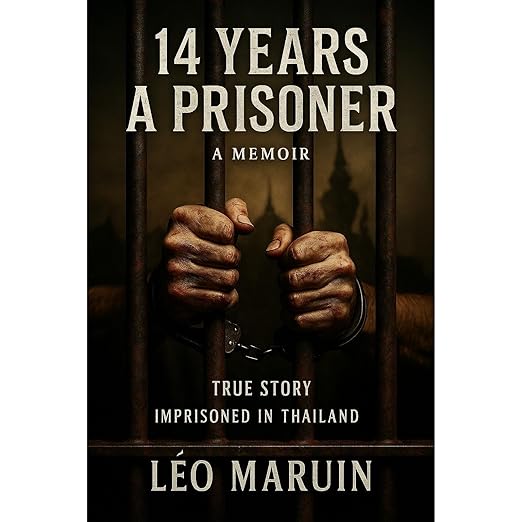
Pattaya's most notorious cells are where this audiobook memoir begins, and Léo Maruin doesn't ease a listener into what's coming. Over fourteen years inside Thailand's prison system, including a stretch in the facility known informally as the Bangkok Hilton, Maruin survived what the synopsis flatly calls 'violence, corruption, and humanity at its rawest.' What kept him alive, by his own account, was a mix of raw instinct, music, and a handful of genuine human bonds formed inside a system designed to strip both away. This is survival memoir in the most literal sense, told from inside a foreign justice system most listeners will have no personal frame of reference for at all.
Searing Honesty and Chilling Detail, Reviewers Agree
The synopsis itself promises 'searing honesty, dark humor, and chilling detail' in the same breath, an unusual combination for a memoir this heavy, and reviewers confirm the mix holds up rather than reading as a marketing overstatement. Boon Mee's review calls authenticity 'the operative term' and notes plainly that Maruin 'doesn't pull any punches describing conditions in Thailand's jails.' Linda Franco's slightly more measured four-star review calls it 'powerful and difficult' to put down, and describes the level of detail as 'vivid and sometimes shocking,' precisely the kind of eye-opening specificity that separates a genuine survival account from a sanitized version of the same story.
Virtual Voice Faces Down Fear, Exhaustion, and Comedic Timing
Virtual Voice narrates, and this is a genuinely demanding assignment for synthetic narration on two separate fronts. First, memoir this personal and traumatic depends on a narrator conveying lived embodiment, real fear, real exhaustion, real relief, that AI narration has consistently struggled to deliver convincingly in comparable titles. Second, the synopsis specifically promises dark humor threaded through the account, and comedic timing, knowing exactly where a beat lands, is a separate, well-documented weak point for synthetic narration on top of the emotional-warmth problem. A book asking this much of a narrator on both fronts at once is a tough match for the format, whatever the strength of Maruin's own underlying material.
The book's brief note about included pictures also signals something about its production ambitions: this reads as a memoir positioned for a wider trade audience rather than a narrowly self-published account, complete with visual documentation to accompany the text. That detail, small as it is, suggests Maruin and his publisher saw real crossover appeal in the story beyond a niche true-crime or expat-memoir readership, which tracks with reviewers describing it in terms usually reserved for more mainstream survival narratives.
An Arc From Instinct to Music to Connection
Anna Harris's review captures something the synopsis's dry summary doesn't quite convey: 'hard to believe someone could live through what he went through,' she writes, adding simply that 'life is precious and things can change quickly,' a genuinely personal reaction rather than a stock endorsement. That kind of response, disbelief that curdles into a reminder to value your own circumstances, is exactly the effect a strong survival memoir is supposed to produce, and it suggests the book earns its emotional impact even filtered through a narration format working against it.
The specificity of place matters here too. This isn't a generalized prison memoir; it names the Bangkok Hilton directly, moves between different facilities across the fourteen-year sentence, and grounds the account in Thailand's specific justice system rather than a more familiar Western prison narrative most listeners will have encountered before. That specificity, combined with reviewers' consistent praise for the book's unflinching detail, gives it real value as a window into a system most outside readers know only by reputation or nickname, not from any genuine firsthand account.
The synopsis names three specific survival strategies directly, 'instinct, music, and rare human connection,' and it's worth taking that list seriously as a structure rather than a throwaway phrase. Moving from a purely reactive, animal-level instinct toward something as deliberately chosen as music, and finally toward connection with other people inside a system engineered to isolate, sketches an arc of a person actively working to stay whole, not just physically enduring. That's a more specific claim than most survival memoirs make about their own internal logic, and it gives the book a clearer emotional shape than 'I survived a terrible place' alone would.
No Companion PDF Flagged for the Pictures
This is intense, unflinching content covering violence and corruption inside a foreign prison system across more than a decade, and listeners sensitive to that kind of sustained, detailed hardship should go in prepared rather than expecting the dark humor mentioned in the synopsis to lighten the overall weight substantially. Worth noting for anyone drawn in by the description's mention of included pictures: no companion PDF is flagged on this specific audiobook listing, unlike some other titles that explicitly bundle one, so it isn't clear whether those images carry over for audio listeners. If seeing the photos matters to you, it's worth checking the print or ebook edition, or confirming before you buy, rather than assuming they'll be included.
At 12 hours and 43 minutes, this also asks for real stamina from the listener, not just emotional resilience. A memoir spanning fourteen years of imprisonment compressed into under thirteen hours of audio necessarily moves quickly between periods and facilities, which means individual incidents sometimes get less room to breathe than a single-year, single-location memoir might give them. That pace suits the book's survival-mode urgency, but listeners wanting to slow down and sit with any one period specifically should expect the narrative to keep moving forward regardless.
Sample a Chapter Before the Full Thirteen Hours
Readers of survival memoir and prison literature generally, and anyone specifically curious about Southeast Asian justice systems from a genuine firsthand account rather than a tourist's secondhand impression, will find real substance here across nearly thirteen hours. The combination reviewers describe, raw honesty alongside real moments of dark humor and resilience, suggests Maruin avoids the trap of either sanitizing his experience or wallowing in it without relief, a difficult balance for this kind of memoir to strike. Travelers to Southeast Asia curious about the region's legal systems beyond the tourist version of things will also find this a sobering, worthwhile listen.
Sensitive listeners who struggle with sustained descriptions of violence, corruption, and institutional cruelty should approach carefully, since the reviews are consistent that Maruin doesn't soften those details. The synthetic narration is also a real factor to weigh here specifically, given how much this particular memoir depends on emotional nuance and comedic timing landing correctly; anyone who finds AI narration distracting in emotionally demanding material may want to sample a chapter before committing to the full nearly-thirteen-hour runtime.
In Brief
- Performance: Virtual Voice faces a genuinely tough double test here, conveying both raw emotional embodiment and the dark humor the synopsis promises, and synthetic delivery struggles with both.
- What it covers: Thai prison survival, institutional violence and corruption, resilience through instinct and human connection
- Feel: Unflinching and raw, with real moments of levity reviewers say keep it from becoming unbearable
- Our call: A genuinely powerful survival memoir let down somewhat by AI narration that can't fully carry its emotional or comedic range.
Common Questions
Does 14 Years a Prisoner include the pictures mentioned in the book's description as part of the audiobook?
It's not clear from this listing. No companion PDF is noted here the way it is on some other audiobooks, so listeners who specifically want the photos should check the print or ebook edition, or confirm before buying.
How long is the 14 Years a Prisoner audiobook?
It runs 12 hours and 43 minutes, covering more than fourteen years of Maruin's imprisonment in real detail.