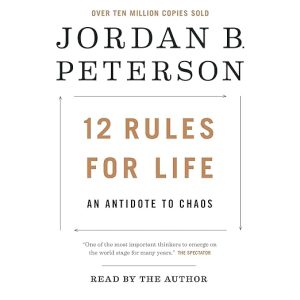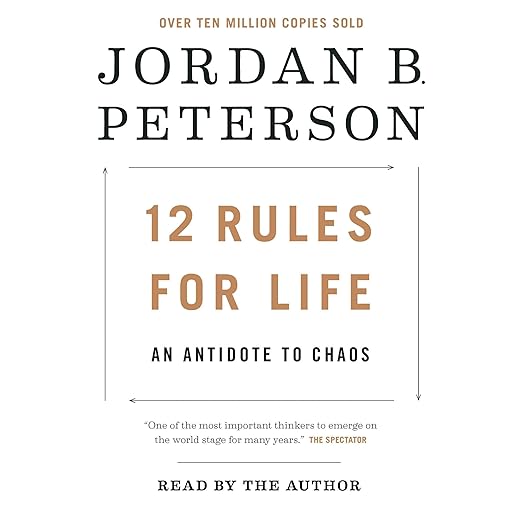
At a Glance
- Voice: Jordan B. Peterson narrates his own work with the full range of his public intellectual voice, intense, rhetorically precise, occasionally thunderous. The self-narration is both the book's greatest asset and a test of how much of Peterson's delivery style you can sustain across fifteen hours.
- Big ideas: Individual responsibility, the relationship between order and chaos, meaning as a defense against suffering
- Atmosphere: Dense and morally urgent, with passages of genuine lyrical power and stretches of lecture-hall intensity
- Worth it?: One of the most commercially consequential self-help books of the past decade, and a genuinely substantive work of applied psychology and mythology that rewards serious engagement regardless of your position on Peterson as a public figure.
I have now listened to 12 Rules for Life twice, at very different points in my life and with very different results. The first time, several years ago, I found it urgent and occasionally overwhelming, the kind of book that makes you sit with a feeling of having been confronted rather than simply informed. The second time, earlier this year, I found it more measured and more historically grounded than I remembered, and more flawed in specific ways I had not noticed before. Both responses, I think, are appropriate to a book that is genuinely ambitious and genuinely uneven in roughly equal measure.
Over ten million copies sold is the number the publisher leads with, and it is a real number representing a real phenomenon. Whatever you think of Jordan Peterson, the fact that this book found that many readers suggests it was addressing something that a significant number of people felt was not being addressed elsewhere. The core message, as Peterson himself summarizes it through the structure of his twelve rules, is that life involves suffering, that meaning is the appropriate response to suffering, and that taking individual responsibility for your own situation is both a moral and a practical necessity. These are not original ideas. Peterson's contribution is the frame he constructs for them, drawing on clinical psychology, Jungian archetypes, evolutionary biology, and the comparative mythology of the world's oldest stories.
The best chapters in this book are genuinely excellent. Rule 4, which instructs you to compare yourself to who you were yesterday, not to someone else today, is a twenty-page argument about the relationship between self-development and external comparison that stands up to scrutiny and is better argued than most academic treatments of the same territory. Rule 6, set your house in perfect order before you criticize the world, is short by the book's standards and lands with the force of a proverb precisely because Peterson earns it through everything he has established before it. Rule 11, on the relationship between children and truth, is where Peterson's clinical experience is most directly useful, and it is where the prose is at its most controlled.
The weaker chapters tend to be the ones where Peterson's mythology-via-psychology framework strains against the complexity of what he is describing. The long excursions into biblical narrative, while intellectually interesting, occasionally substitute mythological interpretation for the kind of empirical argumentation that would anchor the claims more securely. One reviewer described the book as self-help with a hammer, which is accurate. The same force that makes it clarifying can make it blunt where nuance would serve better.
Peterson's Lecture-Room Intensity Fills Fifteen Hours
Peterson's self-narration is an experience that cannot really be separated from the book's content. He reads with the full intensity of his lecture-room delivery, which means the passages that are meant to feel weighty do feel weighty, and the passages that are meant to be lyrical occasionally sound like a man reading poetry he finds very beautiful. That degree of investment from an author-narrator is unusual. Whether it is an asset or a challenge will depend on your relationship to Peterson's public voice.
At fifteen hours and forty minutes, this is a long listen, and the book was clearly not written with audio consumption as the primary format. The density of the prose, which rewards re-reading in the text version, requires more active engagement in audio form. The self-narration compensates partially: Peterson's emphasis and pacing signal which passages he considers central, which functions as informal annotation. But this is not a commute listen. It rewards extended, attentive sessions where you can absorb the arguments as they accumulate.
Kryptonite to Some, Kierkegaard to Others
Peterson is a polarizing figure, and the book was written before much of the public controversy that has defined his profile since 2018. Reading it now, it is worth distinguishing between the arguments in the text and the interpretations those arguments have attracted. The book itself is not primarily a political document, though it has been claimed as one by readers across the spectrum. Its core project is psychological and mythological, and judging it as either a conservative manifesto or a progressive enemy text misses what it is actually doing.
The book's treatment of gender and hierarchies has attracted significant critical attention, and some of the evolutionary psychology Peterson draws on has been contested within the field. These are legitimate intellectual disagreements worth holding. The book is best approached as a serious but not infallible argument that deserves engagement rather than either dismissal or uncritical acceptance. One reviewer who describes it as kryptonite to shoddy social justice warrior thinking is reading it as a culture war text. Another who describes it as life-changing in the context of existentialism and Kierkegaard is reading the same book for different purposes. Both readings are real. The book contains material for both.
Attentive Listeners Rewarded, Passive Ones Exhausted
This is worth your time if you are interested in applied mythology and depth psychology as lenses for self-examination, if you want a self-help framework that takes suffering seriously rather than offering easy resolution, or if you are curious about why this book has been as consequential as it has. Whether or not you agree with Peterson on any given point, engaging seriously with his arguments is intellectually productive in a way that reading about them secondhand is not.
Approach with critical engagement rather than passive consumption. The self-narration rewards attentive listeners and may exhaust passive ones. Fifteen hours is a serious commitment to a book that makes significant intellectual demands. If you are looking for a lighter introduction to Peterson's ideas, his lecture clips online offer a lower-commitment entry point. But for the full argument, the audiobook delivered in his own voice is the most complete version of the experience.
Common Questions
Does Jordan Peterson's self-narration make this a better or worse audiobook experience?
It depends almost entirely on your existing relationship to Peterson's delivery style. He reads with the full intensity of his public lectures, which means genuine rhetorical power in the stronger passages and a certain breathlessness in the denser ones. Listeners who find his speaking style compelling will consider this the definitive version of the book. Those who find it wearying after extended exposure will want to budget the fifteen hours carefully across multiple shorter sessions.
Is 12 Rules for Life primarily a conservative political book, or is that framing reductive?
The framing is reductive. The book's core project is drawn from Jungian psychology, clinical psychotherapy, comparative mythology, and evolutionary biology. Its political implications have been contested and claimed by readers across the spectrum, but the text itself is more interested in the relationship between order and chaos, meaning and suffering, and individual responsibility than in partisan politics. It has been used as a culture war text by some readers, but that use does not define what the book actually argues.
The book draws heavily on biblical narratives and Jungian archetypes. Is it accessible to secular readers?
Peterson approaches the Bible primarily as a repository of accumulated psychological and cultural wisdom rather than as religious doctrine, and his Jungian framework is secular in origin. Secular readers who are willing to engage with mythology as a lens rather than a truth claim have found the book substantive. Readers who find extended biblical exegesis alienating regardless of framing will find some chapters more difficult than others. The clinical psychology sections tend to be the most universally accessible.