The Short Version
- Performance: John Chancer brings academic authority to Cline's dense Bronze Age material without losing narrative propulsion, a skilled performance for technically demanding content.
- What it covers: Societal resilience after collapse, transformation and adaptation, the origins of the Iron Age world
- Feel: Intellectually demanding and rewarding, the best kind of serious popular history
- Our call: A compelling follow-up to the original 1177 B.C. that reframes the Bronze Age collapse as a beginning rather than an ending, richer for listeners who bring the first book's context.
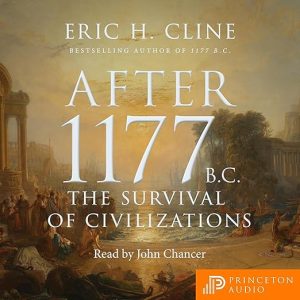
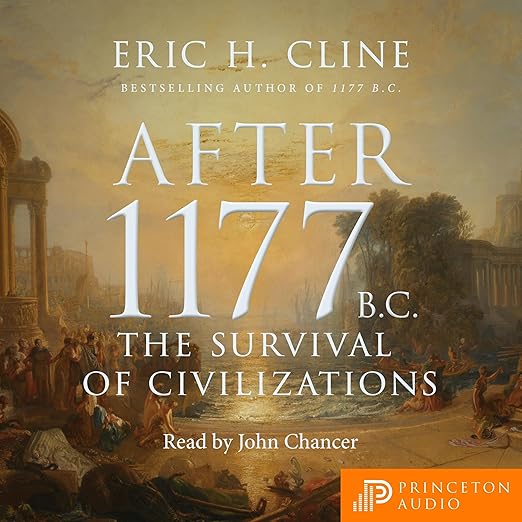
I should note upfront that the audiobook listed here under the 1177 B.C. slug is actually the sequel, After 1177 B.C., and the synopsis confirms this. Eric Cline's original bestseller ended with the Late Bronze Age civilizations in ruins. This follow-up, covering four centuries of what happened next, across the Aegean and Eastern Mediterranean world, up to the first Olympic Games in 776 B.C., is a different kind of argument, and in some ways a more intellectually interesting one.
I came to this material having read the original 1177 B.C. in print some years back. The sequel surprised me. Where the original was organized around a dramatic convergence of catastrophes, invasion, drought, famine, the demise of international trade networks, After 1177 B.C. is structured around diversity of outcome. Some societies collapsed completely. Others transformed. Others that we consider wholly new civilizations turn out to be continuous with what came before. The argument against the simple Dark Age narrative is more complex than it first appears, and considerably more interesting.
The bonus content included in this audiobook edition, Eric Cline's FAQs, is worth noting immediately because it represents an unusual editorial choice that adds substantial value. These are questions that arose frequently after the original 1177 B.C.'s publication, including skeptical questions from academic historians about the collapse thesis, and Cline engages with them directly. This kind of dialogue, built into the audiobook edition, is a model that more popular history books should consider.
Cline's central reframing is that the so-called First Dark Age was not a dark age, it was a reconfiguration. The Phoenicians emerge in this telling as surviving Canaanites who adapted successfully to post-collapse conditions rather than as a wholly new civilization that filled a vacuum. The Philistines were more culturally complex than their Biblical reputation suggests, archaeological evidence points to a sophisticated society rather than the caricature of barbaric invaders. The Neo-Hittites, Neo-Assyrians, and Neo-Babylonians represent continuity as well as change. Reviewer John F., who was fascinated by the Phoenicians-as-surviving-Canaanites argument specifically, captures what is most startling about Cline's perspective on the period: the civilizations we think of as new are often transformations of what already existed rather than replacements for it.
Reviewer Rico noted that Cline does a good job of discussing this story by region to keep it understandable, which is accurate. The organizational strategy is geographic, the book moves across the Aegean, the Eastern Mediterranean, the Levant, and Egypt in successive chapters, tracking different patterns of response to the collapse conditions. This prevents the enormous cast of civilizations, cultures, and archaeological sites from collapsing into each other, but it does mean that the book requires sustained attention to track where you are at any given moment. Passive listening will not serve it well.
Supply Chains Broke, so Iron Became Practical
The sections on the emergence of iron technology and alphabetic writing as consequences of the Bronze Age collapse are among the most illuminating in the book. Cline's argument is that these world-changing innovations emerged from necessity in a period of disruption, the disruption itself created the conditions for their adoption and spread. Iron was not simply superior to bronze and therefore replaced it; the supply chains for tin, essential to bronze production, were disrupted by the collapse, making iron a practical alternative rather than a luxury upgrade. The alphabet was disseminated by Phoenician merchants whose trading networks were filling the commercial vacuum left by the collapsed Late Bronze Age empires.
This is not a new argument in the history of technology, necessity driving adoption during crisis is a familiar framework, but Cline's grounding of it in specific archaeological evidence from specific sites across multiple cultures gives it weight that more theoretical tellings lack. The citations run into the hundreds, and reviewer Rico noted that the book reads as almost scholarly in its documentation. Listener mmm, who described finding history more interesting than expected, found the references useful for expanding their own research interests, which is the mark of popular history operating at its best, it opens doors rather than presenting itself as a final destination.
Chancer's Steady Names Anchor a Reversed Argument
John Chancer has the task of navigating a text dense with place names, personal names, and civilization names across multiple ancient languages and transliteration conventions. He handles this with the steady authority of someone who has spent time with the material rather than sight-reading. The pronunciation of terms like Ugarit, Qadesh, and the various Neo-empires remains consistent throughout the nine-plus hour runtime, which matters more than it might seem, inconsistency in proper noun pronunciation breaks listener trust in the narrator's command of the subject and forces the listener to track two versions of each term simultaneously.
Reviewer Best Reviewer offered the most substantive critique of the book's argument, noting that Cline somewhat reverses course from the original 1177 B.C.'s emphasis on collapse, and that the revised position would benefit from stronger quantitative support. This is a fair academic critique that applies to the scholarly reception of the argument rather than to the audiobook listening experience. For general history listeners, the revision is illuminating rather than confusing, it demonstrates that the original collapse narrative was itself a simplification, and that the archaeological record is richer and messier than the dramatic story of civilizational collapse suggested.
Best with the Original Already Under Your Belt
Listeners who have read or listened to the original 1177 B.C. will get the most from this sequel, the reframing is most meaningful when you know what is being reframed. Those new to Cline's work can still follow After 1177 B.C. independently, but should be prepared for immediate immersion in Bronze Age geography and civilization names without the primer the first book provides. Serious history readers who want academic rigor alongside narrative will find Cline's citation density appropriately substantiating. Those who prefer popular history that skips the scholarly apparatus will occasionally find the documentation slowing the momentum. The 4.4 rating across 464 reviews reflects a broad audience that includes both dedicated ancient history readers and newcomers, and the spread of praise suggests it works across that range.