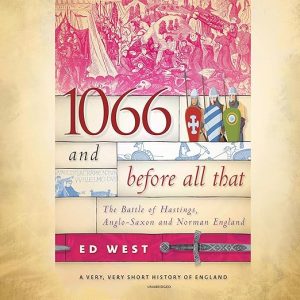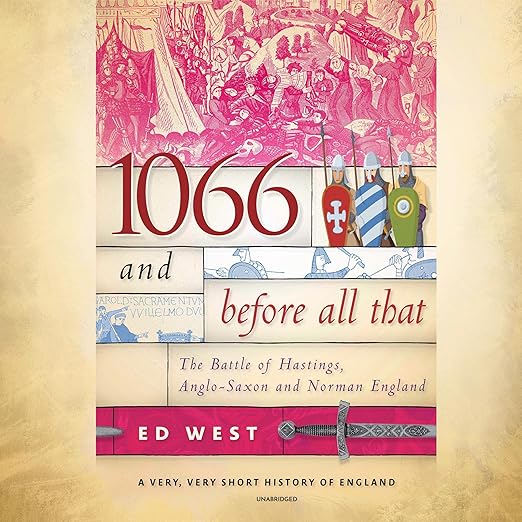
Ed West opens his short history series with the most famous date in English history, and the audiobook of 1066 and Before All That, narrated by Steven Crossley, wastes no time on throat-clearing. West's premise is almost provocative in its simplicity: that the Battle of Hastings was so catastrophic for its losers that it reshaped not just politics but language, architecture, social hierarchy, and cultural identity in ways that ripple into the present. If you've spent time with overstuffed medieval histories, this five-and-a-half-hour listen feels like a corrective, disciplined, funny, and purposefully accessible.
William, Harold, and a Body Count Like Westeros
West has a gift for compressing complexity without flattening it. He introduces William the Bastard, the Norman duke who believed his half-cousin Edward the Confessor had promised him the English throne, not as a cardboard villain but as a product of his society: a world built around military caste and the absolute primacy of dynastic honor. When Harold Godwinson, the richest earl in England and, as West drily notes, the son of what amounted to a pirate, seized the throne upon Edward's January 1066 death, he set in motion a chain of events that would produce one of medieval history's highest body counts. West's comparison to George R. R. Martin is not just a marketing flourish, the political volatility and casualty rate genuinely do recall Westeros, and it works as a genuine hook for readers who came to medieval history through fiction.
But West's real skill is showing why this matters beyond the carnage: what the Norman Conquest did to the English language, to land ownership, to the class system, to the very idea of what it meant to be English. The French-speaking Normans were, as West explains, the preeminent warriors of the 11th century, a society that had built its entire identity around conflict. When that identity collided with Anglo-Saxon England, the result was not simply a change of king but an epochal transformation of culture. West traces that transformation with economy and clarity that academic histories rarely achieve.
Crossley Underplays the Humor, Skips the Drama
Crossley's narration is measured and clear. He doesn't over-perform the humor, West's jokes land better when delivered conversationally, and Crossley understands that. Listeners who flagged the lack of dramatic range for battle sequences have a point, but for a book pitched at newcomers rather than specialists, the even tone works in its favor. It keeps the history central rather than turning it into theater.
Humor as Mnemonic for Hardrada to Hastings
The audiobook format suits this material particularly well. West writes with the rhythms of someone who is genuinely enjoying telling you things you didn't know, and Crossley transmits that pleasure without embellishment. Reviewer Lorraine noted that she laughed so much at West's earlier volume in the series, 1215 and All That, that she had to come back for 1066, the humor is real, not cosmetic. It functions as a kind of mnemonic, making the sequence of events, Harald Hardrada's Norwegian invasion, the Battle of Stamford Bridge, Harold's forced march south, the fatal arrow at Hastings, easier to retain because they're embedded in wit rather than just recitation.
Reviewer Rick Conboy, who had studied post-14th-century British history, found the book genuinely useful for contextualizing what came later, which points to another strength: this isn't written for children, even though it's built for newcomers. The bibliography is included, which matters. West is clearly working from solid sources, and the playful surface doesn't obscure the scholarship underneath. At five and a half hours, it's the kind of listen you can finish in a couple of sessions without losing the thread. For commuters or listeners who struggle to sustain attention across longer histories, the compressed format is not a concession but an asset.
Gateway to the Danish Kings, Nothing More
The book's declared scope, a very, very short history, is also its constraint. West is deliberately not lingering. If you want extended treatment of the feudal system's emergence post-conquest, or a thorough account of how Norman French bled into Old English to produce the hybrid language we now speak, you'll need to supplement elsewhere. What West offers is a confident, well-selected overview that identifies the key turning points and explains why they turned. The chapter on William's character is particularly sharp: the portrait of a man who operated in a world where legitimacy and violence were inseparable gives the conquest a logic that pure bad-guy framing would obscure.
There's also a light treatment of the deeper pre-Norman history, the Danish kings, the Viking presence, the fractured nature of English political unity before Hastings. West covers it, but briskly. The Harald Hardrada thread, the Norwegian claim to the throne that forced Harold to fight a major battle in the north before immediately marching south to meet William, is handled with enough clarity that readers understand why Hastings was a battle Harold fought exhausted, but not with enough depth to satisfy listeners who want the full Scandinavian dimension of the story. For those listeners, the book functions as a gateway, not a destination, which appears to be exactly what it's designed to be.
Podcast Fans of Duncan and Carlin Will Fit
This audiobook is well-suited to listeners approaching English medieval history for the first time, anyone who found traditional histories too slow or too dense, and fans of West's 1215 and All That or his broader catalog who want the complete series. History podcast listeners in the vein of Mike Duncan or Dan Carlin fans who want a shorter format will feel at home here. Skip it if you're already deep in the scholarship, West is explicitly writing for the general reader, and specialists will find the compression frustrating rather than refreshing. But for everyone else, this is a confident, entertaining, and genuinely informative listen that earns its place in any medieval history shelf.
At a Glance
- Performance: Steven Crossley delivers Ed West's dry humor with clean, unhurried clarity, the pacing suits the book's conversational register, though some listeners may want more dramatic range for battle sequences.
- What it covers: medieval power and succession, the cost of conquest, humor as historical pedagogy
- Feel: Brisk and wry, like a very good pub lecture
- Our call: Ed West's compressed, witty retelling of 1066 is the ideal gateway for newcomers to English medieval history who want substance without slog.
Before You Listen
Does the audiobook of 1066 and Before All That work as a standalone, or do I need to read the rest of the series first?
It works completely as a standalone. This is the first volume in the A Very, Very Short History of England series, so no prior reading is required. Each volume covers a distinct period of English history.
Is the humor in this audiobook broad enough to undermine the historical accuracy?
No. Ed West's jokes are embedded in real historical context, the comparisons are pointed, not random. Multiple reviewers with existing history knowledge confirmed they came away with genuine new understanding alongside the laughs.
At just over five hours, is this audiobook substantial enough to feel worthwhile?
For a deliberately compressed history, yes. West covers the political lead-up, the battle itself, the aftermath, and the long-term cultural consequences of the conquest within the runtime. The brevity is the point, not a shortcut.