One hundred skills divided across four hours and forty-six minutes gives each of them under three minutes, and that ratio is the most useful verdict on this audiobook before anything else gets said about it. Under three minutes is enough to explain what a thing is, why it matters and roughly how it goes. It is not enough to teach it. Understanding that going in changes the purchase from a training course into an index of things you did not know existed, which is a perfectly good thing to buy.
One response opens by correcting the title, and the correction is worth having: regardless of what the cover says, this is not a book about a hundred ways to kill but about a hundred ways to survive. The same entry notes that the sections are short and to the point, which makes it usable in five or ten minute gaps. Both observations describe the actual product better than the packaging does. The shelving is a separate slip: a manual covering bear attacks and suicide bombers is filed under health and wellness, a category built for mindfulness and practical wellbeing. The Safety and Emergency Preparedness tag underneath it is accurate. The genre above it is not, and it will keep this away from the people most likely to want it.
The scope on offer is genuinely broad. Securing shelter, building fire, finding food, navigating back toward civilization. Then, in the same volume, thinking through a hostage situation, an active shooter, a suicide bomber, a threat on public transport, and applying trauma medicine as the first person on the scene. Wilderness and city sit side by side, and the copy makes no apology for the jump, on the grounds that preparedness is a single habit applied to different rooms.
What that breadth costs is depth, unavoidably. A hundred entries at this length produce recognition rather than competence, and the honest way to use the book is as a survey that tells you which three or four things are worth learning properly somewhere else. Anyone expecting to finish this file able to do the things in it has misread the format, and the format is doing exactly what a hundred-item reference is supposed to do.
Simonelli Keeps the Hundredth Skill Distinct From the First
Just one four-star sits in this column, and it is the most practically minded entry here, making a comparative case worth relaying. That reader found this volume more useful than the original, praised how it is organized, and described using it alongside bush-craft rather than instead of it, naming Bush-Craft 101 by Dave Canterbury and the Complete Wilderness Training Manual by Hugh McManners as the books it complements. A survival title recommended as a companion to two others is being described accurately.
Framing is the strongest part of the book, and it transfers to audio better than any technique does. The copy asks you to think like a special forces soldier, and the adaptation it describes is a mindset lifted from field operations and scaled down for people with a kitchen drawer instead of a kit. Mindset is exactly what a voice can deliver. Assessing exits, deciding early, knowing that the choice between running and hiding is the whole game, all of that survives the loss of a diagram.
Pete Simonelli is the sole name in the narrator field, and the assignment is a specific kind of difficult. This is procedural prose, a hundred separate items in sequence, with no narrative momentum to borrow and no characters to distinguish. What holds a listener across nearly five hours of that is pacing between entries and enough variation to keep the hundredth from sounding like the first. The publisher is a house with plenty of reference-book experience, which is the only reassurance the page offers on that front.
Unconfirmed Whether the Illustrations Made the File
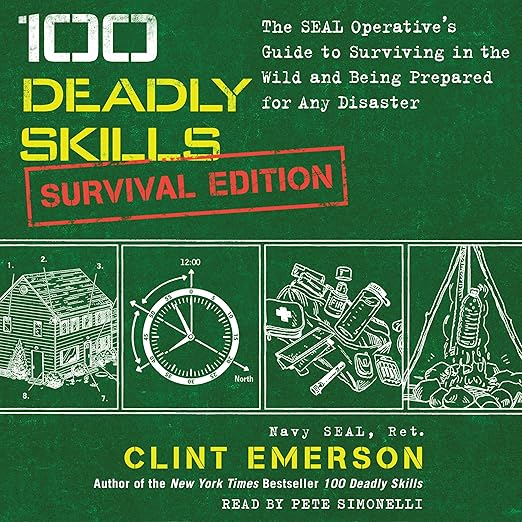
Illustrations are promised outright, easy-to-grasp detailed drawings next to each skill, on the copy's own reasoning that surviving an apocalypse leaves no time for complicated instructions. A written response confirms the layout from the other side, describing pictures and, in that reader's word, funny little blufs printed at the bottom of the page, and quoting one about outswimming your companion rather than the shark. That is a book designed around its own page furniture.
None of which is on this record. Nothing is listed as travelling with the file, in either direction, so a buyer cannot tell whether the drawings travel with the file or were simply left behind. For a reference work whose own copy makes the illustrations the reason it works under pressure, that is the single most consequential gap on the page. The listener it strands is precisely the one the book was written for: somebody who wants the thing in front of them at the moment it is needed, not a memory of hearing it described.
Currency is the third problem, and the copy raises it first. Yesterday's survival guide is no longer relevant, this listing declares, and positions itself as what you need for today's world. This recording was released in October 2016. A book whose main selling point is being up to date is now old enough that the claim needs checking rather than believing, particularly on the urban-threat material, which is the part most tied to a moment.
Treat This Recording as the Trailer Only
One buyer describes exactly the use case that works, having bought it mainly for two tween grandsons and studying it together with them so they would pick up some good survival skills. Shared listening is the right frame: short self-contained entries, a natural stopping point every few minutes, and enough spectacle in the scenarios to hold a young listener while an adult supplies the context. Preparedness-minded households and anybody assembling a first mental kit are the wider audience.
Buyers who want instruction they can act on should look elsewhere, because a hundred entries at this pace deliver awareness and not skill, and a book that has already told you its diagrams matter cannot deliver them here at all. Pass on it too if the urban-threat scenarios would sit badly with you, since the copy names them plainly and the material is not softened. Anybody who wants the reference to be usable in an emergency should be buying the printed edition and treating this file as the trailer.
Common Questions
Does the 100 Deadly Skills audiobook cover wilderness or urban situations?
Both, and the copy alternates between them. Shelter, fire, food and navigating back to civilization sit on the wilderness side. A hostage situation, an active shooter, a suicide bomber, a threat on the subway and applying trauma medicine as a first responder sit on the other. The range is wide, which is part of why each entry is short.
How realistic are the scenarios in this audiobook?
The copy pitches them as deliberately specific, listing being lost at sea, being forced to land a plane, fighting off a bear, and deciding whether to run, hide or fight. That last one is the only decision most listeners will ever actually face, and it is filed alongside three that almost nobody will. Treat the extremes as framing.
What is the author's background?
The copy identifies Clint Emerson as a retired Navy SEAL and a national bestselling author, and states that the hundred skills were adapted for civilians from real field experience of special forces operations. That adaptation is the entire claim. The promise is not that you will train like an operator but that you will think like one.
Is this the first book in the series?
The record will not say. It names 100 Deadly Skills as the series and leaves the volume number blank, while the title itself, Survival Edition, implies a base volume that this one revises or extends. Anyone who wants to read them in order has to work the sequence out somewhere other than this page.