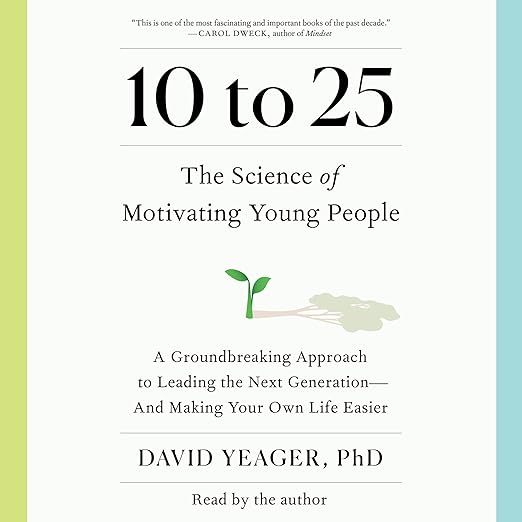
Yeager's central question in 10 to 25 surfaces in the opening minutes of this audiobook: why do adults with good intentions consistently produce the wrong outcomes when interacting with young people, and what does neuroscience actually tell us about why that happens? David Yeager narrates his own book, which is the right call for material this specific to his research program - he knows exactly which findings carry the most weight and which caveats matter, and his narration reflects that precision. At twelve hours and forty-four minutes, this is a substantive listen, but it earns its length.
Yeager is a developmental psychologist at the University of Texas whose work has been endorsed by Angela Duckworth, Carol Dweck, and Adam Grant - a cluster of researchers whose popular writing on growth mindset, grit, and organizational behavior has shaped how a generation of educators and managers think about motivation. His contribution here is more neurobiologically grounded than any of those authors: the claim that puberty triggers a specific brain-based hunger for status and respect, and that this hunger continues into the mid-twenties, is not a metaphor but a finding from neuroscience that has concrete implications for how adults communicate with young people.
The mentor mindset framework that Yeager builds around this neuroscience is both the book's commercial proposition and its genuine intellectual contribution. The distinction he draws between the enforcer mindset - authority through compliance - and the protector mindset - avoiding discomfort by removing challenge - and the mentor mindset, which holds high standards while being transparent about their purpose, is clean and useful. The reason the framework works beyond its label is that Yeager grounds each component in specific experimental findings, often from school districts or workplaces where he has run controlled studies.
The practices he identifies as expressions of the mentor mindset - validating young people's perspectives, asking questions rather than issuing directives, being transparent about your own beliefs and goals, holding to high standards without coddling - are not individually surprising. What Yeager adds to the conventional wisdom is the mechanism: each of these practices works because it addresses the status sensitivity that the brain is specifically calibrated to monitor during the ten-to-twenty-five window. Understanding why the practices work changes how reliably an adult can deploy them, because it makes the underlying logic visible rather than a set of memorized techniques.
One Listener Reports Purchasing Both Audio and Hardcover
Yeager's self-narration is an asset for this specific book in a way that isn't true of all author narrations. The research he presents is built around specific studies, specific school districts, specific conversations between adults and young people, and his narration of those passages carries the texture of a researcher who was present when the data came in. He doesn't perform warmth artificially; his voice has the quality of someone making an argument they believe is important and want you to understand rather than be impressed by.
The book's practical sections - which occupy a significant portion of the second half - are where Yeager's narration serves the material best. The back-and-forth conversation examples, which illustrate the difference between enforcer, protector, and mentor responses to the same situation, are rendered with enough clarity that listeners can pause and apply the framework immediately. One reviewer reported purchasing both the audio and the hardcover, specifically because there are passages they return to in their professional practice with K-12 school districts. That dual-format use is a reliable signal that the content density justifies the runtime and that the material has genuine working value rather than a single listen-and-move-on quality.
The Three-Part Framework Is Also a Marketing Decision
The book's scope is explicitly the ten-to-twenty-five age range, and Yeager's evidence base is strongest for the school and university contexts where he has done his primary research. Listeners who work primarily with young adults in workplace settings will find the framework applicable but will need to do some translation work, since the studies lean heavily on educational environments. Yeager acknowledges this and provides some corporate and nonprofit examples, but the balance is weighted toward schools and families.
The endorsements from Duckworth, Dweck, and Grant on the cover position this book within a specific genre of research-backed popular psychology, and listeners who have found that genre productive in the past will get more from this than those who are skeptical of it. Yeager's research is rigorous, but the mentor mindset label and its packaging as a three-part framework are marketing decisions, and some readers may find the conceptual neatness slightly artificial even as the underlying findings hold up.
The Neuroscience Chapters Stand on Their Own
This audiobook is genuinely useful for anyone who manages, teaches, coaches, or parents young people in the ten-to-twenty-five range. Educators in particular will find the school-based research directly applicable, and the framework is specific enough to be actionable rather than aspirational. The practical conversation examples in the second half are among the most immediately usable content in the popular psychology genre.
Listeners who work exclusively with adults, or who have no regular contact with people in this age range, will still find the neuroscience of adolescent status sensitivity interesting as a general framework. But the practical value of Yeager's framework is proportional to how much time you spend in the ten-to-twenty-five world, and listeners outside that sphere should adjust their expectations accordingly. The neuroscience chapters stand on their own as a clear account of adolescent brain development.
In Brief
- Narration: David Yeager narrates his own work with the practiced authority of a researcher who has given these arguments in lectures for years; his delivery is clear and measured, occasionally more professorial than conversational but never dry.
- Themes: The mentor mindset, adolescent neuroscience, the gap between authority and influence
- Mood: Substantive and practical, with genuine urgency behind the research
- Verdict: Yeager's audiobook lands its central argument cleanly and backs it with enough specific research that the mentor mindset framework feels earned rather than branded.