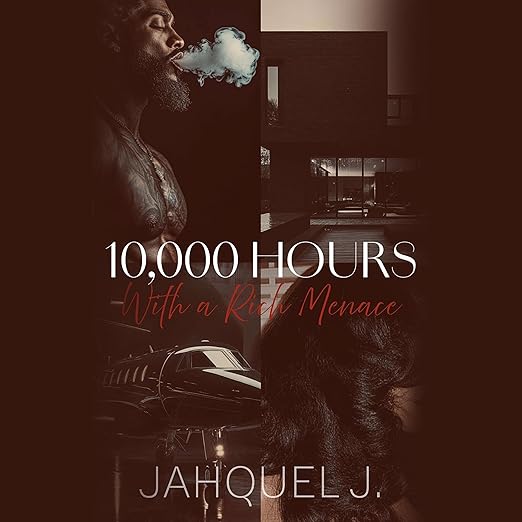
Menace Caselli is not the kind of character you expect to find yourself rooting for in the first chapter. Jahquel J.'s audiobook 10,000 Hours with a Rich Menace, narrated by Myles Washington and the opening volume of the Caselli Family series, establishes that immediately. You are not the protagonist here. You are the collateral damage. Your best friend has stolen from a very powerful man, and rather than face the consequences herself, she handed you over as payment. The setup is operatically extreme and yet, in J.'s hands, it lands with genuine emotional weight rather than pure spectacle.
The premise hinges on a specific kind of betrayal that cuts deeper than most romance setups allow. It is not a misunderstanding. It is not circumstance. Someone you trusted looked you in the eye and made a calculated decision to sacrifice you. That specific wound sits at the center of the story and gives it a moral seriousness that the kidnapping-to-romance structure might otherwise lack. Reviewers have noted the humor, the tears, and the pulse-keeping engagement, but what makes this audiobook work is that J. never lets the absurdity of the situation dissolve the sting of what actually happened.
Chemistry Earned Through Tension, Not Proximity
J. belongs to a tradition of urban fiction writers who understand that emotional authenticity and high-concept plotting are not mutually exclusive. The forced-proximity dynamic here is heightened to an almost theatrical degree, but what emerges in those hours with Menace is a study in how power and intimacy interact. Menace is not redeemed cheaply. He does not immediately become tender. He is what he is, a man from a dangerous family with tattooed evidence of every decision he has made, and the story takes its time letting you understand him without excusing him.
The chemistry that reviewers describe as undeniable is earned through tension rather than engineered through proximity alone. J. builds it through what Menace does not say as much as what he does. For debut readers in urban fiction, as one reviewer noted, this was their first novel in the genre, and the emotional truth and spot-on humor made the transition seamless. That crossover readability is a significant asset. The book does not demand you already love the subgenre's conventions; it constructs a case for them from first principles.
Washington Conveys Staten Island Without Caricature
Myles Washington is the right call for this material. His narration conveys Menace's physical presence without resorting to caricature, and the 11 hours and 51 minutes feel purposefully paced rather than padded. Washington handles the tonal range that J. demands with consistency, moving between scenes of real menace, dry comedy, and the kind of emotionally raw confrontations that this story generates. When the humor lands, it lands because Washington lets it breathe. He does not telegraph the jokes, which means they hit harder.
The structure of the book rewards the length. Each hour spent in Staten Island with Menace accumulates meaning. J. is building a series, and this first installment does the necessary work of establishing family dynamics, loyalty structures, and the specific rules of the world the Casellis occupy. Readers who come expecting a standalone romance may find the ending gestures toward the next volume more than they want, but that is the nature of series-building. What you get here is complete enough to satisfy: the question of the betrayal reaches resolution, and the emotional arc between the two leads closes with integrity.
The Caselli Family setting also does specific work that generic crime-romance backdrops do not. Staten Island has a particular cultural identity in American mythology, bound to organized crime through decades of media but lived from the inside as a working-class community with its own codes of loyalty and obligation. Jahquel J. uses those codes with precision rather than as set dressing. When Menace moves through his world, the social geography is specific enough to function as character development. The family dynamics that thread through this first volume, the tensions between Menace and his brothers, the gravitational weight of the Caselli name, are the infrastructure on which the series will build. Washington conveys all of this through the texture of his delivery, not just through the explicit content of scenes.
Ten Thousand Hours Becomes an Intimacy Metaphor
The mental health thread that one reviewer specifically highlighted is not decorative. J. integrates it into character development with more care than the premise might suggest. It complicates the central relationship in ways that feel true rather than manipulative, and it explains choices that would otherwise read as plot conveniences. Watch for how J. uses silence and restraint in the later chapters, particularly in scenes where emotional confrontation would be the obvious move. The restraint is doing work.
Also worth noting: the title is a promise the book keeps. The 10,000-hours framing gestures at Malcolm Gladwell's principle that mastery comes from sustained exposure, and J. uses it as a structural metaphor for how intimacy and understanding accumulate under duress. Whether you read that as commentary or simply as a clever title, the book earns it by the final act. Washington's delivery in those culminating scenes is the performance that justifies his casting.
Forced-Proximity Fans Get a Strong Series Opener
Listeners who enjoy forced-proximity romance with genuine emotional stakes and a crime-world backdrop will find this a strong series opener. Urban fiction fans who want humor and heartache in the same stretch of chapters will be satisfied. If you are new to the genre and curious whether it can deliver depth alongside entertainment, this is a reasonable starting point based on reviewer consensus.
Those who find crime-family romanticism fundamentally unconvincing regardless of craft, or who prefer romance that reaches a fully closed ending rather than a series launch, may want to wait until more Caselli Family volumes are available before committing to the first. The story is compelling on its own terms, but it is clearly building toward something larger.
Key Details
- Voice: Myles Washington brings an assured, street-level authenticity to Menace Caselli's world, capturing both menace and magnetic pull without overplaying either register.
- Big ideas: Forced proximity romance, loyalty and betrayal between women, crime-family power dynamics
- Atmosphere: Tense, funny, and emotionally surprising in equal measure
- Worth it?: Jahquel J.'s Caselli Family opener delivers on urban fiction's emotional promises and then some, with a narrator who earns every page.